





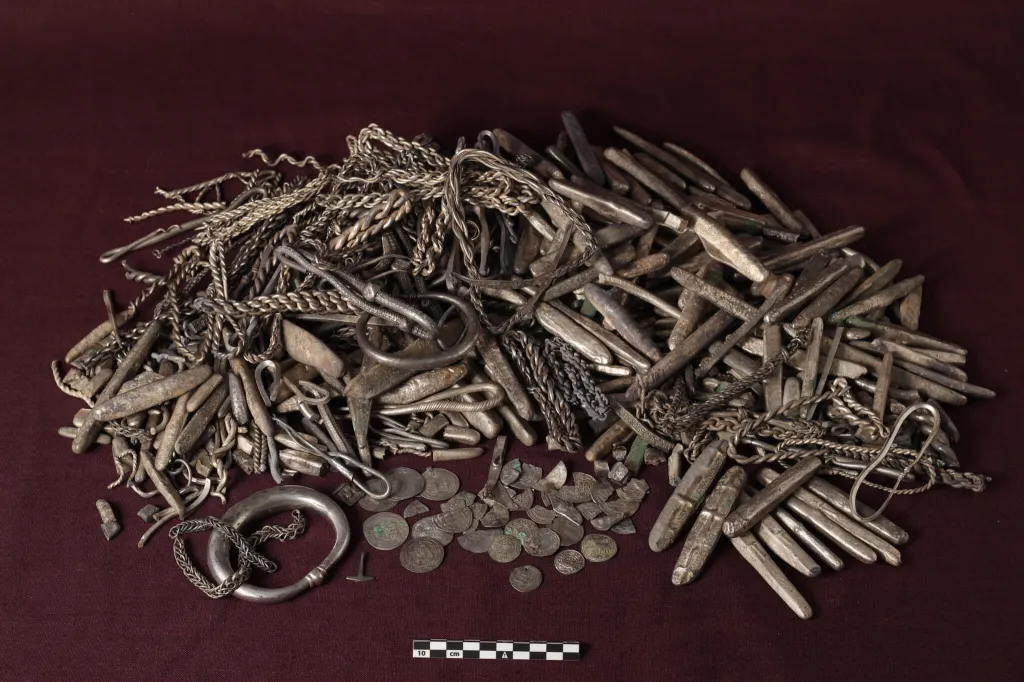
A trove of 700 Viking Age silver objects and fragments has been discovered in a man’s garden in Rebild, North Jutland Museums announced, marking the largest-ever find of its kind in Denmark.
The anonymous homeowner was planning to build a new terrace in his garden when he found the treasure. “It should have just been a few hours of hard gardening work removing stubborn grass, stones and gravel for a new tiled terrace, but it turned out to be the biggest surprise of my life,” he said.
“After half an hour of digging, my grip hit something that made a strange sound. At first I thought it was old iron or fence wire and some potsherds, but when I started digging with my hands, I was suddenly able to fish one metal object after another out of the ground. After a short period of careful work, I realized that it was jewelry, coins and silver bars,” he added.
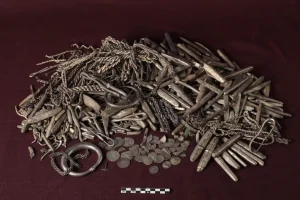
Some 320 objects weighing 14 pounds were found inside a clay vessel, while the rest was found in the surrounding soil. The hoard contains numerous silver bars, as well as bracelets, 47 whole coins and fragments, a small Thor’s hammer, and various cut silver objects. The total find weighs in just shy of 41 pounds, making it three times larger than the previous record holder, dubbed the Terslevskat.
Notably, one of the silver bars has runes engraved on it, which experts believe can be read as “hutu” and interpreted as a name, an ownership mark, or some kind of significant marking.
“This is a find of great importance for our understanding of the Viking Age in Denmark. Not just because of its size, but also because the treasure so clearly shows how silver functioned as wealth and a means of payment in the Viking Age. It’s like finding a safe from the Viking Age,” Torben Sarauw, cultural heritage manager and archaeologist at the Museums of North Jutland, explained.
“When we analyze the weight of the silver objects, the treasure reveals information about the economic practices of the Viking Age. The treasure does not only consist of beautiful objects. Most of them are part of a structured value system by weight,” he continued.
Each piece of the silver trove—the bars, jewelry, coins, and scrap metal—could have been used for payment in Viking society. Experts believe the silver was organized by weight, which directly correlated with the metal’s value. It also shows how Vikings stored wealth.
Additionally, the hoard contained both Arab and Anglo-Saxon coins, indicating the Vikings’ involvement in broader economic exchange between Europe and Southwest Asia during this period.
“The silver was hidden in Rebild, but it points to a much larger world. The coins reveal that there were connections to the Islamic world in the east and England to the west, as well as a Viking Age where people, goods and values moved over enormous distances,” he says.
Two Anglo-Saxon silver pennies minted under King Edward the Elder, who reigned from 899 to 924, provide crucial information for dating the hoard. The Arab silver coins, or dirhams, also contain inscriptions that can be linked to specific minting locations and years. In this find, the dirhams were cut into smaller pieces and used as a means of payment, with their value linked to the weight and fineness of the silver.
“We are faced with an area that time and again delivers spectacular finds from the Viking Age. The new silver treasure shows that the Rebild area was not a peripheral region, but part of the large economic and cultural connections that linked Scandinavia with the areas around the Baltic Sea and the Islamic world to the east, as well as with the North Sea area, England and western Europe to the west,” Sarauw added.
While it is not feasible to conduct an archaeological excavation at the new build site, the treasure is being evaluated by the Danish National Museum.
North Jutland Museums is planning to mount a permanent exhibition of the treasure, along with six gold bracelets from the recently discovered Rold Treasure, at the Fyrkat Viking Museum and UNESCO World Heritage ring fortress associated with 10th century King Harald “Bluetooth” Gormsson of Denmark and Norway, who united Scandinavian tribes and introduced Christianity to the region.


