


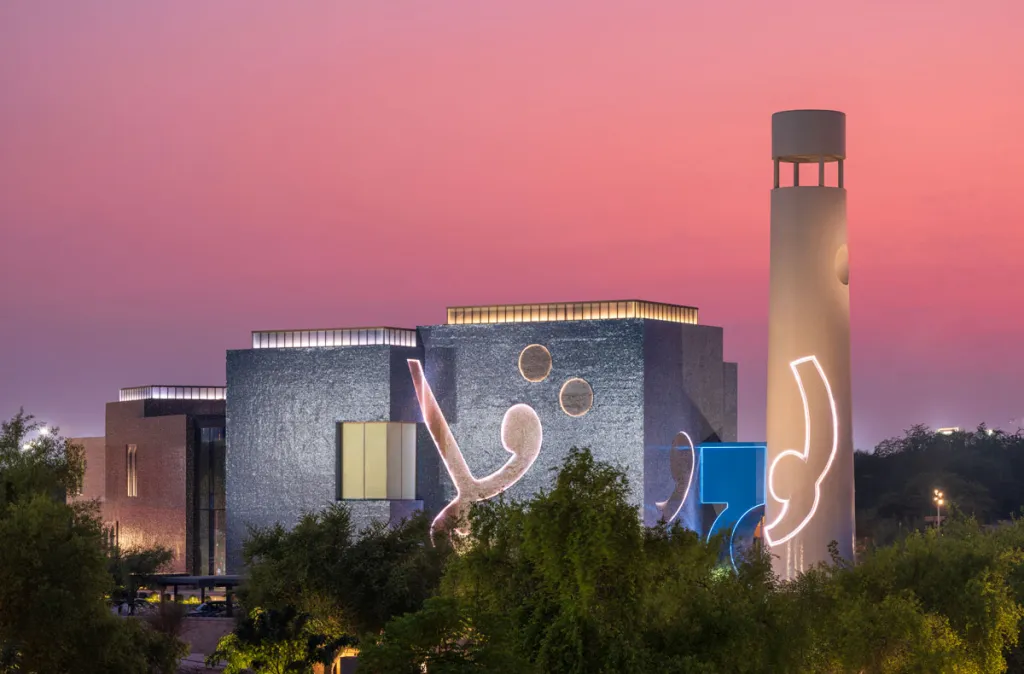
A restless experimenter, Maqbool Fida Husain, often shortened to M. F. Husain, worked through world wars, the independence and partition of the Indian Subcontinent, and the subsequent postcolonial transitions. During this time, depictions of the cultural horizons of rural life, the speed and exuberance of street culture, epic narratives of East and West Asia, and pluralities and convergences of religious thought all entered his work as he searched for ways to hold and bridge together these many facets of the human experience. Though it is difficult to contain the striking versatility and complexity of his career and its profound impact on global art narratives, a new museum in Qatar has set out to do just that.
Opened last November in the capital city of Doha, the Lawh Wa Qalam: M. F. Husain Museum attempts to paint a vivid picture of the polymath’s world and his transnational sensibilities under one roof. “It celebrates his restless imagination, his cross-disciplinary vision, and the profound cultural connections he forged between South Asia, the Arab world, and beyond,” said Noof Mohammed, the museum’s curator and project manager for the Qatar Foundation’s art portfolio.
Commissioned by his long-time supporter Sheikha Moza bint Nasser, under the aegis of the Qatar Foundation, the museum has on view 150 of the artist’s paintings, films, sculptures, and photographs, as well as archival materials that trace the influences, ideas, and memories that shaped Husain’s practice from the 1950s until his death in 2011. Across them, we see a practice that returned repeatedly to questions of faith, science, knowledge, fearless democratic expression, and creativity, all imbued with honest sincerity.
Installation view of the Lawh Wa Qalam: M. F. Husain Museum.
Photo Dany Eid/Courtesy Qatar Foundation
In the decade and a half since his death, Husain’s importance has only continued to be recognized. In 2024, Delhi’s Kiran Nadar Museum of Art organized a survey of the artist as a collateral event to the Venice Biennale, 70 years after he first showed at the international exhibition. Last March, his 14-foot-long 1954 painting Untitled (Gram Yatra) sold for $13.8 million, the highest sum ever achieved for an Indian modernist sum.
The siting in Doha of the first museum of this scale dedicated to Husain is closely tied to the final chapter of the artist’s life. He had a long personal and cultural relationship with Qatar, where he settled during the later years of his self-imposed exile from India, though he continues to be a national hero and a foundational figure to his home country’s art history. Husain made Qatar his home in 2009 at the invite of Sheikha Moza, whose patronage provided the institutional support for some of his most ambitious projects for the final years of his life.

A 2008 sketch by M.F. Husain for a museum in his honor. Lawh Wa Qalam is based on this drawing.
Courtesy Qatar Foundation
Lawh Wa Qalam, which translates to “the Canvas and the Pen,” is based on a 2008 drawing by the artist, now owned by the museum. Brought to life by architect Martand Khosla, the building’s deep-blue, geometric, mosaiced form, measuring nearly 32,300 square feet, merges Husain’s two homes: the incremental urbanism of India and the narrow souq lanes of Doha. Stepping through the gilded arched doors, references of these cityscapes are revealed through a series of shifting volumes and planes housing three core galleries and a periscopic tower, connected by open passageways.
One body of work that benefited from Sheikha Moza’s support is a series of paintings devoted to Arab civilizations, of which Husain completed around 35 before his death. (The artist planned to make 99 paintings, after the “99 Beautiful Names of Allah” in Islam.) On view in the museum’s third and final gallery, several of these works draw on specific historical and intellectual traditions of Islamic civilization, like The Battle of Badr (2008), referencing an early moment of victory for the prophet Muhammad in 624 or Arab Astronomy (2008),honoring scholars whose mappings of the heavens shaped centuries of scientific knowledge. Other works in the series merge Husain’s life with art history, like The Last Supper of the Desert, a playful reworking of Leonardo da Vinci’s Last Supper created in response to the protests against Husain’s work in India.
M.F. Husain, Battle of Badr, from his Arab civilization series, 2008.
Khalid Abdulraman
Preceding this final chapter, the first two galleries trace the social and political currents of 20th-century India as Husain would have experienced them. The first gallery looks at the period during which India was still under British colonial rule and moving toward independence. Among the works here are large-scale panels, rendered as protest posters, that respond to defining moments during this era, from the 1919 massacre in Jallianwala Bagh to Ghandi’s mass resistance in the 1940s with the Quit India Movement. Nearby is see a tribute to Allama Iqbal, a figure integral to the conception of Pakistan, as well as a touching homage to Husain’s mother, who passed during his infancy.
These early works precede Husain’s cofounding, in 1947, of the Bombay Progressive Artists’ Group, and help establish the emotional and ethical foundations of Husain’s practice, in which personal loss is intertwined with historical consciousness and political conviction.
M.F. Husain, Doll’s Wedding, 1950.
©Qatar Foundation
The second gallery, titled “A Curious Mind,” frames Husain as an artist for whom reading, questioning, and looking across artistic and faith traditions were integral to his practice and his devotion to the idea of a universal humanism. For instance, in works such as World Religions (2008) he considers the unity of Abrahamic faiths, and in the “Theorama” series, from the 1990s, he depicts sacred motifs from different belief systems, from the Buddhist lotus to the Vedic dance of creation in one composition. For all the distances Husain traveled, the concerns threading through his work, inspired by an ancient Indian philosophy that all spiritual paths share a single core truth, remained grounded in his cherished motherland, even when he felt that it did not love him back.
A performance in front of M.F. Husain’s Seeroo fi al ardh during the museum’s inauguration last November.
©Qatar Foundation
These two galleries set up the museum’s emotional center, Husain’s final major work, completed posthumously in 2019 by Qatar Foundation. Titled Seeroo fi al ardh, a Quranic phrase meaning “Travel through the earth,” the installation is a large-scale carousel of Murano glass horses and vintage automobiles, a merging of Husain’s “eternal muses” and the innovations that followed. “The work reflects Husain’s enduring fascination with the restless human drive for progress, self-improvement, and transformation, making it a deeply fitting final masterpiece,” Mohammed, Lawh Wa Qalam’s curator, said.
As a monument to Husain realized as a space drawn from his own hand, Lawh Wa Qalam poignantly recalls how his art sought inspiration from the streets, responded to the anxieties of an era of profound transformation, and spotlighted the humanity in intellectual pursuits of pluralities in faith and identities. Those concerns converge here, in a fitting tribute to an important artist whose legacy is being brought into the present, driven by a philosophy to foster cross-regional dialogues.
