


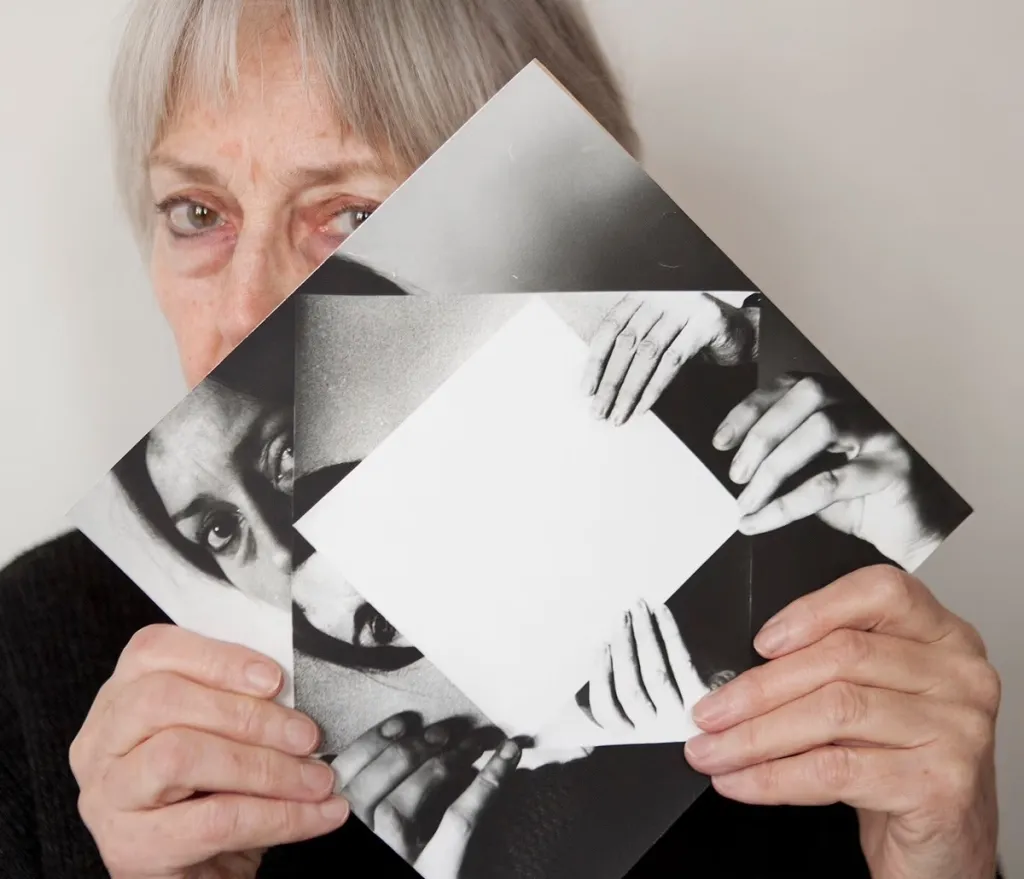
Dóra Maurer, a Hungarian conceptual artist whose output in multiple mediums explored how meaning shifts across time and space, has died at 88. The Art Newspaper reported that the Széchenyi Academy of Literature and Arts, where Maurer served as president, confirmed her passing.
Maurer was one of the most important contemporary artists in Hungary. She is today best known for her works produced in the country while it was still under Soviet rule. Many of those famous works were produced in the 1970s, during a period when Maurer was producing photography and films that primarily featured the artist and her collaborators performing banal acts.
One 1971 piece, titled Mit lehet egy utcakővel csinálni? (What Can One Do with a Paving Stone?), involved Maurer caressing, throwing, and toting around a paver. Given that the performance obliquely invoked the protests of May 1968 in Paris, during which students threw paving stones, the work has been read as a political gesture. But Maurer framed it in different terms, focusing on how one might create a narrative from seeing photographs of it.
“A paving stone is the material of fights—street fighting and so on—and what can you do with a paving stone? Here I made some examples of what I can do with the paving stone,” Maurer told ArtReview. “It is ambivalent. You can consider it is as political. Mostly it is shown in women’s exhibitions, with which, as you know, I do not identify myself.”
Another series, from 1972, was called “Reversible and Changeable Phases of Movement” and involved arrays of photographs showing Maurer performing other gestures—throwing a ball in the air, for example. Presented in a grid, that piece’s photographs variously suggest her tossing the ball or catching it, depending on the order in which the pictures are viewed.
“Since 1969-70, my work has been based on change, shifting, traces, temporality from various perspectives,” she told Studio International. “This means that the reversibility of changed meanings and the series of painted picture objects had the same root.”
Born in Budapest in 1937, Maurer was raised by her mother; her father died half a year before she was born. Living in a residential building with her aunt, Maurer was lured to ink sticks left behind by her father, a cartographer. She recalled “difficult” memories of the siege of Budapest in 1945 by Soviet and Romanian forces, and she said that she spent her childhood copying illustrations seen in books, instilling an interest in drawing that remained with her.
She studied the graphic arts at the Hungarian Academy of Fine Arts, graduating in 1961. She married her husband, the artist Tibor Gáyor, in 1967; because he had dual citizenship in Austria, she could travel to Vienna and take in its art scene. Traveling by minibus, they sometimes snuck others’ artworks out of Hungary with them.
Unlike many in the West, Maurer did not have access to galleries willing to show her work—there were few in Hungary at the time that were not directly sponsored by the state, which dictated what kind of art could and could not be shown, she said in interviews. Still, during the ’70s, she made experimental films and managed to organize exhibitions of her own. (She stopped making films in the ’90s, due in part to all the energy needed to teach students at the Hungarian University of Fine Arts.)
During the ’80s, Maurer produced suck works as the “Handmade Fractal Paintings,” a series she began in 1988 that involved 3mm-wide lines that were arrayed to form grid-like spaces pulsing with color. Similar bright hues showed up in her “Overlappings” paintings, begun in 1999, which feature large squares of color that appear to fall atop one another, creating new tones in their intersections.
Maurer remained relatively obscure on the international scene until 2019, the year she had a Tate Modern survey in London. After that show, blue-chip galleries like White Cube began to exhibit her art.
Yet Maurer often bristled against the notion that she might be famous, telling ArtReview in 2012, “I don’t want to be a star or suchlike. I’m not the type.”
