







A sense of ruin permeates this Venice Biennale, though we already knew that it would going in. And pointedly, several standout national pavilions in the show are steeped in decay—bodily, infrastructural, archaeological. They’re about the broken, bloody political machines pumping the present full of its own reek.
Rubble and stone line the Slovenian Pavilion, where the Nonument Group repurposes materials from previous Biennales into a ruin of a mosque built for Bosnian Muslim soldiers during World War I. Meanwhile, Sara Shamma, representing Syria in its first national pavilion since the Civil War, invokes Palmyra, the ancient site whose tower tombs were obliterated by ISIS during its campaign of cultural erasure.
Germany’s presentation, titled “Ruin,” treats the pavilion’s architecture as a lens through which to question the exhibition’s siloed structure. Is nationalist residue ever erased, or does it continue to metastasize? The work of its artists—Henrike Naumann, who died in February, and Sung Tieu ask that question. Their response would surely merit award consideration—if the Venice Biennale still had a jury. (Its five members resigned abruptly last week, having previously said they wouldn’t consider nations charged with crimes against humanity in the International Criminal Court. The awards will now be chosen by a public vote.)
“In Minor Keys,” Koyo Kouoh’s main exhibition, was also roiled, in that case by the death of its curator. How this Biennale will be remembered, following a succession of shocks that began with Kouoh’s passing, remains uncertain. Will it be recalled as a spectacle stoked by controversy or a much-needed breath of fresh air?
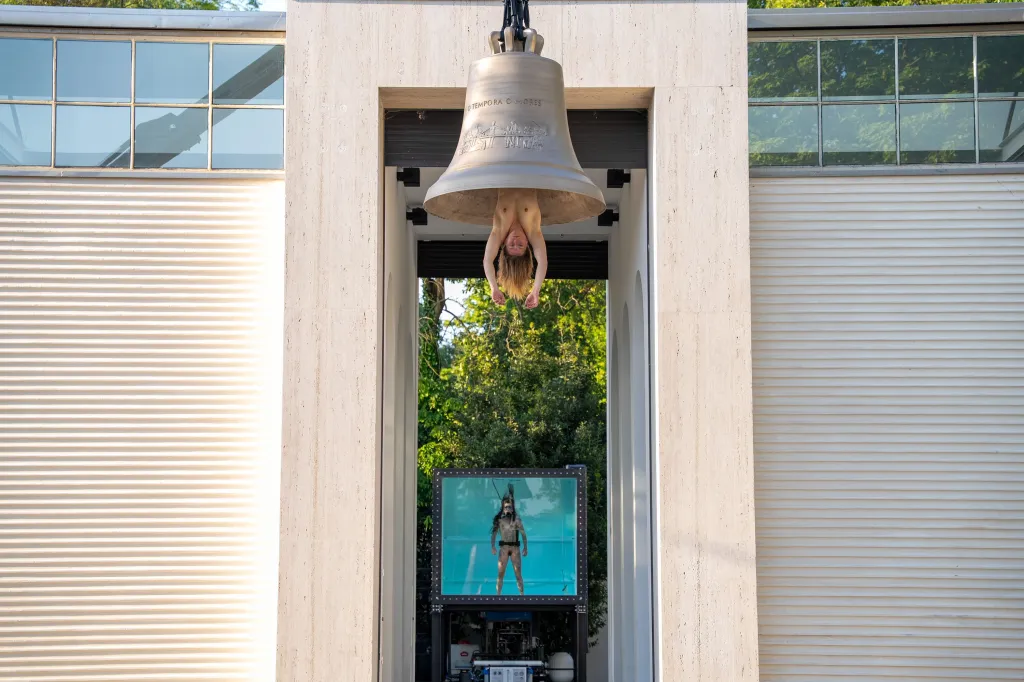
Artist Florentina Holzinger, who literally rang in the Austrian Pavilion, suggested these conditions as one in the same, saying in an opening speech: “What the fuck! There is no jury, there is no prize. We are seeing a system crumble. Let’s not despair. All we need is a shift of wind, a new direction, a reshaping of the symbols of the past.”
Below, more standout pavilions within a critical take on the past, and lesson for the present.


