


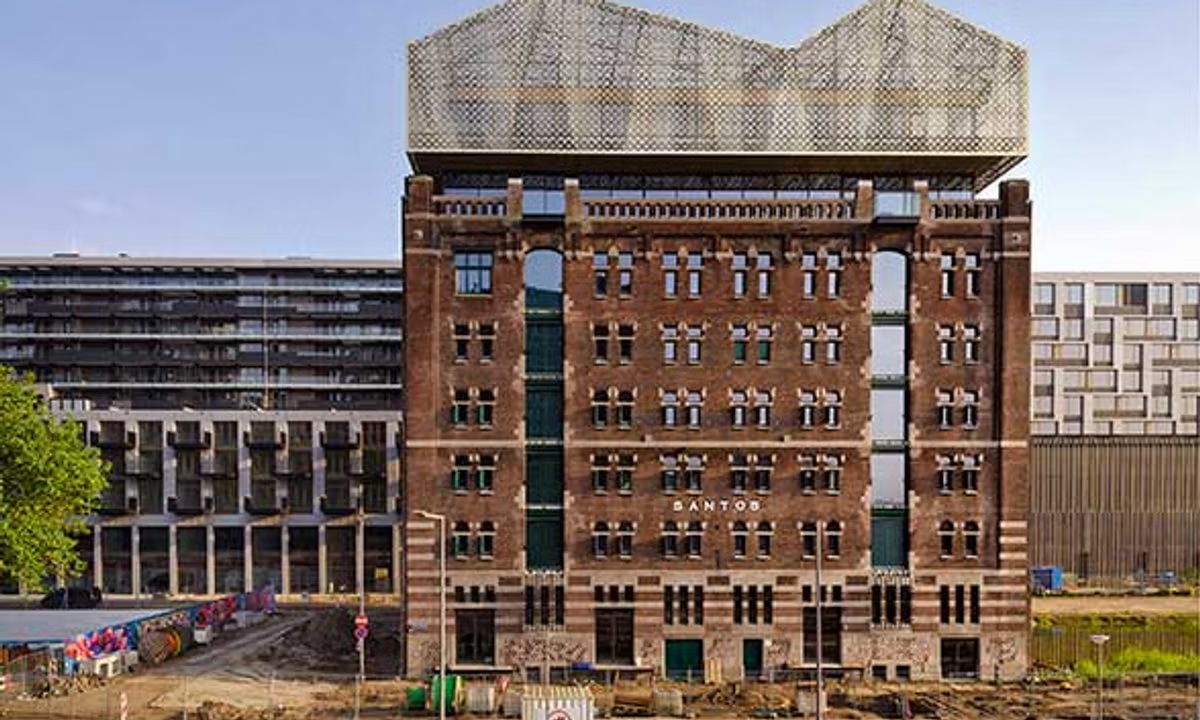
From world-famous snapshots of Anne Frank to fragile 19th-century colonial records, the Nederlands Fotomuseum will show gems of Dutch photographic history at its new site in Rotterdam from 7 February.
The museum will open, with a new director, in a former coffee warehouse converted and expanded by the German architecture studio Renner Hainke Wirth Zirn in collaboration with the Rotterdam firm WDJArchitecten. Over nine floors, it explores the history of photography with galleries of international images and interactive displays.
The national collection of more than 6.5 million images was founded two decades ago when a passionate amateur photographer left a bequest worth around £10m to start the museum. The museum had been based in Las Palmas, a mixed-use building, since 2007 and had long sought a larger, dedicated location.
As well as more than 175 complete archives from big Dutch names such as Ed van der Elsken, Cas Oorthuys and Esther Kroon, it has a large collection of 20th-century documentary photography, the earliest daguerreotype, dated 1842, and contemporary works like Jaya Pelupessy’s The Studio Sculptures.
While the ground floor, library and darkroom are open free of charge to the public, upstairs on the museum floors, the temperature varies, light is limited and certain images will be frequently rotated. “We have 30 works from the collection that are temporary because they’re fragile, and we’ll switch them every three months,” says Grace Wong-Si-Kwie, the head of public programming.
Glass walls in the museum’s new home give an extraordinary view into the temperature-controlled archives where a team of specialists conserves and researches the collection. “The depots at the old location were not visible at all to the public,” says Roderick van der Lee, the interim director. “Here, the design was intended to give a literal view into that part of the museum’s function.”
Alongside a long history in printing, the Dutch have a particular angle on photography due to the way 17th-century painters specialised in capturing the light of the Low Countries, according to Van der Lee. “Since the 17th-century master paintings, light has been an integral part of Dutch art,” he says. “And that’s why photography was quite a natural fit within the Dutch artistic palette.”
While the museum was in financial difficulties a decade ago, it hopes its new building—acquired with the help of the Droom en Daad Foundation—plus the current boom in AI, social media and smartphone cameras will spark more interest in photographic literacy. “If anything, the discussion about AI and the difference between photography and realism has reignited that discussion about photography and its relation to the truth,” Van der Lee says.
Behind the scenes, however, preparations for the opening have been complicated by an employment dispute with former director Birgit Donker, who was sacked last October on the grounds of “breach of trust” with the board. The opening was pushed back several months, according to a briefing from the Rotterdam mayor to the city council, and it is unclear whether there will be any further legal challenge or settlement.
Former director Donker, who did not respond to a request for comment, has fiercely protested her dismissal in the Dutch press.
Van der Lee says that the dismissal was bad timing but that he does not want to underplay its seriousness. “It’s an unfortunate dismissal at not the most opportune time—but not on [trivial] grounds,” he says. “We felt it was necessary to open with a new director.”
On Monday, the museum announced that it had appointed the art historian and curator Zippora Elders Tahalele as its new general and artistic director, to start work on 13 April. A separate business director, the museum said, “will be appointed at a later state”.
- The Nederlands Fotomuseum, Rotterdam, opens on 7 February
