


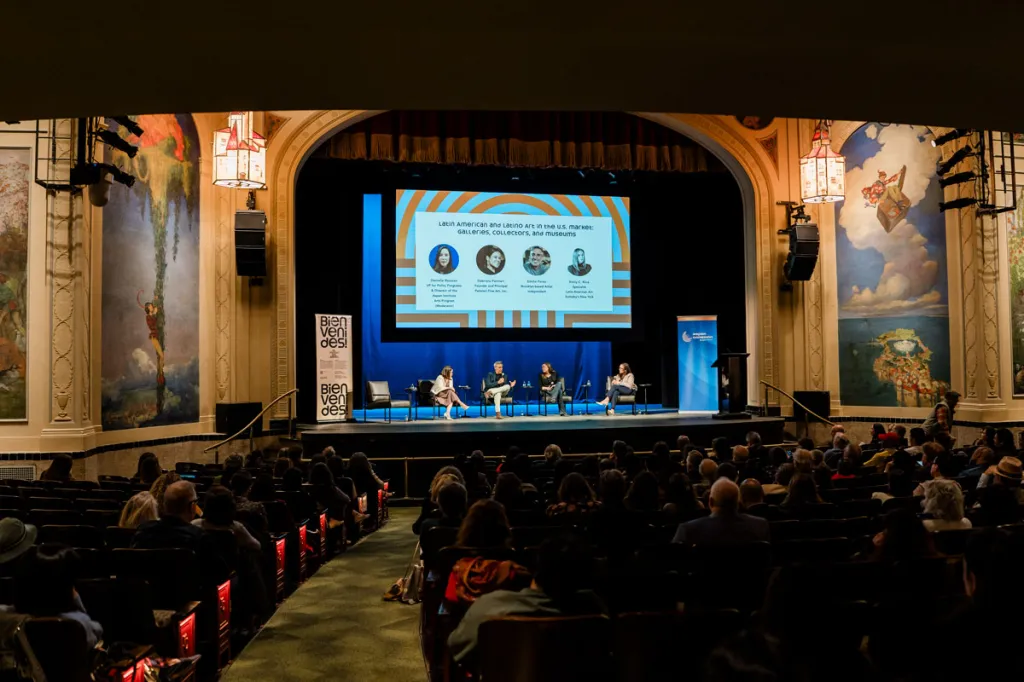
This spring, El Museo del Barrio and Aspen Conexión hosted “The Rise of the U.S. Latino Art Market: Lessons from Latin America,” a half-day symposium in El Museo’s iconic Teatro space.
The event brought together artists, curators, museum directors, market insiders, and more to discuss the most pressing issues facing Latinx art in the art world and how to continue to grow its infrastructure. (ARTnews served as the media sponsor.)
The idea for the event was dreamed up by Aspen Conexión, a division of the Aspen Institute focused on the Latinx community. Previously called Latinos in Society, it was founded, according to executive director Pilar Frank O’Leary, “around a simple but important idea that Latino impact in the United States is not only a domestic story but a hemispheric one across business, culture, finance, sports, and the arts. Latino communities are shaping markets, influencing global demand and redefine how we think about economic growth and cultural power across the Americas and beyond.”
In her introductory remarks, El Museo board chair Karla Harwich described the increased visibility that US Latinx artists are receiving as “a profound cultural shift” but “that there is still significant work to be done to ensure that this influence is matched by sustained institutional, equitable market investment, and long-term infrastructure.”
“The questions we are exploring feel both urgent and long overdue,” Harwich said. “This is precisely why today matters.”
“We are gathering at a moment when Latino culture is increasingly redefining the American and the global mainstream,” Frank O’Leary added, calling it “the Bad Bunny era.”
El Museo executive director Patrick Charpenel set the stage with one of the guiding questions for the day: “At El Museo del Barrio, we think deeply about how to translate cultural moments into structural change. What does it take to move from moments of visibility to lasting recognition?”
One of the key points of the afternoon focused on how we could learn from the success of Latin American art both on the market and institutionally over the past two decades. “The rise of Latin American art over the past two decades did not happen by accident. It was built intentionally, through institutions, collectors, galleries, fairs, and sustained investment over time,” Aspen Conexión managing director Diego Deleersnyder said. Latinx art, on the other hand, is “still in an earlier chapter of that story.”
A case study came in the form of a presentation titled “Building the Market: Latin American Art Fairs in Focus” by Diego Costa Peuser, the founder and global director of the Pinta Group, which stages numerous fairs and art weeks around Latin America and the US. Costa Peuser detailed the strategies that Pinta has taken, which includes a recent branch out to art weeks in different cities, like in Santo Domingo, Dominican Republic, and Panama City, to highlight the individual art scenes there. He concluded by saying, “In short, we understand that the growth of Latin American art does not occur spontaneously, but from sustained work.”
View of the 2026 convening “The Rise of the U.S. Latino Art Market: Lessons from Latin America,” at El Museo del Barrio.
Courtesy Aspen Conexión
The first panel, titled “Latin American and Latino Art in the U.S. Market: Galleries, Collectors, and Museums,” paired adviser Gabriela Palmieri, artist Emilio Perez, and Sotheby’s Latin American specialist Emily C. Nice, moderated by the Aspen Institute’s Danielle Baussan.
Palmieri began by noting that even in the secondary market, Latin American artists are still rising. For example, she pointed to Leonora Carrington’s auction record being reset twice in two years: first at $3.3 million in 2022 and then a whopping $25.8 million in 2024. Institutionally, she pointed out how Wifredo Lam’s masterpiece The Jungle (1942—43) had long hung by the elevators at the Museum of Modern Art; last fall it received pride of place in the artist’s MoMA retrospective.
Nice gave additional context about how Sotheby’s began holding Latin American art auctions after a specialist’s trip to Mexico in 1977. Both Carrington records were set at Sotheby’s, while Frida Kahlo’s El Sueño (La cama) reset the record for the most expensive Latin American artwork when it sold at the auction house for $54.7 million in November 2025.
All of this is “something to get excited about,” Palmieri said, adding, “Context is key, placement is seminal, and excitement is real.”
Perez, whose work is currently featured in “Let Us Gather in a Flourishing Way,” a survey of contemporary Latinx painting, said he wanted to join the day’s convening because he hasn’t always been included in conversations like this one. “Given my background, of course, I’m always going to be Latino—that’s who I see when I look in the mirror in the morning,” he said. “But when it comes to how the work is perceived, it really has so much to do with nuance. … As an artist, my interest [focuses on] being able to connect with a much broader audience, and sometimes I find labels to be somewhat of a constraint.”
He added, “For any artist, the important thing is showing up every day, and when those opportunities happen, when those doors open, you have to walk through them.”

View of the 2026 convening “The Rise of the U.S. Latino Art Market: Lessons from Latin America,” at El Museo del Barrio.
Courtesy Aspen Conexión
The day’s second panel, which I moderated, served as a rebuttal of sorts to the previous one. Titled “Decolonizing the Art System: Visibility and Invisibility in Latin American and Latino Art,” it included Silvia Cubiñá, executive director and chief curator of the Bass Museum of Art in Miami; Irene Gelfman, global curator for the Pinta Group; Patricia Hanna, director of the Jorge M. Pérez Collection and El Espacio 23; and Susanna V. Temkin, El Museo’s interim chief curator.
“We talk a lot about the market, sales, record sales, and these works entering collections,” Hanna said, “but these works need to be seen, so how do people even know they exist if they don’t go to institutions and museums?” One approach is for El Espacio 23, founded by collectors Darlene and Jorge M. Pérez, to show the works in an annual exhibition, a must-see during Art Basel Miami Beach. “Our approach in terms of visibility is to really insert these artists into a more global conversation.”
Another way, Temkin offered, is through exhibitions like El Museo’s La Trienal, which relaunched in 2021. Before joining El Museo, she worked as a Latin Americanist and assistant curator at the Americas Society. “It was only after being a part of exhibitions here that I realized what a platform El Museo in particular can be for the visibility of Latin American and Latino artists,” she said. “Shortly after the first Trienal, we witnessed [some featured artists’] work finally being acquired by major institutions.” (Hanna noted that the Pérez collection had acquired works from La Trienal.)
While looking to Latin America can provide one path, Cubiñá cautioned against relying too much on that being the road map. “It’s a little bit of an unfair comparison,” she said, noting, first and foremost, the population size is tenfold: Latin America and the Caribbean at roughly 673 million while the US Latinx population at 68 million. She added that each country also has its own dedicated ecosystem of museums, galleries, and collectors. “Creating that [infrastructure]—which El Museo del Barrio does so well, and I think all of us try a little bit to—do is really important and the way forward.”
The day’s keynote speech was delivered by E. Carmen Ramos, chief curatorial and conservation officer of the National Gallery of Art in Washington, D.C. Drawing on her decades of experience as a curator, Ramos said, “I bring lived experience grounded in the belief that equal opportunity, curiosity, pride, and joy can help advance Latinx art in the present and future.”
She then clarified that there is still much work to be done. “Our field, while undoubtedly better than in the not-too-distant past, still fails to fully recognize the realities facing many Latinx artists and institutions—their profound underrepresentation and their trailblazing leadership remain widely overlooked and underknown.”
Ramos added that galleries, collectors, and critics are “essential partners” to curators and institutions like El Museo in these efforts. “I hope we leave today with a renewed sense of responsibility and possibility,” she said. “The stories we revisited, the artists we uplifted, the institutions we recognized—all reminders that progress is never incidental. It is built over the long haul through conviction, collaboration, and the courage to imagine something better.”
Convenings like this one, Aspen Conexión’s Deleersnyder said in his closing remarks, show that “the talent is here, the cultural influence is undeniable, the demographic and economic momentum is significant,” and aim to help grow the infrastructure for Latinx art. “We hope today is not the end of a conversation, but the beginning of many more—across institutions, across markets, and across borders.”
