


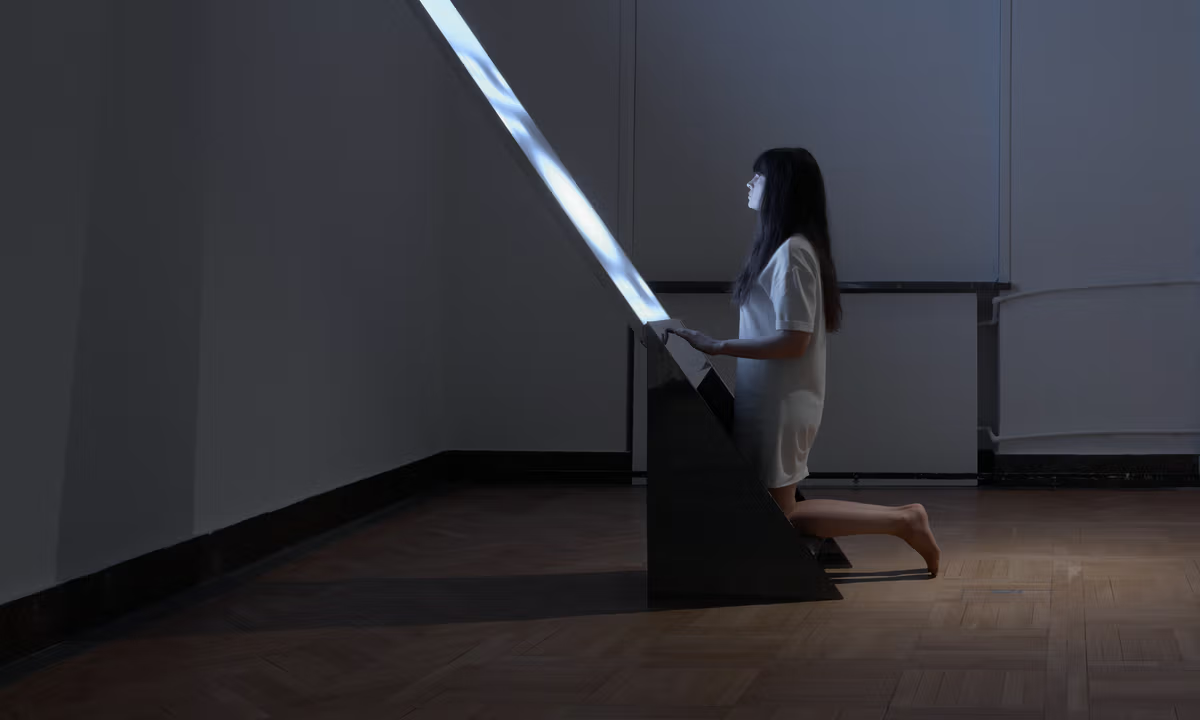
It is not often one finds oneself down on their knees in front of a work of art. But that was the case for many visitors to the recent exhibition Elusive Sense: On the Fluid Boundaries of Perception at London’s art’otel. The exhibition presented five contemporary artists from Poland whose works explored the impact of technology on the senses. Art goers crouched on a leather kneeler at the foot of a monolithic digital screen and used the touchpad in front of them to aimlessly scroll through streams of nonsensical lit up shapes and symbols.
“The infinity scroll is a mechanism often utilised by social media services and platforms, suggesting infinite amounts of content,” read the label for Infinity (2020), an interactive installation by the Polish collective panGenerator. “Endless scrolling induces a state of permanent craving in the mind, tempting it with an endless stream of new information, which, however, it is incapable of processing. Scrolling thus becomes a purely sensory experience, inducing a hypnosis of sorts.”
Kneeling is an important element to the work, according to Jakub Koźniewski, one of the members of panGenerator. “We want to make you a bit uncomfortable,” he says. “This is a performative piece, and the user is the performer. We want to make people feel awkward and a bit strange, to make them more aware and open to reflecting on the act of daily digital, visual scrolling.” The kneeling adds a religious element too, although Koźniewski admits it is not always readily understood by all of the cultures and contexts that it has been presented in. “There are similarities between the trust and belief that we put in digital technology and religious beliefs,” Koźniewski says. “People don’t really get into the details of how different technologies work, it is kind of like magic for us. It’s just like a black box. So in a way, we are like people in the Middle Ages who weren’t aware of how nature works, so they believed in stories about gods.”
panGenerator was founded in 2010 and today consists of three artists: Krzysztof Cybulski, Krzysztof Goliński and Jakub Koźniewski. The group create new media art that “plays with technology”, Koźniewski says, to highlight certain phenomena of contemporary life. “For us, the worthwhile new media art is that which actually explores new ways of expressing yourself rather than just using readymade tools. We try to invent new stuff, so we create a lot of custom-made interfaces, displays and kinetic installations. We like to physicalise digital phenomena, which are, by nature, ephemeral,” he says. By bringing the digital into the physical realm, panGenerator aims to highlight the impact of technology on our lives, such as the effects of social media on mental health.
panGenerator’s Hash to ash (2017)
Another of panGenerator’s works that directly responds to social media is the installation Hash to ash (2017), which invites viewers to take a selfie that appears on a screen before seemingly melting and turning into ash, which is released from the monitor onto the floor. A stone plaque with a hashtag symbol engraved onto it, combined with the grey dust, creates the effect of a grave. The work takes aim at the widespread and superficial selfie culture that has reigned since the dawn of social media as well as highlighting the fragility of digital photos. “It’s so easy now to take photos and post them, and then we just upload them to the cloud, and we assume that they’re going to be there forever. So we don’t curate photos of ourselves like we used to do, making family photo albums or whatnot,” Koźniewski says.
He adds: “We trust the cloud. But are you sure that Google is going to be around in 50 years time? Are these servers still going to be there? There is a fragility to these digital records and a false illusion of permanence.”
While the phenomena of social media is a subject that panGenerator has explored in its work, the collective are not fans of it themselves. “The go-to platform for us right now is Instagram, but we’re not doing what we probably should in terms of pleasing the algorithm. We’re not posting daily or reels, so our reach has diminished,” Koźniewski says. “Our installations have a very particular aesthetic—they’re not usually very colourful and flashy, which is another thing that Instagram doesn’t favour. So we are posting content, but we don’t really feel very welcome there.”
Koźniewski believes that this desire to please the social media algorithms is influencing contemporary art aesthetics, and it is something that panGenerator works hard to resist. “I often catch myself at the early stages of designing an installation thinking about the final photo of it and whether it’s going to look nice, because I know that that’s the way I’m going to actually reach a larger audience,” he says. “Unfortunately, more and more artists are really trying to please the algorithm first, rather than trying to express themselves and thinking about what message they can convey. A lot of works are just trying to fit into some aesthetic trend that is, for some reason, favoured by the algorithm.” Koźniewski argues that you can see this in the work of some well known digital artists. “They’re using readymade engines, they’re not inventing anything new, it’s super repetitive and there is no meaning behind it,” he says.
A major challenge that panGenerator faces is the increased use of artificial intelligence to create visual content online. “The overproduction of digital content is getting worse and worse. You’re just drowning in that stuff on social media. We’re having to compete with all these bots and artificially created content, so it’s becoming hard to stick out from the crowd,” Koźniewski says. “The real value that you bring and the effort you put into a work is becoming less and less important. So that’s the sad trend that’s happening right now.”
