


Wary of being labelled, many Asian Americans once believed that the safest way to enter the art world was by making their identities invisible. But invisibility is fragile. After the Immigration and Nationality Act of 1965—which abolished the discriminatory national quotas that had defined US immigration policy since the 1920s—many Asian artists arrived in New York and entered an art world already defined by hierarchy. For decades thereafter, downplaying identity could feel like survival. But what we try to sidestep is never separate from us.
At the Milton Resnick and Pat Passlof Foundation, the exhibition How Asian Is It? features 12 pioneering East Asian American abstractionists, all born between 1928 and 1955. Some immigrated to the US. Others were born here. All began their careers at a time when identity could feel like a liability. As the show’s curator, Lilly Wei, tells The Art Newspaper: “Perhaps America itself needs to be redefined.”
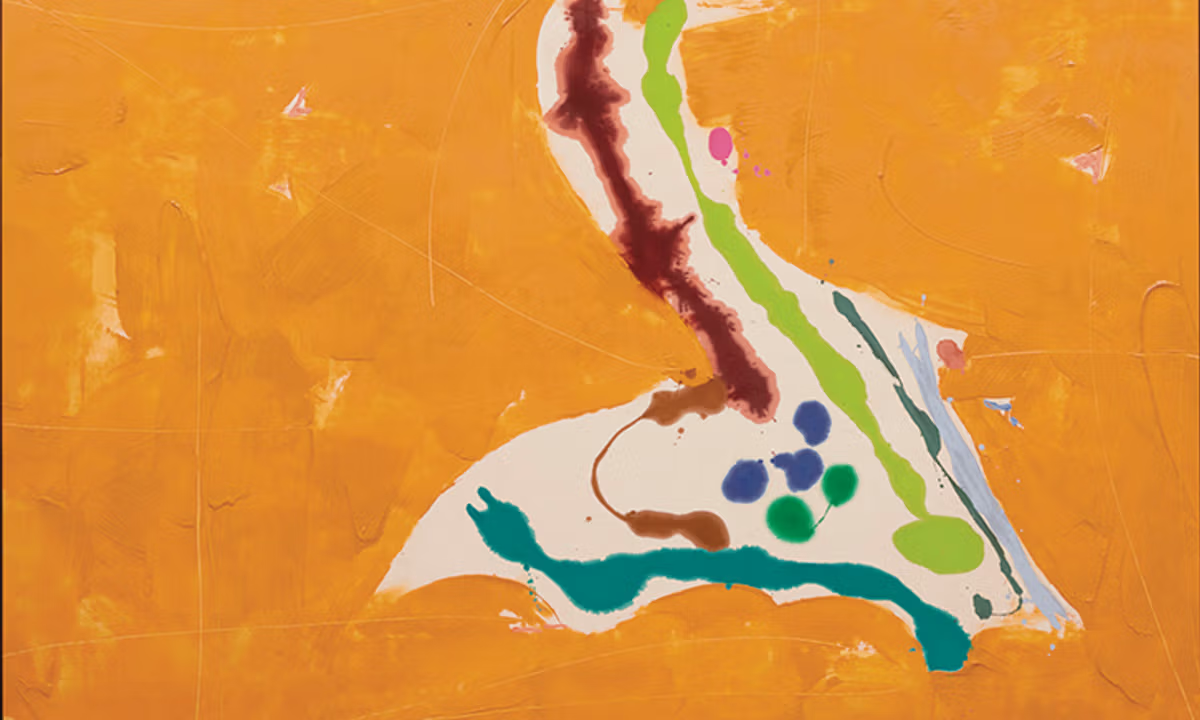
What is most striking about these works is not what was painted but what was withheld. There is no shared style or manifesto. What emerges instead is a disciplined negotiation with space. It is difficult not to think of liubai (留白)—the principle in Chinese ink painting that treats white space as active, where what remains unpainted suggests sky, mist or breath. The void holds the composition rather than receding from it.
In Barbara Takenaga’s Hovenweep (2016), white marks scatter across a black field as if the surface were expanding in real time. Growing up Japanese American in what she calls “a pretty white community” in Nebraska, the artist remembers that “fitting in was an issue”. She rarely thought of “Asianness” in her work. “In hindsight, you can’t really take it out of a person,” she adds. What endures is not symbolism but structure, an attraction to positive-negative reversals, asymmetry, flatness.
Meanwhile, Emily Cheng’s A Force Like Gravity series (2022) expands outwards from luminous centres, suggesting motion rather than a fixed form. “It’s really about the chi,” she says. Influenced by Daoism, the work pursues energy rather than iconography. While she has faced barriers of both gender and race, Cheng says she was never defeated. She prefers to focus on painting itself, on what exceeds categorisation.
Charles Yuen describes identity as “a continual state of semi-belonging”. Early abstraction was simply the language available to him. Over time, influenced by Persian miniatures and nonlinear spatial systems, he moved beyond it. In Visiting Xanadu (2025), saturated reds and acidic yellows create an unstable, disorienting space. Inspired by conversations with his dying sister, Yuen’s painting resists fixed meaning. Death, he says, is “a transition to an immaterial state”.
David Diao’s Grandsweep (1970), shown publicly for the first time, anchors the exhibition in the politics of process. The olive field ripples with subtle swells made by pouring paint and dragging it with cardboard tubes. “No mystery. The viewer is dealt in,” Diao says. Having arrived in New York in the 1950s at age 12 and determined to assimilate, Diao aligned himself with minimalism and conceptual art at a time when few Asian artists were visible.
The question is not how “Asian” the art looks in this show but how its artists inhabited abstraction when difference was easier to mute than to name. Across the exhibition, what feels shared is attention to interval, pause, what remains unsaid. In that space between visibility and restraint, history quietly sits.
• How Asian Is It?, Milton Resnick and Pat Passlof Foundation, until 11 July
