







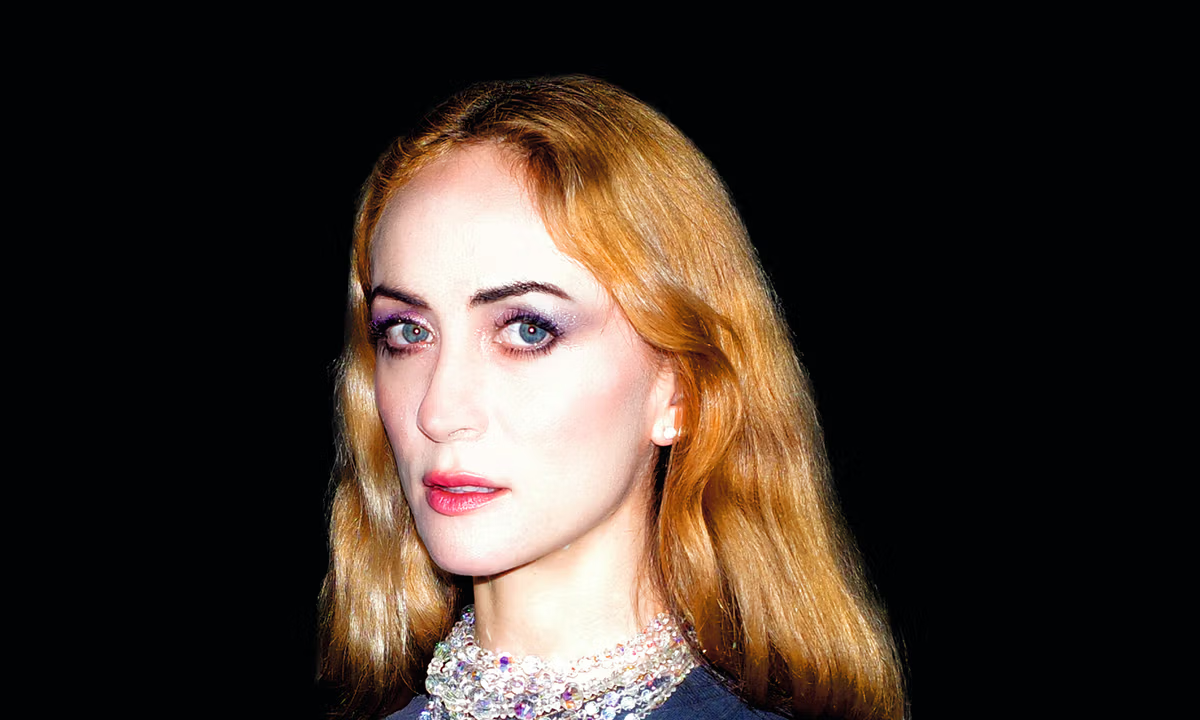
The Croatian British multi-disciplinary artist Marianna Simnett is best known for films that explore the recesses of desire, pain, violence and power, in which her body is often a site of exploration and transformation. She mines personal and cultural history, including the folklore of her mother’s Balkan homeland and the history of conflict in that region, to expose the jagged edges of suppressed memory, unspoken anxiety and generational trauma in hypnotic, disturbing and empathetic works that span performance, sculpture, drawing and painting.
Simnett often works by creating tension between apparently opposite states. In The Needle and the Larynx (2016), the boundary between care and violence is blurred, as viewers watch the artist’s throat being injected with Botox, a procedure usually reserved for young men who want to lower their voices. Horror and revulsion figure heavily in her work, but there are also flashes of joy, humour, and surprise: in her new show at the Secession in Vienna the bright lights and exuberance of the circus make the darkness of the shadows all the more unsettling. The artist has also created a book for the show, Dodo Margarine, written by Camilla Grudova and illustrated by Simnett. It is an unexpectedly soothing mixture of fiction, mood and atmosphere, containing hints of the show’s themes.
Marianna Simnett’s Fountain (2026), a neon of a woman urinating, which she regards as a “very liberated gesture”, references Balkan folklore and Greek mythology Photo: Sophie Pölzl; courtesy of the artist and Société, Berlin
The Art Newspaper: Your new exhibition is called Circus. Could you set the scene?
Marianna Simnett: It’s spectacular, but also extremely minimal. The Secession gave me the basement, and we’ve gone full goth—black ceiling, floors, walls, everything is pitch black. I’m mostly known for my video installations, so I wanted to switch the narrative and present a light, sound and sculpture exhibition. Catherine Wheel (2026), the first work, refers to a very thrilling firework—I loved it when I was a kid—but also to a torture and execution method. There is something about the momentum, the ferocity, the switch from violence into excitement and delight and thrill that interests me. You encounter a blue spinning reflective skirt, which alludes to the tent of a circus, or to the garment of a female. It’s a hypnotic and disturbing work, [accompanied by] the sound of me being tickled for a period of four hours.
How did you choose your tickler?
I was very specific about who I hired to tickle me: a friend of mine called Tim Dahl—Tickler Tim. He is a prolific musician, and he plays bass for Lydia Lunch, among others. He’s strong, punk, and doesn’t mind being punched in the face. He’s also not a creep, a vital criterion. And then there’s his immense experience with sound; he was able to play me like an instrument, inducing an enormous dynamic range, from croaks to cackles to speaking in tongues. He was dripping with sweat, he was absolutely exhausted [during the performance].
The circus is a place of extremes and transgressions; it’s a strange way to entertain children.
I try not to moralise in my work but to reveal that nobody is exempt from having perverse pleasures. The act of looking is inherently a type of violence. And entertainment is often violence shrouded in a fun disguise, just like our world of bright colours and capitalism and glee and opportunity. Desirability often conceals dark truths.
In your sound-and-light installation Faint with Light (2016), bars of light rise and fall to a soundtrack of you hyperventilating to make yourself faint four times, to the point of seizure. It is inspired in part by the astonishing story of your grandfather, who escaped death during the Holocaust by fainting as he was about to be shot.
Fainting is historically problematic. The French philosopher Catherine Clément’s book Syncope: The Philosophy of Rapture was a vital source for me in reframing the act of fainting. She talks about it as a type of rapture, exiting the world to pause for a moment, and then come back anew.

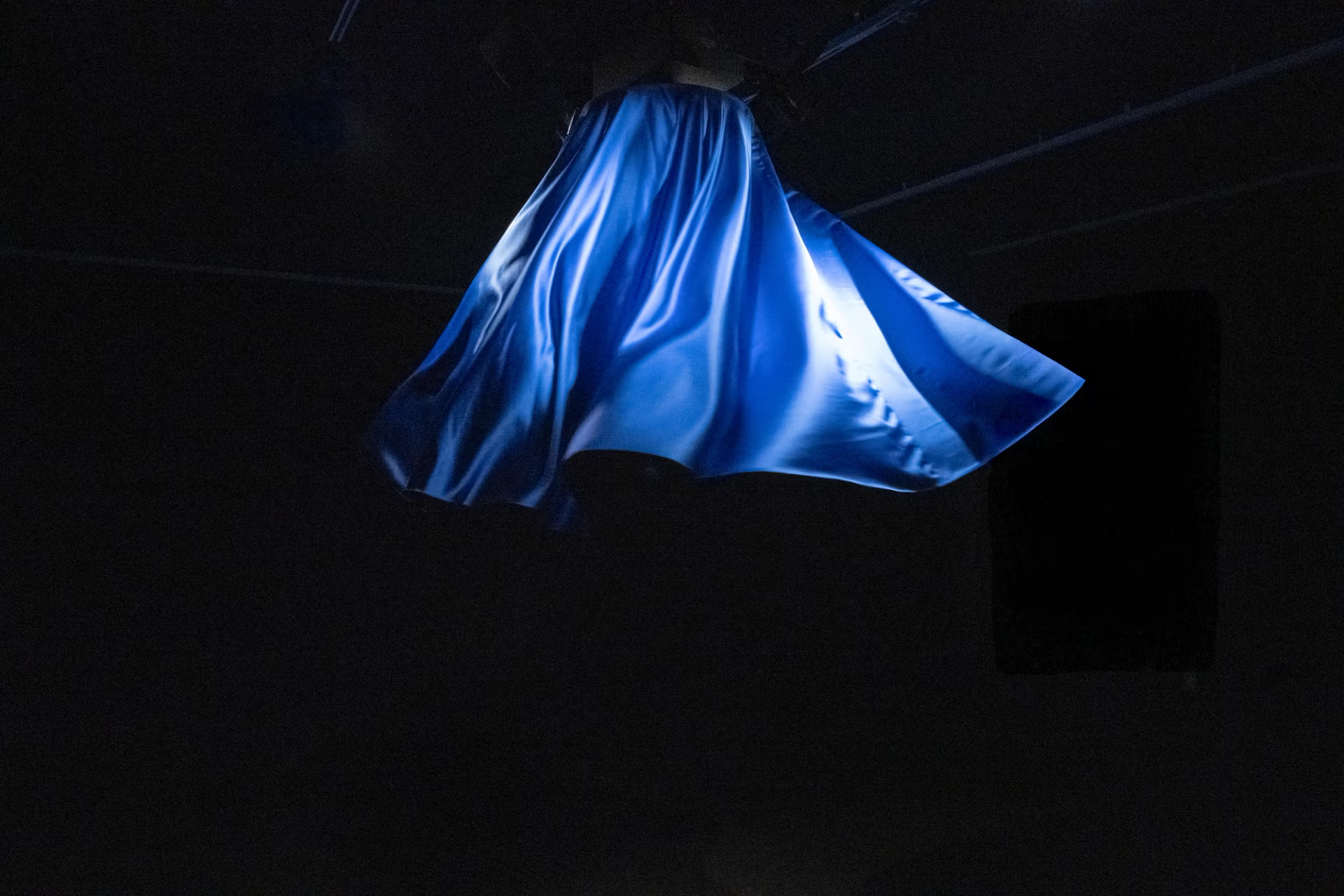
The artist’s Catherine Wheel (2026) is a kinetic installation featuring a swirling skirt, taking its name from both a thrilling firework and a Medieval torture method Photo: Sophie Pölzl; courtesy of the artist and Société, Berlin
The story behind the fainting work is my grandfather’s survival. I’m conscious of not using the Holocaust to prop up my artwork, and this is not a piece about that, but it was my impetus to make it, knowing that I could never get close to someone else’s experience, especially when it contains so much horror. My approach to the piece was to emulate the gesture without the narrative and without representing my body. And because I’m a film-maker, I was looking at all the fainting females in early cinema—the 1920s and 30s were full of swooning women. And then there’s [the psychoanalyst Sigmund] Freud and his six symptoms of hysteria, one of which was fainting.
How does your approach to performance compare to that of others in the field?
The 1970s body performance artists were very much into risking the live body on stage—it is precisely that tension keeping the audience on the edge of their seat. Although they certainly paved the way for my work, I don’t want to prompt fear for the performer’s body. It’s deliberately a recording and not a live act; the danger has always already happened. And, sure, these are risky undertakings, being tickled or passing out or inducing seizures, but it’s not for you to worry about as a viewer.
We don’t actually see your body at all in this show, do we?
I want my body to disappear. You might ask why I do this to myself; you could go back to how I was born, how I grew up. But more conceptually—the cold answer—is that it’s not about me. I don’t want pity. I want to create a dynamic space for other people’s experiences to flood into the work. It’s difficult to create what I call “void art”, because it sounds like a cop-out, but it’s about creating the perfect amount of openness for others to become open too, exposing our most fragile states through empathetic engagement.
And yet it is a very bodily show.
I think fainting, tickling and pissing all came together in one crystallised act. I felt it was the right moment to go back to the raw states of the body. Tickling is the perfect example of the collision between desire, satisfaction, repulsion and distress. It completely dismantles these neat justifications of what we’re supposed to feel.
Fountain (2026) is a neon of a urinating woman. It makes me think of brothel signs—we are a long way from seeing women’s bodies as powerful in a non-sexual way.
I used a preparatory line drawing of that neon in the promo for the show, and Meta [owner of Facebook and Instagram] took it down, and then I put a censored sign over the vagina, and they took it down again. I was like, “What is so offensive about a woman having a wee?” It’s indicative of the biases that control and suppress us, whether machine or human. And there’s this use of industrial language to describe a seemingly private act, right? There’s a rudeness to the materials. I wanted Circus to have a raw, brutal quality—there’s no delicacy except for the fabric of the skirt. And depicting liquid with light was a challenging thing to do.

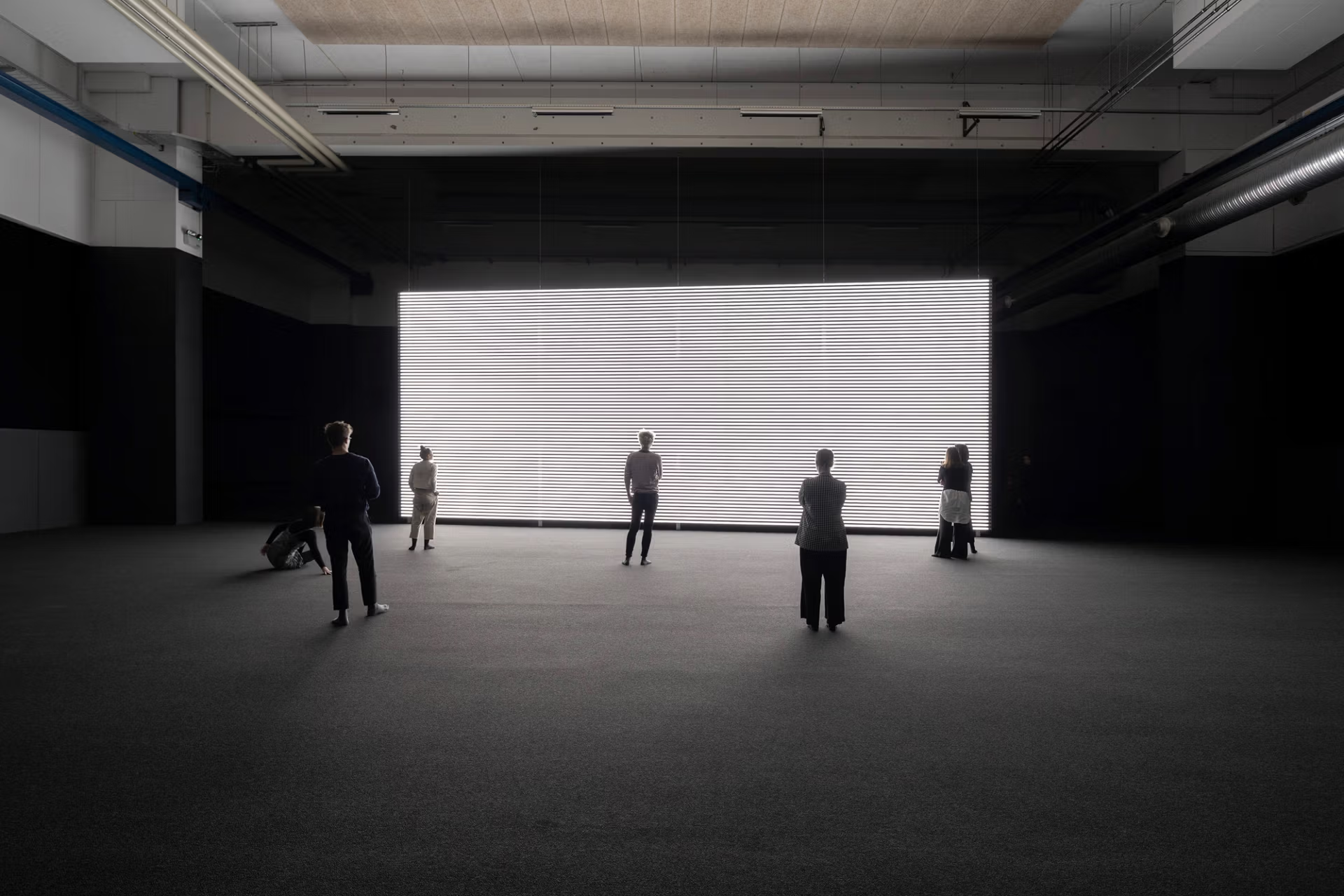
In the installation Faint with Light (2016), seen here at Copenhagen Contemporary, Simnett interprets her grandfather’s experience of escaping death in the Second World War by fainting just as he was about to be shot Photo: Anders Sune Berg; courtesy of the artist
The origins of this is a Balkan folktale where a urinating woman wards off the devil and evil spirits. Also in Greek mythology, there’s Baubo, who used skirt-lifting as a trick to make Demeter laugh, which opened up her ability to eat and drink and produce nourishment and fertility for the earth. The Greek term for lifting one’s skirt to expose the buttocks or genitalia is anasyrma—there’s a word for the gesture itself. It’s fascinating, it really goes back deep. It’s about courage and resistance and retaliation and refusal in many different cultures.
I think of it as a very joyous work. I was experimenting with squatting or standing. But squatting is just so ridiculously petty, I wanted it to feel like a very liberated gesture.
How important is music and sound in your work?
I grapple with it. Sound is present in all of my work, even if the emphasis is on silence. It’s one of the most powerful mediums you can work with. It penetrates, it’s inescapable, it stays in your brain. I compose and play music, often soundtracking my own films. It’s something I’ve grown up with since I was five. I feel very comfortable and familiar with it, but I also feel a resistance to the authoritarianism of classical training. And I can’t really shake that, because it’s part of my upbringing.
• Marianna Simnett: Circus, Secession, Vienna, until 31 May


