


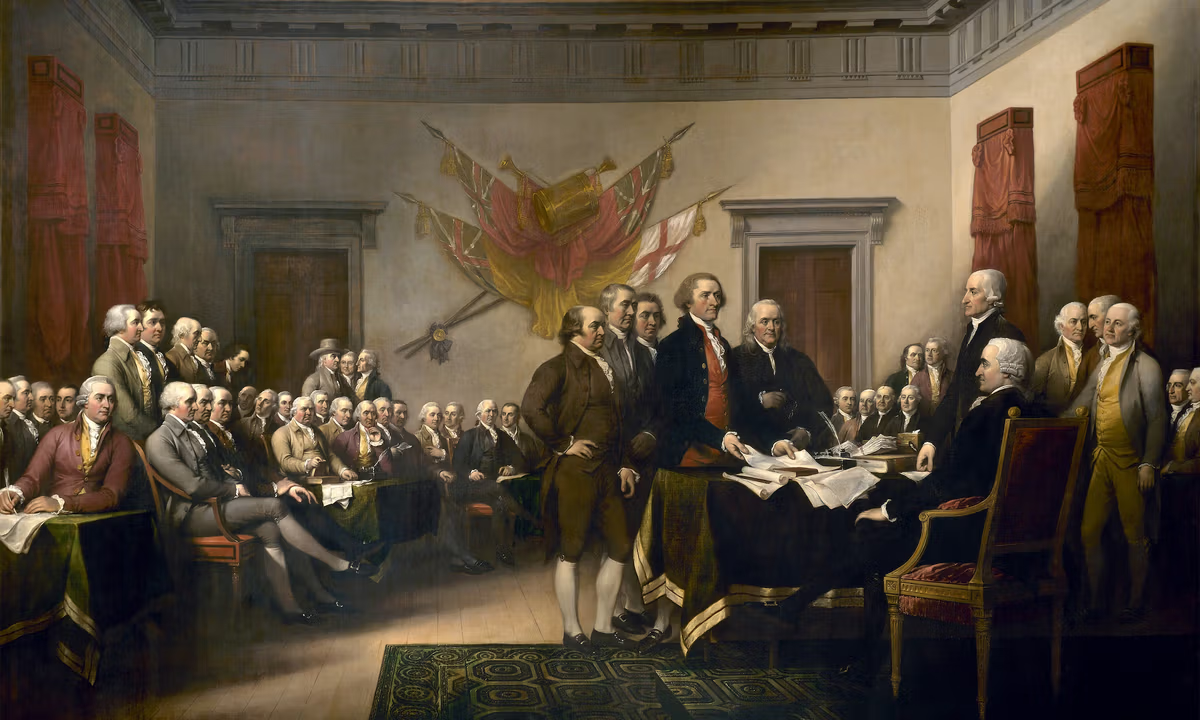
In 1771, Benjamin Franklin wrote to the artist Charles Willson Peale: “The arts have always travelled westward, and there is no doubt of their flourishing hereafter on our side of the Atlantic, as the number of wealthy inhabitants shall increase… since, from several instances, it appears that our people are not deficient in genius.”
Franklin was right about the future of the art market in the United States, but not about his own time. As early as 1676, London merchants were already calling New England “the greate martt and staple”. Recent economic research suggests American income per head actually exceeded Britain’s until the Revolutionary War (1775-83), overturning the long-held view that this didn’t happen until the 1880s. Before the war, Britain imported a third of its goods from America, which is more than from Europe, while exporting slightly less. The art trade, which depends on surplus wealth, followed suit. London’s art and collectables exports in the 1760s and 70s flowed healthily to New York, Pennsylvania, New England, New Providence, Virginia, Maryland, Carolina and Florida, with few imports coming back.
By 1800, however, the Revolution had cut US income per head by 20% in a fall comparable to the Great Depression of 1929-33. The Anglo-American art trade itself shrank between 1775 and 1779 before reviving in New York the following year, though it never matched Britain’s trade with Europe and the East Indies.
As the US marks the 250th anniversary of its Declaration of Independence this week, it is worth asking why certain American artists chose to work in Britain, with some later returning home, while several British painters made the opposite journey during the 18th century.
The politics of the Revolution are well documented, including in art history, as part of a war against a mother country’s tax demands, ignited by the 1765 Stamp Act. The most dramatic case is that of John Trumbull, the American army colonel and “Painter of the Revolution” who was imprisoned in London in 1780. Zara Anishanslin’s recent book The Painter’s Fire (2025) examines three other “patriot” artists in London. But loyalist sympathies in the art world were just as visible. Joseph Wilton’s statue of a defiant, armed America at the original Royal Academy (RA) in 1780—perhaps coloured by the fact his 1770 statue of George III in New York had been toppled in 1776—is as striking as Joseph Wright’s provocative 1780 London etching, Yankee Doodle, or the Great Satan. After the war, artists had plenty more to protest, from Britain’s 1787 sedition laws to the 1798 acts targeting aliens in America.
Joseph Wright, Yankee-Doodle, or the American Satan, 1780 The British Museum, London
In addition to picking their political allegiances, artists at this time had to contend with a more prosaic issue: how to make a living through the revolution and war. Most gravitated toward stable, prosperous, active markets, often sidestepping politics, however hypocritical that might seem, to avoid alienating patrons. Johan Zoffany, a founding RA member, voiced unease about the American war to an English patron in 1779, shortly before seeking his fortune painting in India. John Singleton Copley took a different approach, splitting his career: 20 years in America, where roughly 80% of his portraits trace to just 28 family trees (strengthened by his marriage into the wealthy Hancock family), followed by 25 more prosperous years in Britain from 1775.
For most artists, the calculation was economic and cultural, and the arithmetic favoured Britain. America’s economy was roughly a third the size of Britain’s, limiting commission opportunities, and its wealthy class was far smaller. An annual income of £8,000 was typical among Britain’s 287 peers, or members of the House of Lords,in 1803, but almost unheard of in America. Even reaching Britain cost upwards of £3 for passage, which was about a third of an average American income and was sometimes covered by patrons.
Once there, the cost of living, especially rent and taxes, was the biggest challenge. London rents doubled between 1740 and 1800, while renting in Boston in this period was a third to a half cheaper. Artists clustered in expensive areas near their clients, which was Covent Garden for the best native artists, and paid a rent premium even over tradesmen, likely reflecting the riskiness of their profession. Americans often shared lodgings, later congregating around Fitzroy Square. Mather Brown and Trumbull both rented from the Scottish American artist John Smibert.
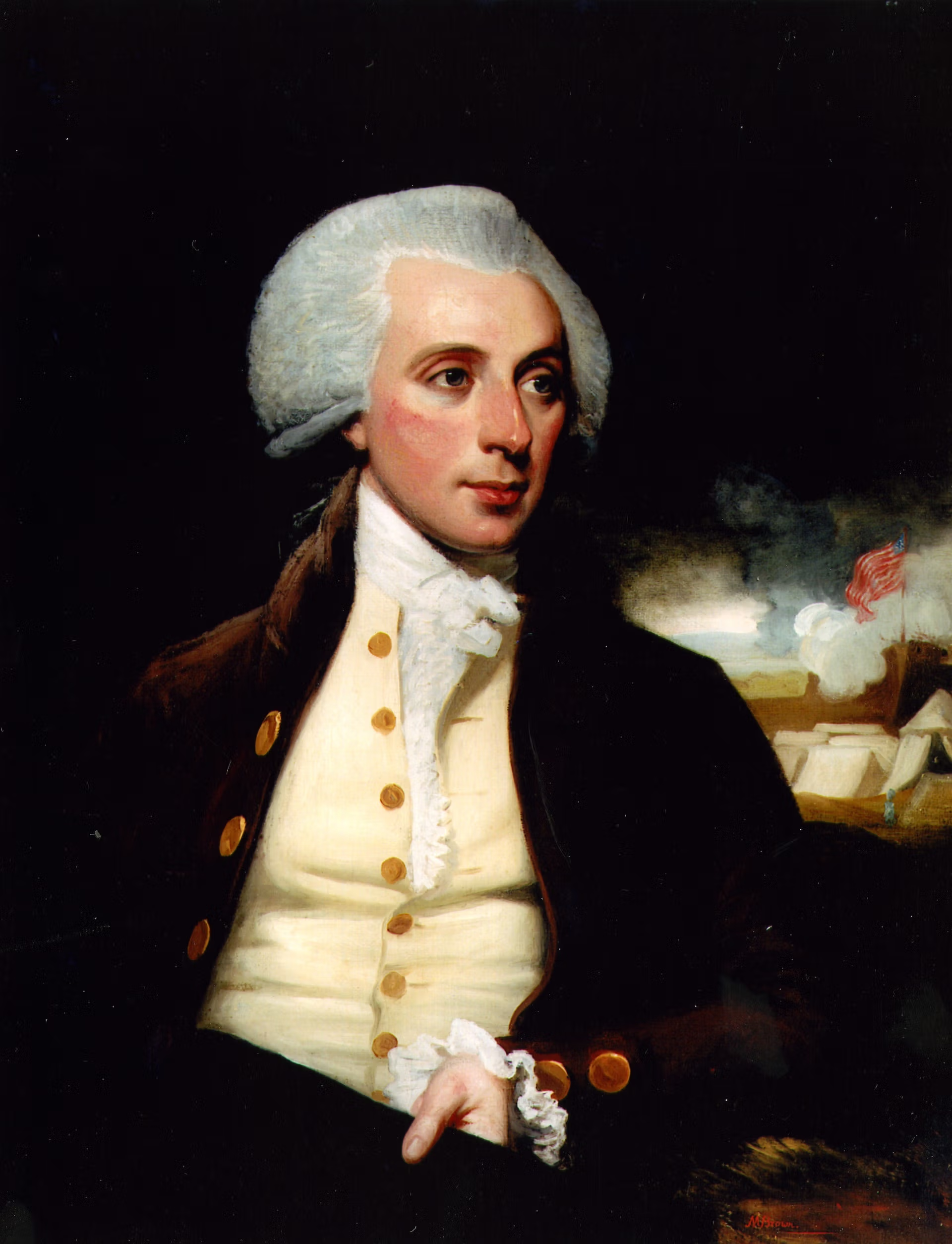
Mather Brown, Colonel William Stephen Smith, 1786 National Park Service
Taxation—the very spark of the Revolution—also made Britain less attractive. British citizens paid roughly 26 shillings per head annually versus about 1 shilling in America. Nearly three quarters of British taxes were raised through excise and customs, plus land, property and eventually income tax. America’s pre-war taxes from 1764 to 1775 covered 17 goods and services, from sugar to legal restraints, and were sometimes targeted at the citizens of New York, Boston and Québec. Yet they raised only a fraction of the Seven Years’ War (1756-63) debt they were meant to repay. The Revolution itself later required a 1791 whiskey tax to cover its costs.
Many artists weighed these factors and crossed the Atlantic in both directions. Earlier in the century, Smibert split his career between making 175 pictures in London from 1709 to 1730 and 241 in America until his death in 1751, drawn by a new and prosperous clientele in pre-Revolutionary America. Later in the century, around 30 American artists worked in London, joining an estimated 800 mostly native painters working there in 1770.
Some American artists thrived in Britain in ways that few native painters could match. Benjamin West, born to modest circumstances in Pennsylvania, became a royal painter in 1772 and the RA’s second president in 1792. George III paid him a £1,000 annual stipend plus generous commissions—his Windsor Castle paintings earned him £20,000—and William Beckford added a 1,000 guinea (£1,050) stipend. From his Newman Street studio, West built a collection spanning Titian, Rubens and Rembrandt alongside ‘patriotic’ British and American works.
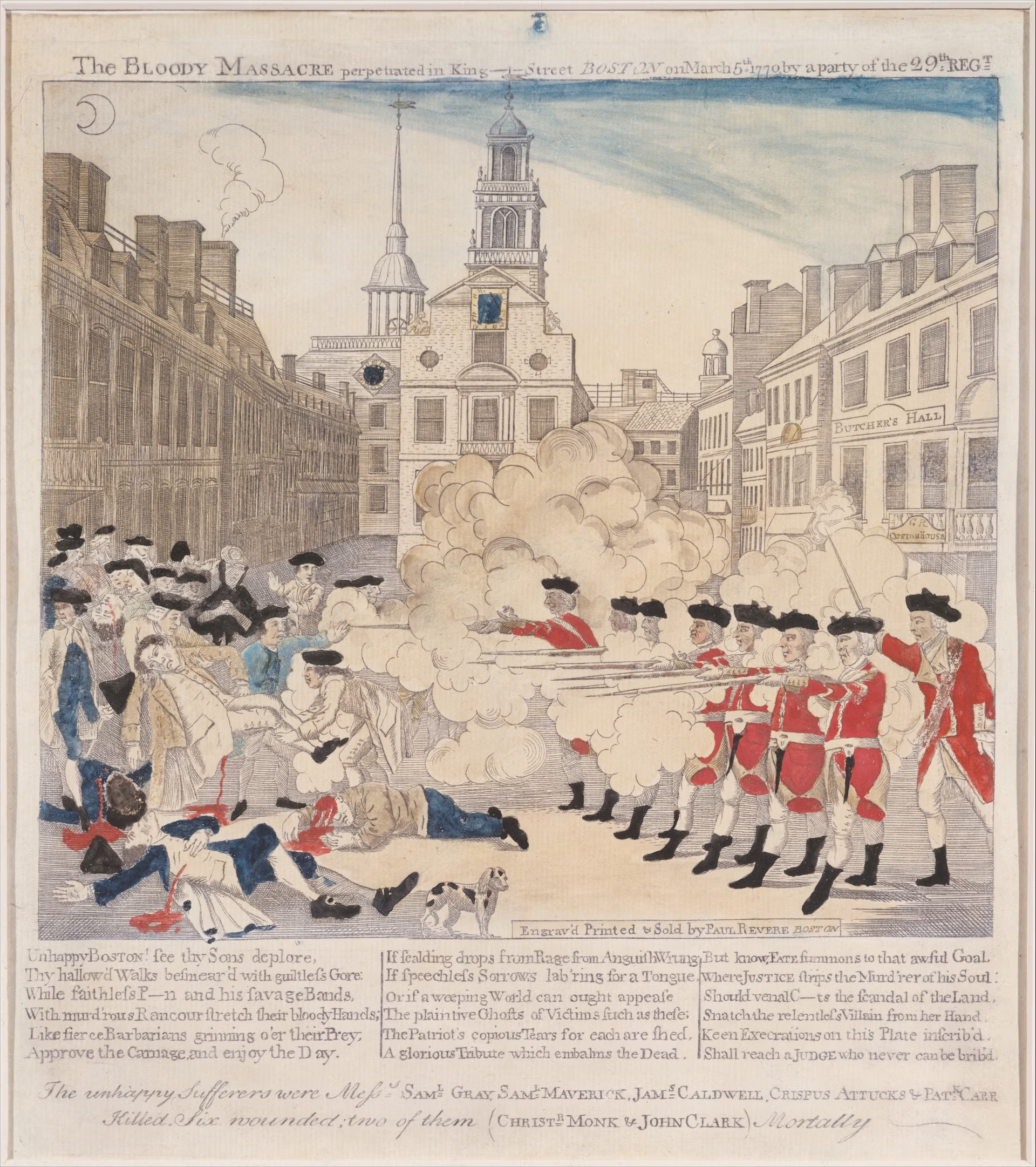
Engraved, printed and sold by Paul Revere Jr, after Henry Pelham, The Boston Massacre, or, The Bloody Massacre perpetrated in King Street, Boston on March 5, 1770 by a party of the 29th Regiment, 1770 Gift of Mrs Russell Sage, 1910. Metropolitan Museum of Art, New York
The two markets also cross-pollinated stylistically. Both developed topographical views, caricatures and prints, reflecting interest in exploration, protest and propaganda, tailored to their own audiences. Boston households, for instance, showed a marked taste for prints starting in 1740 that was reinforced by the harrowing image of the 1770 Boston Massacre. In Britain, Americans gained from new institutions like the Society of Artists and the RA, where they refined their techniques and built networks. Matthew Pratt’s 1766 painting of West with his pupils, shown at the Society decades before equivalent American academies existed, captures this. American strides in history painting, in turn, inspired British artists, particularly when depicting patriotic subjects. West’s Death of General Wolfe drew huge crowds at the RA and circulated widely in print. At Prime Minister William Pitt’s urging, RA president West also set higher standards at the academy. One-man-show exhibitions, pioneered by Joseph Wright of Derby and adopted successfully by Copley, drove public interest and prices. Copley’s 1783 Siege of Gibraltar, shown in a Green Park pavilion, drew 60,000 visitors at a shilling each, earning him £3,000 in ticket sales alone, dwarfing his £1,000 commission, which was later supplemented by £5,000 from print sales.
Altogether, these exchanges helped shape the modern art market on both sides of the Atlantic. At auction in Britain from 1770 to 1800, there was a significant turnover from West, Brown and William Russell Birch (who emigrated from England to Philadelphia in 1794) at prices ranging up to £105. Today, the Revolution’s American artists remain embedded in British culture. Art UK lists 377 works by West in UK public collections (plus 60 in the Royal Collection) from an output of more than 700; 112 by Copley from over 350; 99 by Brown; 86 by Stuart from over 1,000; 22 by Trumbull from 250; and 6 by Peale from roughly 1,100. Meanwhile, the US has gained museums, such as Peale’s in 1780s Philadelphia, and art academies in New York and Pennsylvania since the start of the 19th century. The story of America and Britain’s art market during the war demonstrates art’s power to transcend conflict and inspire connection in almost any circumstance.
