


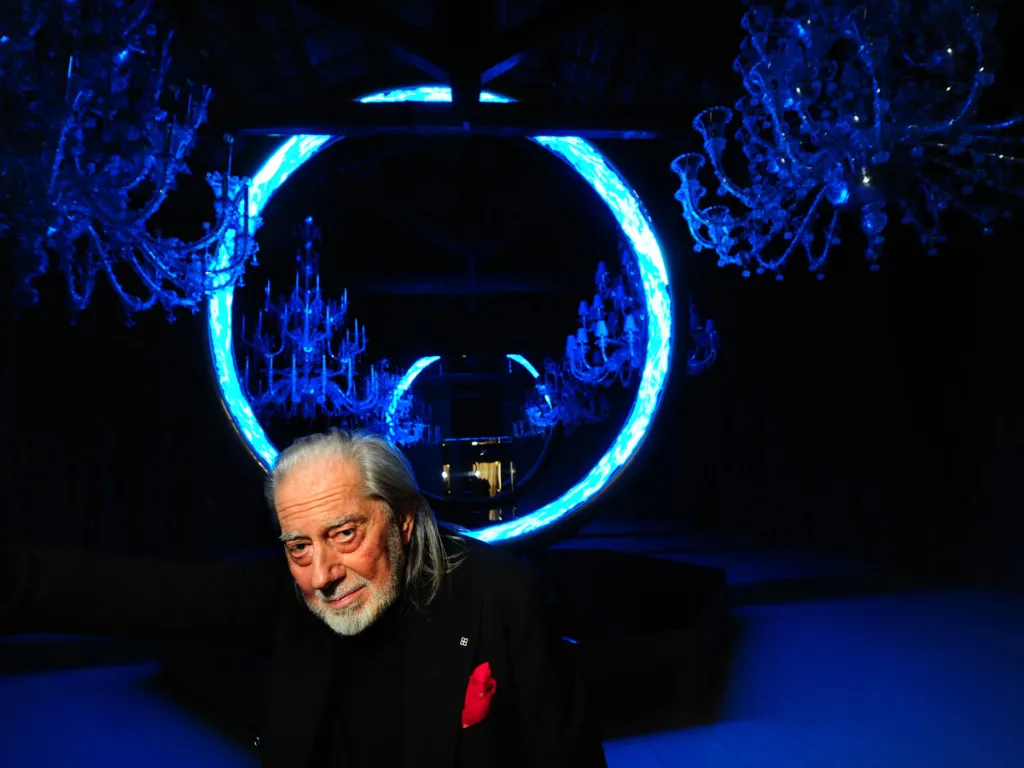
Fabrizio Plessi, a pioneer of video art, died on August 23 in Venice at 86. His death was reported by La Repubblica.
Plessi was best known for engaging history and tradition with the digital, creating installations that took on an architecture of their own. A true experimenter, he also had a flair for eschewing one medium for another, moving between water, fire, stone, memory, and most recently glass.
As a teenager, Plessi moved to Venice, first to study at the city’s Art High School and then at its Academy of Fine Arts. He completed his degree in 1962 and was appointed professor in painting. During this period, in the early ’60s, he began to research water as a subject and conceptual medium spanning time, memory, and movement—a concept that would continue throughout his career.
In the ’70s, bodies of water would become central to his practice, featuring in performances, films, and videos. He created his first video works in 1973 as part of a collaboration with the Visual Activities Center at Palazzo dei Diamanti in Ferrara, Italy. In 1981, he presented Underwater at the Venice Film Festival; it subsequently showed at the Centre Pompidou in Paris. In the 1980s and ‘90s, he drew inspiration from light and stone after spending time in and continually returning to Mallorca, Spain.
Much like the transformative powers of water and light, Plessi also found the digital to be spiritual. “Everyone thinks of digital as connected to material technology, when it is the most immaterial element there is,” he once told Repubblica. “Painting and sculpture are material. LED lights, light, are immaterial. I draw continuously, every day for at least three hours. I draw light, I draw ideas and what we will then see thanks to the luminous pixels.”
He saw no difference between the stained glass windows in Gothic cathedrals (“nothing more than large pixels of light”) or televisions (whether “80-kilogram black-and-white boxes” from the earliest part of his career or the “elegant, minimalist forms” of today). “[N]othing has changed. Technology doesn’t exist. It only exists as we use it, as we humanize it,” he said. “In a video, we see something that has no substance and then evaporates. That’s why, for me, it’s the most spiritual thing there is.”
Born on April 3, 1940, in Reggio Emilia, Plessi had a long-standing relationship with the Venice Biennale, having both exhibited in the main exhibition and mounted presentations in multiple editions. At the 1986 Biennale, for example, he represented Italy, debuting his video installation Bronx (1986). Featuring 26 shovels placed in the center of 26 television monitors set inside a dark, narrow iron structure, that installation also included video footage of running water that reflected off the surfaces of the shovels, a metaphor for the changing industrial landscape of its namesake New York borough. The following year, he showed at Documenta 8 in Kassel, Germany, which led to further international acclaim.
“La Biennale di Venezia loses an artist who accompanied and, in many moments, anticipated the transformations of contemporary language,” the Venice Biennale said in a statement. “His work brought the ancestral force of the elements into dialogue with the immaterial dimension of technology, restoring to the electronic image a surprising physicality, and to matter a new possibility of movement, light and memory. Fabrizio Plessi’s long history with La Biennale di Venezia thus remains a significant part of the history of the institution and of artistic research: a history that spans more than fifty years without ever losing its visionary force.”
In 1999, Plessi was honored with two major international awards: the 13th Rome Quadriennale and the Kunstpreis der Nord/LB in Hanover, which named him Germany’s Artist of the Year. The following year, he once again represented Italy on the international stage, first at the Gwangju Biennale in South Korea and then at Expo 2000 in Hanover, Germany.
Additionally, Plessi’s works have been shown at major institutions such as the Centre Pompidou in Paris and the Solomon R. Guggenheim Museum in New York, and in 2014, the Ludwig Múzeum in Budapest mounted a retrospective of his work, titled “Liquid Labyrinth.”
Even among the darkest times, Plessi never stopped creating. In 2020, at the height of the pandemic, for instance, the city of Venice honored his 80th birthday with a digital installation spelling out “Pax Tibi” (or “Peace be with you” in Latin) on the windows of the Correr Museum to which Plessi responded by creating a 32-foot-tall “Christmas tree” comprised of 80 LED monitors in the Piazza San Marco.
Most recently, Plessi took up a new medium: glass. Working alongside master glassblowers in nearby Murano, he created a series of objects that were exhibited last year, in the final show he realized during his lifetime, “Perdersi in un bicchier d’acqua” (Getting Lost in a Glass of Water) at Barovier&Toso Arte in Murano.
“His works always brought light: a physical light and, at the same time, an idea of energy, the future, and rebirth. Fabrizio knew how to look at Venice without nostalgia, creating a dialogue between its history and the contemporary, to the point of presenting our city as ‘the grammar of his artistic work,’” Venice Mayor Simone Venturini said in a statement. “We will work to ensure that his message continues to resonate in the works and initiatives of many other artists who will create art following his example.”
