


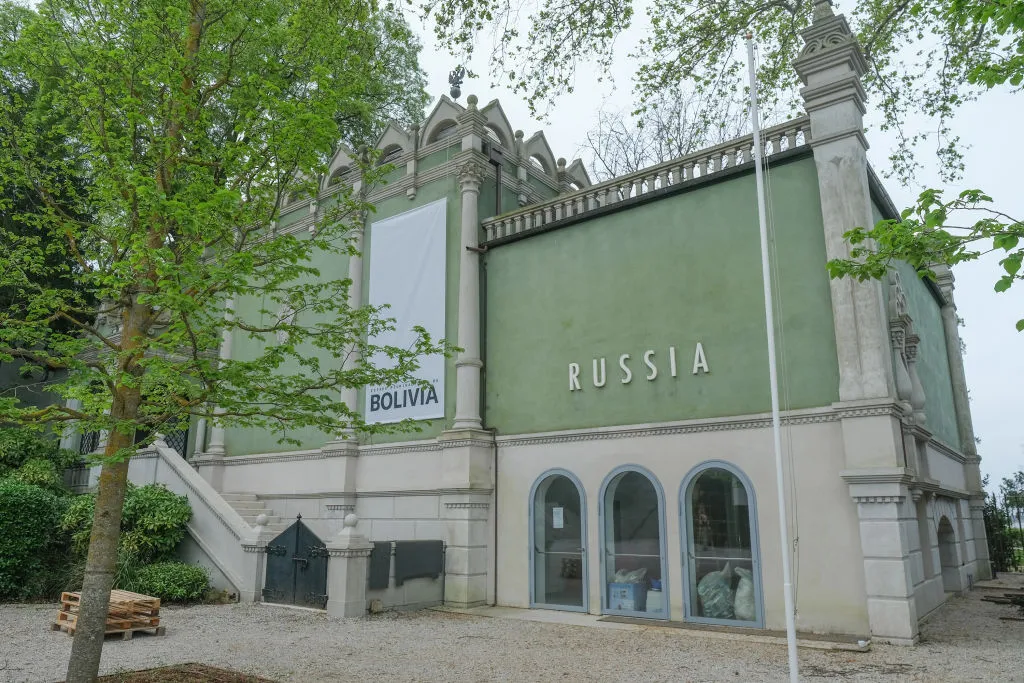
Finland’s political leadership will not attend the Venice Biennale this year if the Russian Pavilion goes on view as planned, marking the latest escalation of European opposition to Russia’s return to international exhibition.
In a statement released Thursday, Finland’s Ministry of Education and Culture said that its position is that Russia must not be allowed to participate “as long as Russia’s war of aggression in Ukraine continues.” However, Minister of Science and Culture Mari-Leena Talvitie said some public officials from Finland will still attend in order to support Finnish arts and culture.
While the move stops short of a full withdrawal, Finland’s decision underscores growing political pressure on the Biennale to revoke Russia’s participation as the country prepares to stage a national pavilion for the first time since its 2022 invasion of Ukraine.
In March, 22 high-ranking politicians representing European nations from France to Poland signed an open letter led by Latvia to the Biennale calling Russia’s presence “deeply troubling” and said the pavilion “raises serious questions about the risk of state-directed cultural diplomacy being presented under the guise of artistic exchange.” Finnish officials also signed that letter. Then, earlier this month, the European Commission warned the Biennale it could lose a €2 million grant for its 2028 edition if it fails to address concerns that it may have violated EU sanctions against Russia by allowing it to participate.
Biennale organizers have maintained, most recently in a March statement, that they are a neutral body that accepts pavilion applications from any nation recognized in Italy, saying that it “rejects any form of exclusion or censorship of culture and art.” But, as ARTnews‘s Alex Greenberger argued in a op-ed last month, no art exhibition is ever truly neutral, and it is high time the Biennale convene an ethics panel, like the UN, the Olympics, and other major international bodies, to adjudicate disputes.
Russia’s pavilion, titled “The Tree is Rooted in the Sky,” is expected to feature a multidisciplinary program of musicians, poets, and artists from Russia and abroad. Organizers have framed the project as an assertion that culture can transcend politics. “Through the meeting of different cultures, the project aims to create a space for dialogue and exchange, where local roots can intertwine with global visions, generating new artistic perspectives and strengthening a sense of international community,” the organizers told ARTnews last month.
With Russia, Israel, Iran, and the US tied up in conflicts, this year’s edition of the Biennale looks increasingly like a stage for geopolitical positioning, as much as an art exhibition.
