


Art Basel Qatar closed its inaugural edition this week with numbers that suggest Doha has quickly established itself as a serious market platform. Getting there required patience.
Selling in Doha was always going to unfold differently. The Qatari royal family was given a private walkthrough on Monday, the day before VIP preview began. Sorces told ARTnews that galleries were told that any work placed on hold would either be confirmed as sold or released within 24 hours.
Yet even on Thursday afternoon, the first public day, dealers could be seen checking their phones and scanning the aisles for signals. During the VIP days, galleries were comfortable saying there was “interest,” yet hesitant to share figures. As the week progressed, decisions began to crystallize. Guy Bennett, Qatar Museums’ director of collections and acquisitions and a former Christie’s specialist and dealer, was spotted moving steadily from booth to booth with a stack of papers in hand, checking in with exhibitors on Wednesday, likely to assuage dealers who were worried that the royals’ interest was waning. By the fair’s close, however, several institutional placements had come through (though to whom, most galleries were unwilling to share.)
More than 17,000 visitors attended across the VIP and public days at M7 and Doha Design District, according to the fair, with thousands more circulating through special projects staged across Msheireb. Nearly half of the private collectors and patrons came from the MENASA region, joined by attendees from Asia, Africa, Europe, and the Americas. Representatives from more than 85 museums and foundations were present. And of course Emir Sheikh Tamim bin Hamad Al-Thani toured the fair, as did Sheikha Al Mayassa bint Hamad bin Khalifa Al-Thani, along with other senior officials.
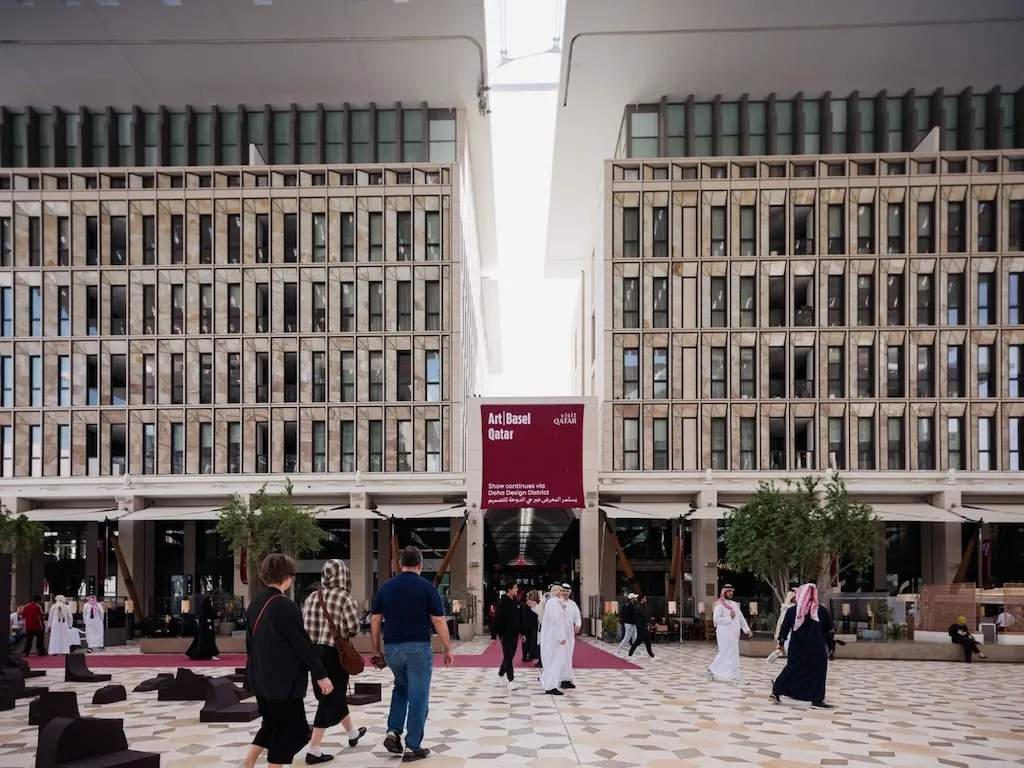
Inside the M7 building at Art Basel Qatar. Courtesy Art Basel.
Ismail Noor of Seeing Things Stu
In the official closing statement, Art Basel CEO Noah Horowitz described the edition as “a powerful validation of a shared vision.” Chief Artistic Officer Vincenzo de Bellis said the ambition was to respond directly to the city and the region. Wael Shawky framed it succinctly: “Art Basel Qatar has presented a new way forward for the art market.” Whether that way forward means smaller, more focused editions of other Art Basel fairs, or if that only applies to this inaugural edition of Art Basel Qater, is unclear. But “a new way forward” sounds nice, doesn’t it?
On the floor, that vision translated into steady sales across tiers.
David Kordansky Gallery sold all three paintings in its presentation of Lucy Bull, with prices ranging from $375,000 to $450,000. Two went to prominent Middle Eastern collections, including a museum. Mike Homer, partner and senior director at the gallery, said placing all three works underscored “the region’s growing engagement with Western contemporary artists.”

Nari Ward’s, Still Livin’ Forever (2024)
VeneKlasen sold out its booth of six paintings by Issy Wood, priced between $35,000 and $190,000. Most were acquired by collectors from the region, several of them resulting in new relationships for the gallery.
Lehmann Maupin reported early sales from its focused presentation of Nari Ward. PRAISEWORTHY (2025), a new work from the artist’s shoelace series making its public debut in Doha, sold in the range of $80,000 to $100,000 to collectors based in Los Angeles. Still Livin’, Forever (2024) also sold in the same range.
ATHR Gallery posted one of the most detailed tallies of the week with its solo presentation of Ahmed Mater. On preview day, IPO (2025) sold for $95,000, alongside two editions of Black Stone (2025) for $55,000 and $60,000. By the fair’s close, Second Meeting (2025) sold for $220,000, War Room I (2025) and People Counter (2025) each for $130,000, and all five editions of Black Stone (2025) had sold, ranging from $55,000 to $79,000. Two editions of Social Fabric II (2025) placed at $45,000 and $50,000. The booth spanned $45,000 to $220,000 and effectively sold out.
Installation view of ATHR’s solo presentation of Ahmed Mater.
Ismail Noor
White Cube reported eight sculptures sold from its solo presentation of Georg Baselitz. The sculptures, sources say, were priced at €800,000 each, while the paintings in the booth ranged from €650,000 to €1.1 million. Founder Jay Jopling described the fair as “a big success,” citing strong sales and meaningful conversations.
Paula Cooper Gallery placed four wall works by Terry Adkins with a public institution in the region, each priced between $300,000 and $400,000. It may have been one of the week’s most significant institutional acquisitions.
Thaddaeus Ropac was one of the few that confirmed specific sales from its booth. Raqib Shaw’s Echoes Over Arabia II (2025), executed in acrylic liner and enamel on birch wood, sold for £375,000. Another work, Echoes Over Arabia: Upon the Migration of Memory, the Poet, the Performer, with Wisdom and Time (2025), made in acrylic liner and enamel on paper mounted on aluminium, sold for £225,000.
Sean Kelly sold the majority of its booth, the gallery said, with works ranging from $85,000 to $235,000, all placed with Middle Eastern collections. Luxembourg & Co. brought four works by Katsumi Nakai priced between $75,000 and $140,000, confirming sales discussions while declining specifics. Lisson Gallery reported sales of works by Olga de Amaral from different periods of her career, though without disclosing prices.
Terry Adkins, Aviarium (Dicksissel), 2014 at Paula Cooper’s booth. © 2026 The Estate of Terry Adkins / Artists Rights Society (ARS), New York. Courtesy Paula Cooper Gallery, New York. Photo: Steven Probert
Courtesy Paula Cooper Gallery, New York. Photo: Steven Probert
At the lower end of the market, Sargent’s Daughters reported strong results for its presentation of Aiza Ahmed. The largest work sold to an institution whose name has not yet been made public. Multiple smaller and medium-scale works also sold, with prices ranging from $3,500 to $25,000. Allegra LaViola, founder and director of Sargent’s Daughters, said, “The fair was a fantastic experience on all fronts. Presenting a solo booth is always an effective way of allowing viewers to fully enter the world of the artist. There was a great deal of interest and support from collectors who were new to me, but clearly deeply committed to the region and who were excited to discover new voices.”
So … six-figure works moved steadily. Mid-market material found buyers. Institutional placements were confirmed and, by the end, the mood shifted from suspense to resolution.
The natural comparison is to Basel’s other most recent fairs, Miami and Paris.
In Miami Beach this December, the top end flexed muscle. David Zwirner sold a Gerhard Richter for $5.5 million and an Alice Neel for $3.3 million. Hauser & Wirth placed a George Condo for just under $4 million and Louise Bourgeois works at $3.2 million and $2.5 million. Pace sold Sam Gilliam’s Heroines, Beyoncé, Serena and Althea (2020) for $1.1 million. Works priced at $15 million and $18.5 million drew crowds and headlines.
Paris in October operated at an even higher register. Hauser & Wirth placed a 1987 Gerhard Richter abstraction for $23 million. White Cube sold Julie Mehretu’s Charioteer (2007) for $11.5 million and a George Baselitz sculpture for €2.5 million. Bruce Nauman’s Masturbating Man reached $4.7 million. Karma sold Matthew Wong’s White Wave, Black Sand (2017) for $3.5 million.
Doha’s price ceiling sat lower. The center of gravity clustered between $80,000 and $450,000, with select works reaching into the high six figures and beyond. The emphasis was different. The fair was aimed at building collector depth. It activated institutions. It activated a regional market that is transacting with growing confidence. The foundation is now in place. Forthcoming editions will reveal whether this market has a higher ceiling, or if its a bubble bound to pop.
