


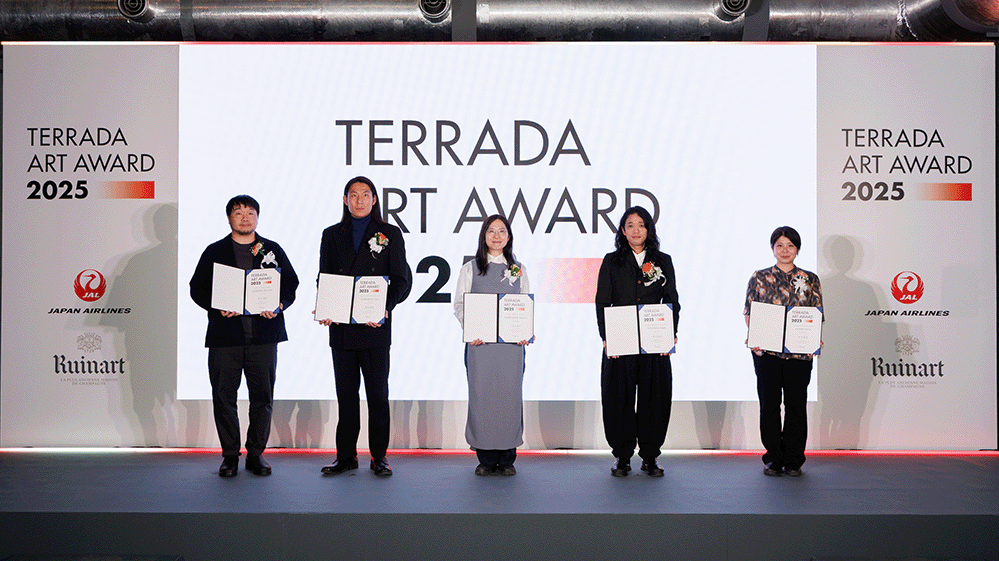
Warehouse TERRADA, which supports emerging artists on the foundation of its art-storage business, opened the finalist exhibition for TERRADA ART AWARD 2025 on January 16. Works by five artists poised to shape the next generation are now on view.
Founded in 1950, Warehouse TERRADA began its art storage business in the 1970s. Since the 2000s, it has actively expanded a wide range of initiatives dedicated to supporting art, including operating museums and art events using warehouse spaces, managing gallery complexes, retailing traditional art materials, conserving and restoring artworks, and providing transportation services. In recent years in particular, the company has focused on supporting the production of emerging artists—for example, by opening rental studios in Kyoto, extending its activities beyond its home base in Tennoz, Japan.
It was against this backdrop that Warehouse TERRADA launched the TERRADA ART AWARD in 2014. Japan has no shortage of art awards, organized by both public institutions and private organizations, but what sets the TERRADA ART AWARD apart—especially since it became a biennial program in 2021—is that it is designed to invest not so much in an artist’s current “achievements” than in their future potential. The award encompasses contemporary art in the broadest sense, from two-dimensional work and sculpture to textiles, media art, and bodily expression including performance. Within this scope, however, the evaluation places the greatest emphasis on the artist’s proposed exhibition plan—the challenge the artist seeks to undertake.
Artists selected as finalists by a five-member final jury composed of curators, researchers, artists, art advisors, and others receive not only 3 million yen as a production grant to attempt ambitious new work that would be difficult to realize financially on their own , but also the opportunity to exhibit in a distinctive warehouse setting. In addition, two years of free artwork storage is provided as a supplementary prize.
The TERRADA ART AWARD 2025 Finalist Exhibition began on January 16. Chosen as finalists from among numerous applications from Japan and abroad are five artists: Daisuke Kuroda, Yuki Kobayashi, Sakura Koretsune, Yuske Taninaka, and Claire Fujita. As in 2023, the final jurors were Takahiro Kaneshima (associate professor, SCAPe, Kanazawa College of Art), Yukie Kamiya (head, curatorial division, chief curator, The National Art Center, Tokyo), Yuki Terase (founder, Art Intelligence Global), Daito Manabe (artist, programmer, composer), and Meruro Washida (director, 21st Century Museum of Contemporary Art, Kanazawa; associate professor, Tokyo University of the Arts).
At the awards ceremony held on January 15, Kaneshima, speaking on behalf of the jury, offered the following overview: “This edition we received many works—what might be called art practices—that translated phenomena such as relationships to everyday life and ways of connecting with society into their form. The works by the artists selected as finalists also allow audiences to experience each artist’s thinking and practice, and they are emblematic of our time.”
The work of each award recipient is introduced below.
Daisuke Kuroda (Yuki Terase Award)

Artwork by Daisuke Kuroda.
Photo: Keizo KIOKU
Drawing on research into postwar abstract sculpture, Daisuke Kuroda presented a video-centered project in which he “extracts and performs” sculptors of the period like an itako—a spirit medium (especially in folk belief in Japan’s Tohoku region) said to speak the words of the dead or spirits through their own mouth.
The project was sparked in 2020, when Kuroda encountered facts that diverged from accepted narratives, as well as aspects that had gone unspoken in historical accounts, forcing him to confront anew the fundamental question of what sculpture is. After thoroughly researching and understanding sculptors including Brancusi, he paints motifs and animals associated with them onto his own face and performs improvisationally, shifting between monologue and dialogue in which he plays multiple roles, as though inhabiting the artists themselves.
The sculptors Kuroda performs are comic and, at the same time, eerie, leaving a creeping sense of discomfort. Through their speech, the work probes why abstract sculpture became active in Japan around 1950. For Kuroda, this is an attempt to excavate what history does not tell—something that cannot be explained simply by the easy image of “postwar liberation.” Juror Yuki Terase commented, “Although it is a comedic video work, it made me aware of similarities between the atmosphere of the postwar period and that of today, such as invisible pressures surrounding expression.”
Yuki Kobayashi (Meruro Washida Award)
Artwork by Yuki Kobayashi.
Photo: Keizo KIOKU
Starting from Wing Chun—the southern Chinese martial art said to have been founded by Ng Mui, a Shaolin nun and fighter, and later spread worldwide by Ip Man and his disciples—Yuki Kobayashi developed a performance-based project. The finalist exhibition presents part of The Wing Chun Project.
Known for work examining discrimination embedded in sport, Kobayashi began training in Wing Chun in Kyoto in 2019, and since 2022 has continued his studies in Hong Kong and China. In this project, he approaches martial arts from a “queer perspective,” exploring how physicality can be reconsidered within the historical contexts surrounding East Asia. Juror Meruro Washida evaluated the work as follows:
“Often in the art world, when artists make work by referencing things outside art, it can fall into mere borrowing. But by becoming a practitioner of Wing Chun himself, Kobayashi has succeeded in presenting martial arts within the context of art. In Kobayashi’s installation, the wooden, human-shaped training apparatus traditionally used in Wing Chun—the muk yan jong—stands as an autonomous sculptural work adapted to his own body; yet in the sense that without training that actually uses it, it cannot be called a complete work, it might also be said to pose a question to the museum’s system of evaluation.”
During the exhibition period, Kobayashi will practice Wing Chun daily in his exhibition space.
Sakura Koretsune (Yukie Kamiya Award)
Artwork by Sakura Koretsune.
Photo: Isao Negishi
Through fieldwork and interviews conducted in various locations, Sakura Koretsune has become increasingly concerned with the relationship between whales and humans. The works presented in this exhibition extend a practice of more than a decade, focused on historical changes in that relationship and the stories that have emerged between the two.
Aware that debates around whaling easily harden into binary oppositions, Koretsune does not simply judge that history as good or evil, nor render it “as if it never happened.” Instead, as a clue for thinking about the future, she seeks—through expression—to bring back into relief the events and states of mind that existed between humans and whales. For this exhibition, she created “imaginary toys” using whale teeth and baleen she received from people she met through her research, including those who once worked on whaling ships. Some works use baleen obtained from stranded whales.
Baleen was once used in the West for corsets, and in Japan it was processed into hairpins and paper knives. By giving tangible form again—through handwork—to the memories and cultures lodged in such objects, which disappeared from everyday life as lifestyles changed, Koretsune attempts to visualize the relationship between whales and humans that undeniably existed across a long history.
She traces her choice of “toys” as a form to visits to indigenous villages in Alaska. Whaling continues there today; life is organized around whales, giving rise to culture in the form of songs, festivals, and dance. Koretsune encountered hunters’ toys—for example, kendama-like objects that teach methods for catching seals beneath the ice—and recognized their potential as a medium: small and simple yet capable of expressing local ways of living and practical knowledge. Through these toys are conveyed scenes from past livelihoods, such as boats and whales pursuing one another, and fishing in which people scoop up fish while avoiding fur seals.
Yuske Taninaka (Takahiro Kaneshima Award)
Artwork by Yuske Taninaka.
Photo: Keizo KIOKU
Suspended at the center of the exhibition space is an interactive work that functions as both sculpture and musical instrument. Inspired by Asian reed instruments such as the shō used in gagaku and the Thai khaen, Yuske Taninaka conceived the piece as sculpture and performance at once. Visitors are permitted to play it; however, unless three people coordinate their breath and blow together through the three mouthpieces, no sound is produced.
In creating the work, Taninaka placed importance on crafting “an experience in which the work begins to move when people play or engage with it,” adding:
Artwork by Yuske Taninaka.
Photo: Keizo KIOKU
“To make this work function both as sculpture and as an instrument, I created it in collaboration with various specialists, including engineers. There wasn’t a clear ‘form’ from the beginning; rather, through the process in which concepts and ideas are embodied through collaboration, a ‘living form’ rises up. It is generally assumed that artworks have an intended ‘meaning,’ and that similar interpretations arise regardless of who sees them. Personally, however, I think it matters more that unique experiences and interpretations emerge depending on who makes the work, who sees it, or who plays it.”
Also on view in the same space are sculptures produced from research Taninaka conducted at an iPS cell research institute. Taking as their motif the process by which a fertilized egg divides into three germ layers and differentiates into different bodily parts, the works are composed of three materials: glass, bronze, and metal. In contrast to a Western medical perspective that apprehends the body by dividing it into parts, Taninaka also draws on a Chinese-medicine sense of time, exploring the relationship between treatment and time.
Claire Fujita (Daito Manabe Award)
Artwork by Claire Fujita.
Photo: Keizo KIOKU
Using plants as motifs to question what it means to understand others and the surrounding environment deeply, and to build relationships with care, Claire Fujita presented a group of works threaded by skepticism toward anthropocentrism.
In one work using a Venus flytrap, signals obtained by artificially forcing the plant’s action of closing its mouth—an action it normally performs to capture insects and obtain energy—are sent to a record player connected to the plant, causing music to play.
In another work using lilies (artificial flowers were used due to venue restrictions), Fujita separates the stamen and pistil of the lily—though lilies are naturally bisexual flowers—and built a device that continues pollinating them endlessly, like an assembly line. With no choice and no consent, pollination is compelled under conditions imposed from outside. If the work is likened to human reproduction, the implication is chilling. Elsewhere, in a piece in which a branch is kept upright by an artificial weight even as it is about to be caught by a rotating wheel, a struggle between control and resistance is made visible.
Artwork by Claire Fujita.
Photo: Keizo KIOKU
Through the “forced labor” imposed on nonhuman “living others,” Fujita directs a sharp question at contemporary society as it is lived now—one in which economic rationality and production efficiency are prioritized. Juror Daito Manabe praised “the thought process that sublimated universal themes such as communication and time into analog, mechanical works that use the biology and ecology of plants.”
TERRADA ART AWARD 2025 Finalist Exhibition
