


Nanina Guyer, the curator of photography at Zurich’s Museum Rietberg, started noticing something surprising. The very photographs she was researching in archives—many from the colonial era—began appearing in the work of contemporary artists, “which is very strange, considering the millions of photos that are online available in these archives”. The new exhibition she has curated at Museum Rietberg, A Kind of Paradise: Colonial-Era Photography in Contemporary Art, explores this keen interest of artists in photography from past times, and the multiplicity of uses they have put it to.
It was not difficult for Guyer to find examples—this year’s Venice Biennale features many artists who use such photography in their work, and several are represented in the Rietberg exhibition, including Sammy Baloji and Rosana Paulino. A longlist of around 50 to 60 names was focused down to 20. “I was looking for depth,” Guyer explains, “or multiple layers in the scenes or the stories that these artists were telling through their art.”
Many of the artists also expand the medium, weaving photographs together into three-dimensional sculptures, turning them into films, or recontextualising the original images. “It turned out that the practice, the process of creating this art was so meaningful,” Guyer says. “The gestures were always such an important part of the whole meaning of the artwork.” For example, the Swiss artist Sasha Huber takes the photographs of naked enslaved people from American plantations commissioned by the naturalist Louis Agassiz to prop up his theory of a hierarchy of races, and reclothes them in shimmering armour made from piercing the photographs with a staple gun. Her fury at injustice is turned into protection and care.
The exhibition is divided into four sections. The first looks at how artists have acted as archivists. “In this section, all of the artworks have a very strong link to the artists’ biographies,” Guyer says. “They are looking for who they are, finding missing links.” One such artist is the late Dinh Q. Lê, who went back to his native Vietnam to look for family photographs that had been lost when he escaped the country as a child. Instead, in junk shops he found the lost photographs of other families, which he turned into mosquito-net-like shapes like those he slept under during his journey to safety.
Sasha Huber’s “reclothed” formerly naked portrait Tailoring Freedom—Delia, profile (2023) © 2026, ProLitteris, Zurich; Harvard University, courtesy of the artist
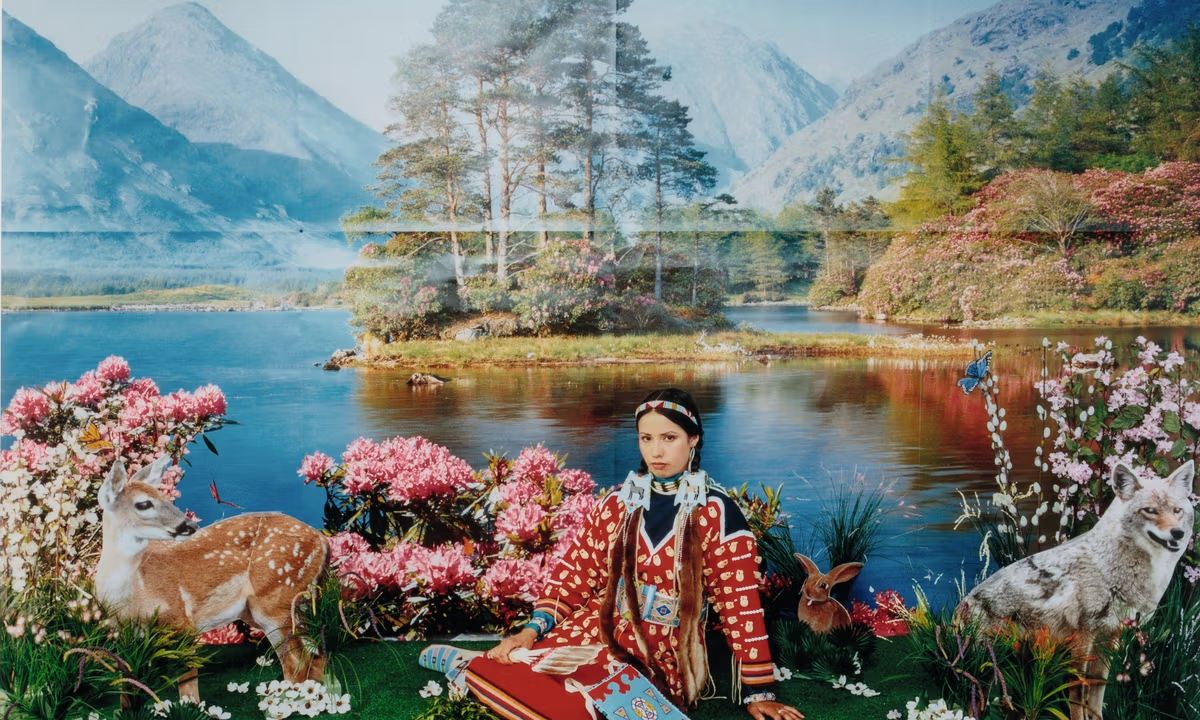
The second section is on confronting the stereotypes propagated by colonial-era photography. Several of the artists here use humour and satire, including Wendy Red Star who presents herself in colourful dioramas replete with the clichés of “Native American” life, similar to those found in some natural history museums. Meanwhile the Senegalese artist Omar Victor Diop, in collaboration with the British film-maker Lee Shulman, drops himself into everyday scenes from white, middle-class American families from the 1950s and 60s, an at-ease but incongruous presence.
The healing power of art is the focus of the third section. Here artists address the parallel exploitation of body and land that occurred under the colonial system, counteracting the historical images with “radical empathy”. As well as Sasha Huber, this section includes the artist Zenaéca Singh, whose ancestors were brought to South Africa from India to work on sugar plantations. She hints at this history by setting her family photographs in sugar glass, the images blurred and obscured by the murky orange panes.
Museum Rietberg is devoted to the art of Asia, Africa, America and Oceania, and has a large archive of colonial-era photography in its collections. Some of the artists in the exhibition have used this archive in their work, but Guyer was deliberate in not showing the originals alongside as that would be “undermine the intent of the artists. They want to repair or erase these photos.”
The show ends in a section called In the Photo Fantastic, inspired by the 2022 exhibition In the Black Fantastic at London’s Hayward Gallery. Here artists use “critical fabulation” to fill in gaps of history, to create stories not told often enough. They include Andrea Chung, who retells the story of Drexciya, a mythical land populated by people who were thrown from the slave ships during the Middle Passage. Faces from the Rietberg collection are printed on to leaves, which will be gradually covered in salt during the course of the exhibition.
Why does Guyer think so many artists are using archival photography in their work? “I think there are pragmatic reasons—archives have become more and more easily available, especially digital ones. And then there is the reason that photography is such a wonderful tool. It collapses time, it allows you to reach to a time long gone and a place no longer existing. And with artistic engagement you can bring those stories back from the time gone to now, because all of them are still ongoing.”
• A Kind of Paradise: Colonial-Era Photography in Contemporary Art, Museum Rietberg, Zurich, until 6 September
