


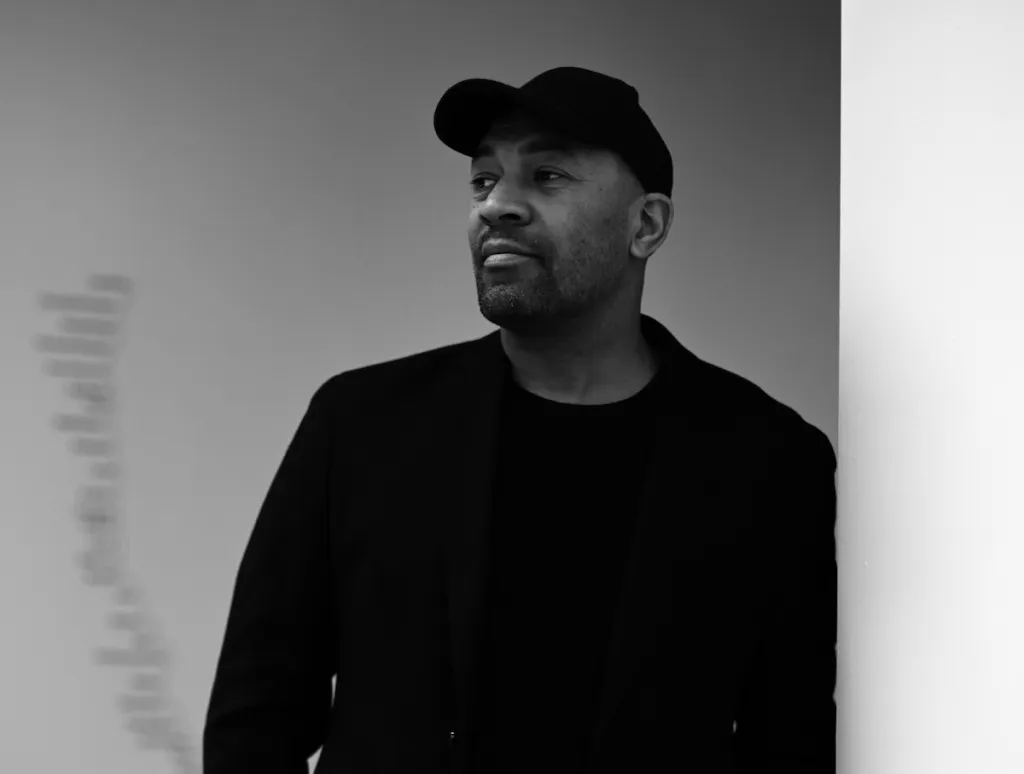
“What I try to do with my work is to fill the many gaps in history, and to tell history in different ways,” said artist François-Xavier Gbré, speaking via a video call.
It was fitting that Gbré spoke these words, since so much information is still transmitted orally from older to younger generations in Africa. Born in France to French and Ivorian parents, Gbré uses his art to keep alive “the memory of the continent.” He added, “This story needs to be written. And it could be written with words, but also with pictures.”
A few days later after his interview with ARTnews, in late January, Gbré’s “Radio Ballast” made its US debut in a duo exhibition with fellow Ivorian Nuits Balnéaires at the International Center of Photography (ICP), in a show curated by David Campany. This body of work is about the railroad system built in Côte d’Ivoire over a century ago by French colonizers to transport extracted natural minerals in the country to the port of Abidjan. It is a poignant group of pictures, especially because Gbré’s grandfather was a railway worker and the artist has a lifelong fascination with trains.
The genesis of this project came in the early 2010s, when Gbré was living in Mali, close to a train station. For about a year starting in 2024, Gbré photographed the railroad line and the landscape around it, from the north of Côte d’Ivoire to the south, to interrogate the country’s histories of colonization, independence and modernity. The title of the series refers both to untold stories and the crushed rocks on which railway tracks are laid.
“I’ve been looking at the new industry. At the villages that became cities thanks to the trains. I’ve been looking at the first train stations built more than one century ago,” shared Gbré. “Then I’ve been looking at the modern architecture, because when Côte d’Ivoire became independent, Félix Houphouët-Boigny [the country’s first president] decided to modify this train station to make it modern, like he did in the city of Abidjan.”
The pictures came with challenges: some railroad workers were not keen on Gbré taking these images, in part because they were unfamiliar with his work and the project. Françoise Remarck, the Ivorian Minister of Culture, who had seen Gbré’s work at exhibitions in Abidjan and at the 2024 Venice Biennale, helped the photographer gain access.
Campany, the creative director of the ICP, told ARTnews that Gbré represents the “past in a political sense, but also in a kind of economic and cultural sense. François-Xavier understands photography almost like a kind of archaeology. He’s really developed quite a sophisticated way of thinking about [how] an image made in the present can be this gateway or portal into thinking about the past.”
Born in 1978 in the French city of Lille, Gbré did not intend to become a photographer. He broke his shoulder while playing football, and thereafter was invited by a friend to join him in a photo lab. Gbré’s journey in the field started in 2000, when he began shooting the city where he was born in black and white. Having “realized that I was not interested in going to the university anymore,” he left his biochemistry class to study photography at the École Supérieure des Métiers Artistiques in Montpellier, France, between 2000 and 2002. Around that time, he worked as an assistant for other photographers in Milan who specialized in fashion, beauty, design, landscape, and architecture. Gbré gravitated toward the latter two types of photography—especially because he had always loved architecture. In 2007, some four years after he became a professional photographer, he officially decided to focus on architecture and landscapes.
François-Xavier Gbré, Agnéby, Agboville, from the series “Radio Ballast,” 2024.
©2025 François-Xavier Gbré/ADAGP, Paris
“When you are a young photographer, you are looking for a style, for something to tell, how to tell it and what you really want to tell. I was a general photographer, shooting portraits, fashion, landscape. It was a mix of many, many things and it wasn’t really clear. And I really like working with other photographers focusing on architecture and design [then] I realized that I was really interested in that,” recalled Gbré. “That’s what I really wanted to do because when you [walk] around, you are kind of free. And you are not closed in a studio [and] you can go around wherever you want. And I loved architecture from the beginning. I used to draw. I loved geometry when I was at school so it came back.”
After a few years of working in Italy, Gbré relocated to Africa: first to the Malian capital of Bamako, then to the Ivorian city of Abidjan, where he currently lives and works in addition to La Rochelle in France. Periodically, his practice also involves traveling elsewhere, to countries such as Madagascar.
In 2023, Gbré was invited by Fondation H, a Malagasy art foundation with spaces in Antananarivo and Paris, for a residency on the architectural heritage of the former city, which is the capital of Madagascar, a former colony of France. He recalled that he was “free to go around the city” during the residency. What resulted was an exhibition titled “Lova,” which means “Heritage” in Malagasy. The show featured works shot during his time in Antananarivo: including capturing the city’s architecture and colonial remnants. These pictures tell stories about the city and country’s past, not by recounting events from long ago but by picturing the places containing history.
“He’s a traveler. He works like he has a map in his head. François-Xavier cannot be lost in a city even if the city is [new to him],” said Cécile Fakhoury, the founder of the eponymous gallery which has represented Gbré for close to 15 years. “[His] very sharp photographs [have] so much history. He captures the story of our humanity through landscape and architecture.”
Fakhoury first found out about Gbré’s work during a research period in 2012 prior to opening her gallery in Abidjan, which now also has spaces in Dakar and Paris. She even had a file on her computer of the photographer’s work before she knew him personally. She recalled that they met “by chance,” when the photographer participated in the Biennale Regard Beninin Cotonou that same year. On display in that Biennale was a body of work by Gbré documenting the erstwhile National Printing Factory in Porto Novo, which was in disrepair.

François-Xavier Gbré, Rubino, from the series “Radio Ballast,” 2024.
©2025 François-Xavier Gbré/ADAGP, Paris
The photographer shared with the gallerist that he had plans to be in Côte d’Ivoire with his family from Mali, where he was based at the time, and when Gbré eventually visited the gallery months later, he did so with a body of work. It marked the beginning of the long-term working relationship.
Fakhoury disclosed that when she exhibited Gbré’s art at the 1-54 Contemporary African Art Fair in London in 2013, her booth attracted visitors such as Arthur Walther, a photography collector who then went on to tell Tate curator Simon Baker about Gbré. Walther bought two works and donated one to Tate Modern. Since then, Fakhoury’s gallery has shown Gbré’s work around the world, helping place it in biennials, exhibitions, and collections like those of MoMA, the Centre Pompidou, Fondation H, and the Smithsonian Institution.
François-Xavier Gbré, Gare de Bouaké, from the series “Radio Ballast,” 2024.
©2025 François-Xavier Gbré/ADAGP, Paris
Showing his work at places and exhibitions like the one at the ICP is Gbré’s way of continuing to document and display history.
“Radio Ballast is a part of the history of Côte d’Ivoire using the train system as a reason to look at the history of the country,” said Gbré. The body of work and exhibition is in line with his practice being about “filling the gaps and making history accessible to everyone.”
