


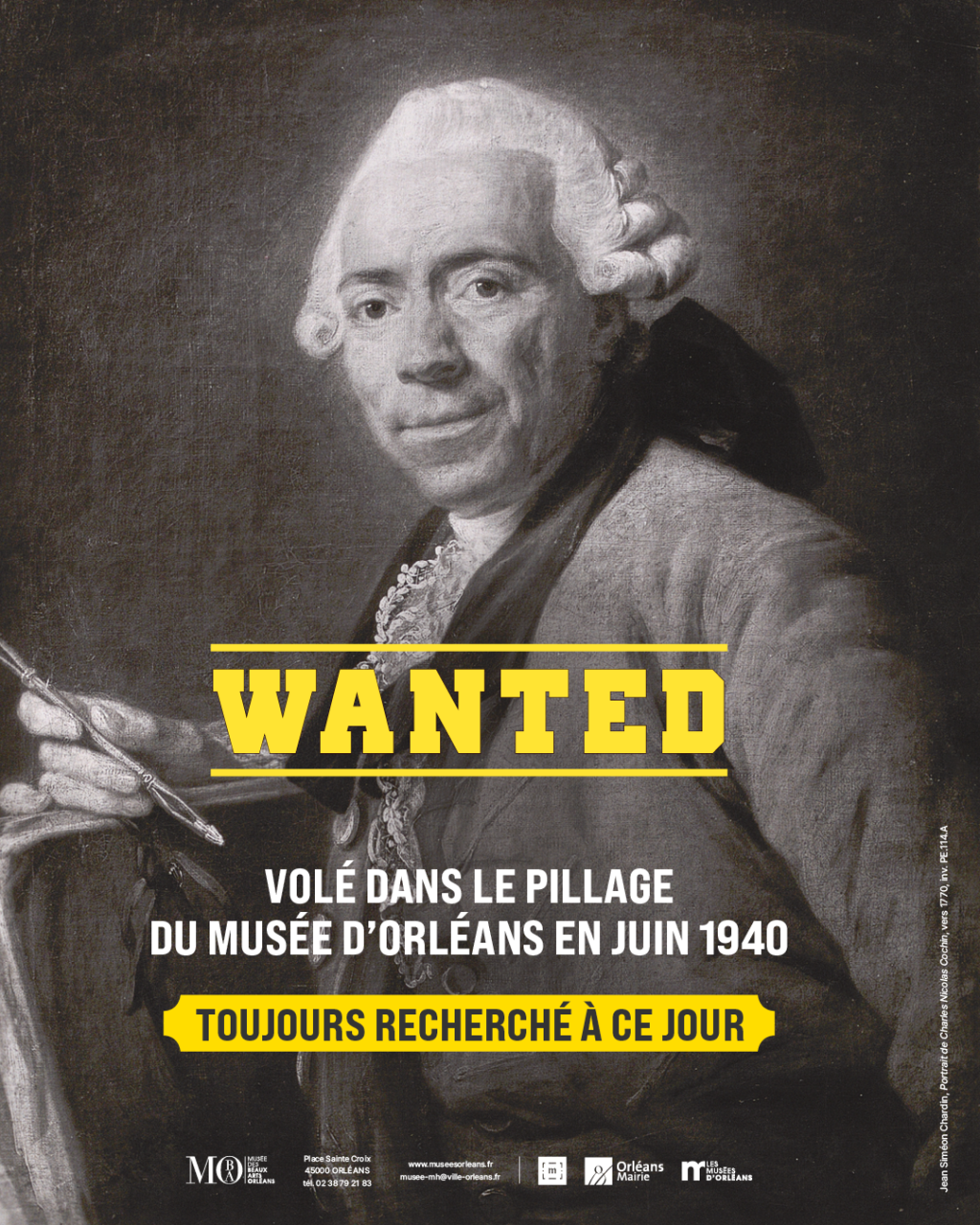
Have you seen a middle-aged man sporting an 18th-century, white, powdered wig, a nobleman’s fine clothes, and a gentle, open smile? If so, you may have come upon a certain Charles-Nicolas Cochin the Younger, a French engraver, designer, and art critic, who worked for King Louis XV and lived from 1715 to 1790.
The fact that he is long dead does not preclude him from effectively being a wanted man in France today. Or more accurately, a painting of him by the celebrated French artist Jean Siméon Chardin is actively being sought after, after it was plundered from the Musée des Beaux-Arts d’Orléans during the German invasion of the city during World War II.
Over 86 years later, the French museum along the banks of the Loire River is trying to get that Chardin back, along with 423 other looted artworks, and has launched a “Wanted” poster campaign to help find them, reported Le Monde. As part of this clever initiative, the words “WANTED” appear written in yellow, chunky, all caps in American Old Western font, across a host of black-and-white images of the missing paintings on the museum’s social media, website, and other news platforms.
“The goal is, on one hand, to make this history known and give a renewed life to these missing paintings, and on the other hand, it is to invite everyone to participate in this search, so that everyone stays alert, and no one can ever again say ‘we didn’t know,’” said the museum director, Olivia Voisin, in an e-mail to ARTnews.
In June 1940, Nazis attacked the city of Orléans, burning an annex of its fine arts museum, known as the Musée Paul Fourché, which, in the chaos of the invading Germans, was almost entirely ransacked, likely by people on both sides of the conflict. Some 350 paintings from Europe, dating as far back as the 16th century, were lost. Other artworks from the museum have disappeared or were stolen at different periods, sometimes from French administrative offices where paintings went on loan.
To date, 424 paintings are still missing from the Orleans museum collection. They include one attributed to Raphael’s Renaissance workshop, an Edouard Manet, art by Italian 15th-century painter Lorenzo Costa, the German Hans Holbein the Younger, and the Flemish 17th-century painter Anthony van Dyck. Asked about their total value, Voisin told ARTnews that “these works are inalienable and imprescriptible, and therefore have no value in themselves, since they cannot be sold.”
Two years ago, Voisin initiated new research efforts to build as complete a catalog as possible of the lost artworks, because no such “list” existed, she explained. “We needed to provide a tool that could be usable by everyone,” from auctioneers to dealers and other professionals, she said.
“One might think that, a century later, nothing would be found. And yet, over the past two years, three paintings were returned, each with different stories, showing that attitudes have changed and the moment was right to relaunch a broad search effort,” she added.

Indeed, the museum has been trying to raise awareness about the looted art from its collection for years, with relatively little success. The new “Wanted” campaign has meant “talking about it more lightly, taking a sidestep, and it has allowed us to capture public interest so that today people are talking and hearing about it,” she said. She pointed to articles in the French media and the Times of London.
The museum continues to spread the word, with one recent social media post, in which it asks viewers to share a video about their search for the “wanted” paintings: “There is nothing to gain, but perhaps by seeing it, you’ll recognize an artwork you’d noticed somewhere … A simple act for the public good and for generations to come.”
