








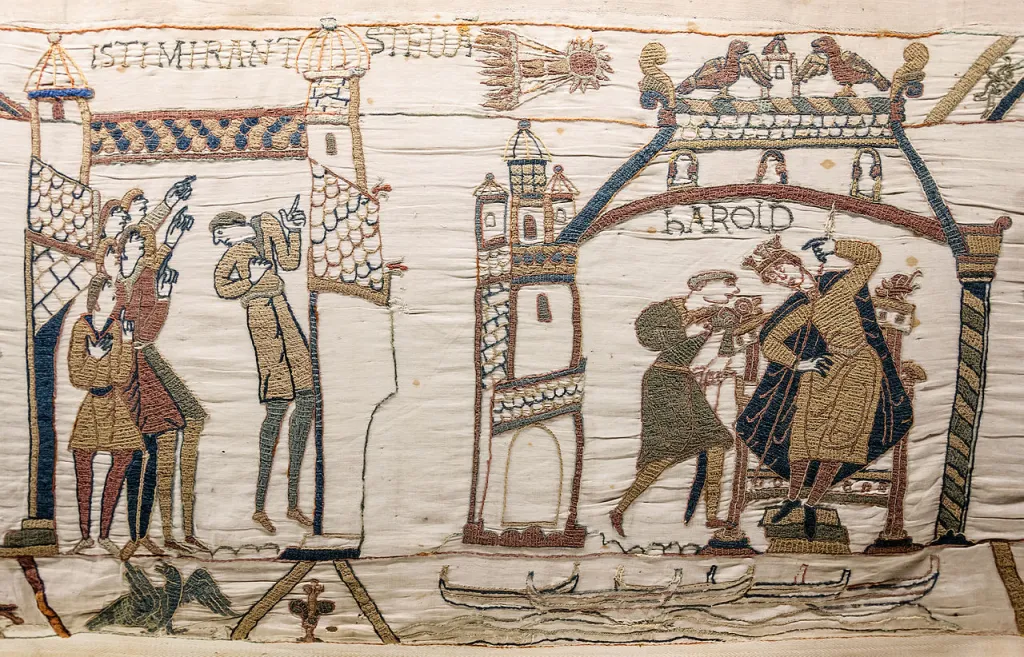
Cueing a collective sigh of relief on both sides of the English Channel, the millennium-old Bayeux Tapestry was not damaged during its contested voyage from France to London’s British Museum, according to French culture ministry officials, speaking to AFP on Thursday.
“I am able to confirm that there was no visible alteration and that the tapestry traveled well,” said Delphine Christophe, France’s general director of heritage and architecture, speaking Thursday, July 16, after the medieval tapestry was unpacked for the first time since its historic arrival in England on July 10, where it is being loaned in a diplomatic gesture of goodwill from France.
The tapestry was boxed in a suspended casing designed to reduce shock waves during its secret, meticulously planned transport by truck from Normandy, and it was only removed yesterday to allow the linen and wool weave to acclimate. Indeed, the nearly 1000-year-old tapestry is so delicate and carries pre-existing damage from having survived wars, dodgy exhibition methods, and restoration efforts, that in many places, it is literally hanging by a thread.
At some point on Friday, the tapestry was due to be unfurled on a very long table with the help of 100 members of staff. Then, France’s culture minister, Catherine Pégard, was scheduled to see it. “I don’t know her, she’s new, but I expect she’s formidable. All French culture ministers are,” quipped George Osborne, British Museum chairman, speaking at a boardroom at the British Museum yesterday, prior to its unpacking, reported the Times of London. He added that “French colleagues” have been involved with every stage of the relic’s transfer, before its public display in the British Museum starting in September.
Many in France and elsewhere have objected to the tapestry’s removal from the Musée de la Tapisserie de Bayeux in Normandy, where it has been exhibited since 1983. However, their arguments were overruled by subsequent expert studies and a ruling by France’s highest administrative court, the Conseil d’Etat.
The incomplete, 70-meter-long embroidered artwork, which depicts events leading up to the Battle of Hastings and the 1066 Norman Conquest of England, is thought to have been made in Canterbury, England, and possibly brought to Bayeux in France soon afterward. The first known mention of it is in the 15th century, as part of the Bayeux Cathedral’s long-held inventory.
Barring its creation, the tapestry, which narrates a moment in English history that forever changed the country’s language, culture, and legal system, had not been back in the UK until this month, underscoring the historic nature of the loan.
“As far as Britain’s history is concerned, what other exhibition could be as significant?” Osborne asked at the same boardroom meeting. “Magna Carta is just a document. Stonehenge isn’t leaving Wiltshire any time soon. I think there will be a tremendous wow factor when people see the tapestry.”
That brings us to the next big challenge: getting hold of tickets. Osborne said that up to a million people are expected to visit the tapestry over the 10 months it is on view at the British Museum. The first 100,000 tickets were sold in a flash, but the museum says more batches will go on sale progressively, so stay tuned.


