


Georg Baselitz, a preeminent painter of postwar Germany and an engine of the 1980s Neo-Expressionist movement that rebuked Minimalism, and who would later come under fire for his comments about women artists, has died at 88. His death was first announced in a press release by Thaddaeus Ropac, one of the galleries that represented the artist.
Baselitz exploded into the German art consciousness in the 1960s with a formal grit matched by tormented subject matter: his breakout “Heroes” series (1965–66) features bloated, blocky figures balancing on ruined buildings and toppled flags. Through his eyes, postwar German society appeared raw and taut as an exposed muscle. Next came his “Fracture” series, which sees axemen and prey alike torn into strips and stitched back into mythic Germanic forests—“wounded landscapes,” as he described them.
Baselitz pushed figuration beyond recognizable form into abstraction—ultimately, and famously, flipping the medium itself: his experiments culminated in his signature upside-down portraits and landscapes, both genres apt for his unique dissection of masculinity. This visual vocabulary emerged in The Man at the Tree (1968) and The Wood on Its Head (1969), and later devolved, with his subjects abstracted to the point of pulp.
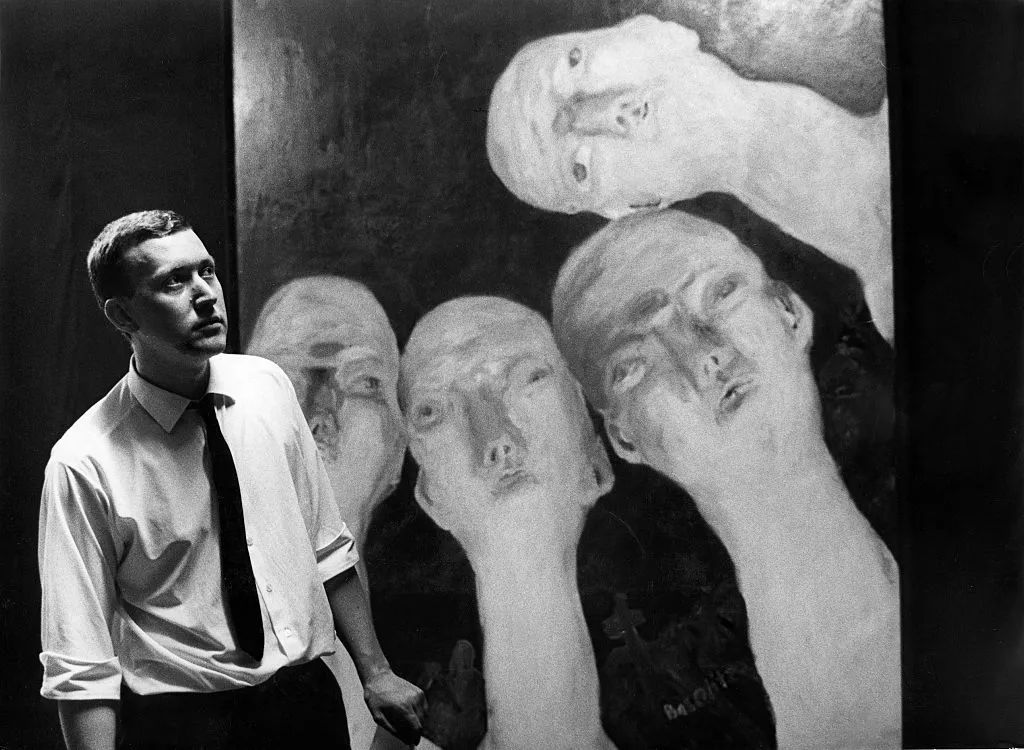
An installation view of “Georg Baselitz. Die Helden” at Frankfurt’s Staedel Museum in 2016.
Corbis via Getty Images
He “taps into one of German art’s oldest themes – the omnipresence of death and inevitability of decay,” critic Jonathan Jones wrote in the Guardian in 2016. “Just as Renaissance artists saw the skull stare back at them from the mirror, so this modern master faces human decline and sees a strange beauty in it.”
By the 1980s, Baselitz’s profile began to expand beyond Germany, when he was exhibited in dialogue with figurative painters sharing his expressionist leanings, including Italy’s Sandro Chia and Francesco Clemente. His place in contemporary art history grew more complex as, alongside German contemporaries such as Anselm Kiefer, he rebuffed the preceding decade’s en vogue movements of Minimalism and Conceptualism.
Hans-Georg Bruno Kern was born in 1938 in Deutschbaselitz, a village outside Dresden, during the height of Nazi rule. His father, Johannes Kern, a schoolteacher, was required to join the Nazi Party—a membership that, in the postwar period, led to his being barred from teaching by the East German government. His mother, Lieselotte, began teaching to support the family, while a young Hans-Georg studied social realism in East Berlin. (The artist would take Baselitz, the latter half of his hometown, as his surname in 1961, after he left East Germany.)
Interviews and anecdotes from Baselitz and his peers over the years paint a portrait of a charismatic, talented student—albeit one with authority issues: He was expelled from art school in 1957, after which he moved to West Berlin to study at the Staatliche Hochschule für Bildende Künste. As a young art student in Communist East Germany during the mid-1950s, he recounted, “you could paint realistically or abstractly. Realism was linked to socialism while abstraction meant you supported capitalism.”
Studying in West Germany in 1958, Baselitz had a pivotal encounter with Abstract Expressionism when the Museum of Modern Art’s survey of Jackson Pollock traveled to the Hochschule. Alongside the Pollock exhibition was another MoMA show, the landmark “New American Painting.” “It was so incredible,” he said. “I could touch it.” Seeing works by Pollock, Clyfford Still, Philip Guston, and Willem de Kooning, Baselitz recalled that he “felt I could not be better than they were.” So he decided to remain firmly a figurative artist—or, as he put it, “I didn’t take part in this modern style. It was an existential decision. I remained an outsider.”
As a young artist, Baselitz first drew attention in Berlin’s then small art scene, via a two-person exhibition alongside his peer Eugen Schönebeck. The exhibition poster doubled as a manifesto, titled Pandamonisches Manifest I, 1. Version (Pandemonium Manifesto, First Version), a portion of which he authored read: “In me there are prepubertal enclaves [the smell when I was born]; in me there is the greening of youth, love in decoration, the tower-building idea.”
Artist Carroll Dunham, writing in Artforum in 2018 on the occasion of Baselitz’s exhibition at the Hirshhorn Museum and Sculpture Garden, described his early work as “provincial” in light of his mature oeuvre, “but it must be understood as his rebellion against both the political and academic proscriptions of his art education under Communism, and against the timid postwar abstractions being made in a still thoroughly traumatized Germany.”
His first solo exhibition of paintings, in 1963 at Galerie Werner & Katz in Berlin, provoked a critical uproar. Labeled “disturbing” by visitors, the works introduced his signature palette of decay. Die große Nacht im Eimer (The Big Night Down the Drain), made that year, depicts a figure of indiscernible age with a cadaverous pallor and yellow splotches, brandishing an oversized phallus beneath a soot-black veil. Art historian Klaus Gallwitz described the motif as representative of anxiously performed masculinity: “The shape of the face, like the upper body covered with informal brushstrokes, has no other physiognomic features apart from the eyes and a large ear,” Gallwitz said of Die große Nacht im Eimer.
Baselitz’s longstanding conceptual entanglements of power, masculinity, and art were cast in a stark new light in 2013, when the artist told Der Spiegel, “Women don’t paint very well.” Despite swift backlash, two years later he reiterated the view in an interview with the Guardian, arguing that when it comes to the talent of women painters and how much their work sell for: “The market doesn’t lie.”
“Even though painting classes in art academies are more than 90% made up of women, it’s a fact that very few of them succeed,” he said. “It’s nothing to do with education, or chances, or male gallery owners. It’s to do with something else, and it’s not my job to answer why it’s so. It doesn’t just apply to painting, either, but also music.”
Doubling down, he rejected the idea of structural bias in favor of male artists, instead attributing the disparity to a personal failing: “What does it matter so much? If women are ambitious enough to succeed, they can do so, thank you very much. But up until now, they have failed to prove that they want to. Normally, women sell themselves well, but not as painters.” (The comments resurfaced among critics in 2019 amid the broader #MeToo movement, which had exposed sexual misconduct by powerful men across virtually all sectors of arts and culture.)
That year, Gagosian New York opened “Georg Baselitz: Devotion,” which prominently featured portraits by Baselitz paying homage to painters he had encountered in his formative viewing of New American Painting, as well as portraits of his peers. As ARTnews noted at the time, almost all of the living artists depicted in the show were women (including Cecily Brown and Tracey Emin), most of them born in the years just before and after his first solo show in 1963.

Baselitz posing in front of a self-portrait during an exhibition of his work in Baden Baden in 2009.
DDP/AFP via Getty Images
Baselitz courted controversy of a different sort shortly after, during the Covid-19 pandemic. He was among those in Germany who decried government measures intended to curb the spread of the disease, including the Infection Protection Act, under which districts or towns could be ordered to close if there were more than 100 Covid cases in a seven-day period. In an interview with Welt am Sonntag in 2021, he dismissed the “horror stories” about Covid on primetime news as “bullshit.”
Baselitz later resigned from his post at the Bavarian Academy of Fine Arts, a prominent art association in Munich, as its then-president Winfried Nerdinger became embroiled in controversy following criticism of lockdown policy. Nerdinger had accused the German government of viewing artists as “completely unimportant” due to the temporary closure of art spaces. Baselitz said he resigned in response to the backlash against Nerdinger, not the remarks themselves, calling the protesters’ behavior “disgusting.”
Baselitz’s reputation, however, absorbed each controversy and seemed little impacted by it. In the last five years, it has been reinforced by solo exhibitions at the Munch Museum, the Morgan Library & Museum, the Metropolitan Museum of Art, the Pinakothek der Moderne, and the Centre Pompidou, among others worldwide. His litany of honors includes the Légion d’Honneur and the Chevalier de l’Ordre des Arts et des Lettres in France, Austria’s Decoration of Honour for Science and Art in Vienna, and an honorary professorship at the Academy of Fine Arts in Kraków. He has repeatedly shown in the Venice Biennale–related events, collateral or curated exhibitions, starting in the 1980s.
In interviews conducted late in his life, he often returned to his past, retrospectively locating the start of his artistic journey to the destruction of Dresden by Allied bombing raids in early 1945. “I always thought that what I do is real-life melancholy,” he said. “Being dystopian means nothing other than inventing a bad future. The utopians invent paradise and the dystopians invent hell. But both are futures. And my position is far away from this. I do not reflect into the distance.”
He is survived by his son, the art dealer Anton Kern.
