


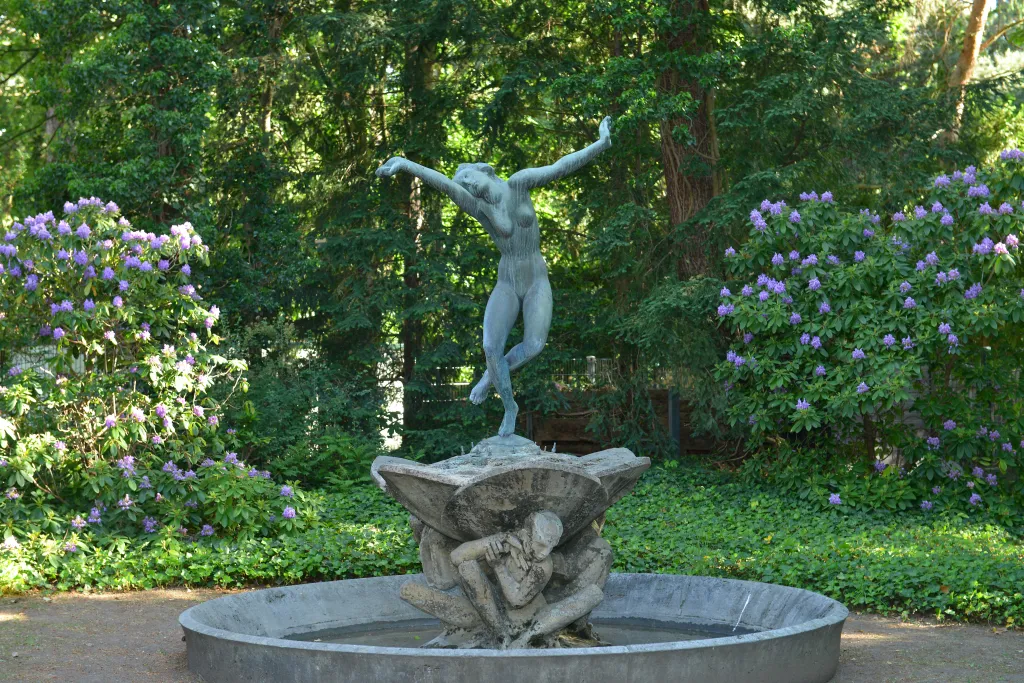
A landmark sculpture by renowned German artist Georg Kolbe will be removed from public display in Berlin and returned to the heirs of the Jewish family who lost it under Nazi persecution.
The 1922 work, Tänzerinnen-Brunnen (Dancers’ Fountain), stood for nearly five decades in the garden of the Georg Kolbe Museum and had become one of its most recognizable pieces. After an extensive provenance investigation, the museum concluded that the sculpture must be restituted because it is regarded as “cultural property looted as a result of Nazi persecution,” museum director Kathrin Reinhardt said.
The fountain was commissioned in 1922 by a wealthy Jewish insurance executive and art collector, Stahl, who later served as head of Berlin’s Jewish community. He installed the bronze sculpture in the garden of his villa in the leafy Dahlem district, where it became a centerpiece of the property.
Kolbe, one of Germany’s most prominent early 20th-century sculptors, was celebrated for his dynamic bronze figures of dancers and athletes. Created during the vibrant cultural years of the Weimar Republic, the fountain reflects his characteristic style: expressive, fluid female figures arranged in rhythmic movement around a basin.
Stahl’s life was upended after the Nazis came to power in Germany in 1933. By 1941, amid intensifying anti-Jewish measures, he was forced under racial laws and economic coercion to sell his home and the sculpture for a price far below their true value. The museum has now characterized the deal as a “persecution-related loss.” Shortly afterward, he and his wife were deported to the Theresienstadt concentration camp. Stahl was murdered there. His widow survived and emigrated to the US in 1950.
Reinhardt said the institution regards the sale as involuntary and morally indefensible. “What was done to Stahl—not only the expropriation itself—is an unforgivable and immeasurable injustice,” she said, adding that securing a fair and just solution with the heirs had been a top priority.
The restitution follows years of research into the sculpture’s ownership history between 1933 and 1945, a period that has come under increasing scrutiny in German museums. Under the 1998 Washington Principles on Nazi-Confiscated Art, Germany committed to identifying and returning works looted or sold under duress during the Nazi era. In recent years, institutions across the country have expanded provenance research efforts, resulting in a growing number of restitutions.
The Georg Kolbe Museum, housed in the sculptor’s former studio building in Berlin’s Westend district, said the decision was made in agreement with Stahl’s descendants. Discussions are ongoing about the future of the sculpture, including whether it might remain accessible to the public in some form.
