


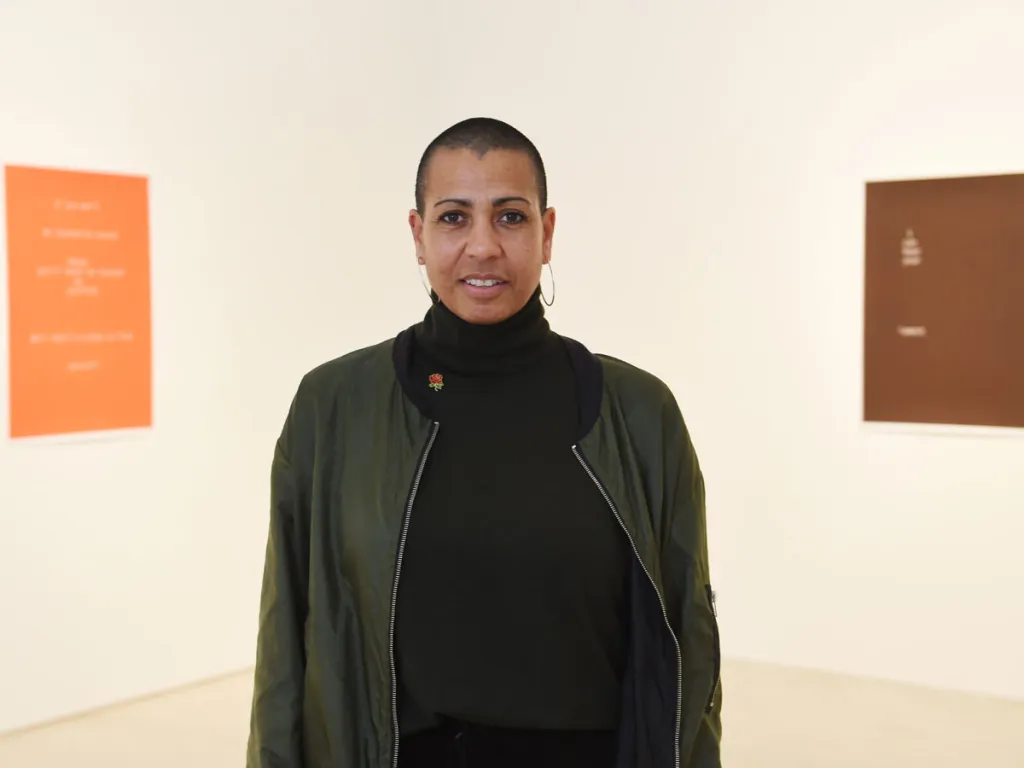
A video work by Helen Cammock that has been on view at the National Portrait Gallery in London for nine months has recently sparked controversy for its claim about former British Prime Minister Winston Churchill’s role in the Bengal famine of 1943.
In the 40-minute video, titled Persistence (2025), Cammock, who won the Turner Prize in 2019, mentions Oliver Cromwell’s conquest of Ireland, which included a famine. In her narration, according to the Guardian, she says, Cromwell “starved people, en masse, a little like the wilful starvation of the Indian population by Winston Churchill.”
The controversy was first stirred up in the conservative British newspaper the Telegraph earlier this week, when arts correspondent Craig Simpson wrote that Persistence “criticises a number of national figures depicted in the taxpayer-funded gallery, and incorrectly claims that Churchill ‘wilfully’ inflicted mass starvation on Indians” and that it “suggests that Churchill used mass starvation as a weapon of war.”
Simpson followed up that article that reported that Andrew Roberts, Baron Roberts of Belgravia, who had published a 2018 biography on Churchill, had called the claim a “barefaced lie.” Roberts had also reportedly written a letter to the NPG’s board about the work, which had 50 signatories, including Churchill’s grandson. The letter characterized the film as “ideologically motivated rant,” per the Telegraph.
While defenders of Churchill have claimed that his policies did not cause the famine, a 2019 study that looked at weather data from the period provided “scientific backing for arguments that Churchill-era British policies were a significant factor contributing to the catastrophe,” according to a Guardian article from the time of the study’s publication.
In a statement sent to ARTnews, Cammock did not directly address the controversy or the claim about Churchill, writing, “The work I made across a year is a 40-minute moving image work which thinks about the role of the portrait historically and then its relevance today. It considers who is honoured and valorised and who is not; whose stories are told and whose are not. The piece thinks about how histories are created and then maintained and how the portrait is inextricably linked to systems of social and economic power.”
Her statement continues, “The piece required research—both in and outside of the National Portrait Gallery’s archives and collection. Across the work I touch on many different histories and stories—some of which are directly present in the collection and archive and some of which are tangential conversations across different themes, drawn from the collection—both what it contains and what is absent.”
A statement from the NPG adds, “At the National Portrait Gallery, in addition to our own permanent collection displays, we also give opportunities to artists to create works of art in response to our collection. This work by Helen Cammock, which was commissioned in 2023 and has been on temporary display at the NPG since September 2025, is created and narrated by the artist and includes her personal reflections on historical and current events. We support freedom of artistic expression while not necessarily endorsing the opinions expressed by any of the artists shown at the Gallery.”
Persistence was commissioned by the NPG in December 2023 as part of the “Artists First: Contemporary Perspectives on Portraiture,” an exhibition spread throughout the museum’s galleries that features commissions from eight artists in addition to Cammock, including Mary Evans, Charmaine Watkiss, Małgorzata Mirga-Tas, and Mary Reid Kelley and Patrick Kelley.
The aim of the exhibition is to reserve one of the NPG’s founding principles of collecting portraits that focus on “the celebrity of the person represented rather than the merit of the artist” by “foreground[ing] the artistic vision of nine contemporary artists who were invited to create work in dialogue with the Gallery’s permanent Collection,” according to an exhibition description, which adds that these commissions “challenge the roots of portraiture and rethink its potential for today and for the future.”
Persistence includes shots of the NPG’s building, its archives, and works on view in its galleries, as well as other locations. Also included are historical figures like Ethel Smyth, Ada Lovelace, and Charlotte Mew. “The combination of subjects and sources,” an NPG description of the work reads, “intends ‘to speak to ideas around absence and presence and power’. Portraiture – understood as a conduit for the affirmation of power and presence – is at the heart of Cammock’s layered images and voices in what she understands as a collective portrait focused on the ‘reimagining, retelling and recentering’ of absence.”
In her statement, Cammock added, “Persistence asks us to consider the presence of multiple histories. Nina Simone once said, ‘An artist’s duty, as far as I’m concerned, is to reflect the times,’ and sometimes this means revisiting, enquiry and challenge. The National Portrait Gallery is an incredibly important public resource and as such it’s vital that it continues to engage in dialogue about the works that it is custodian of, and their relevance historically and to a range of contemporary understandings of the world we live in.”
