


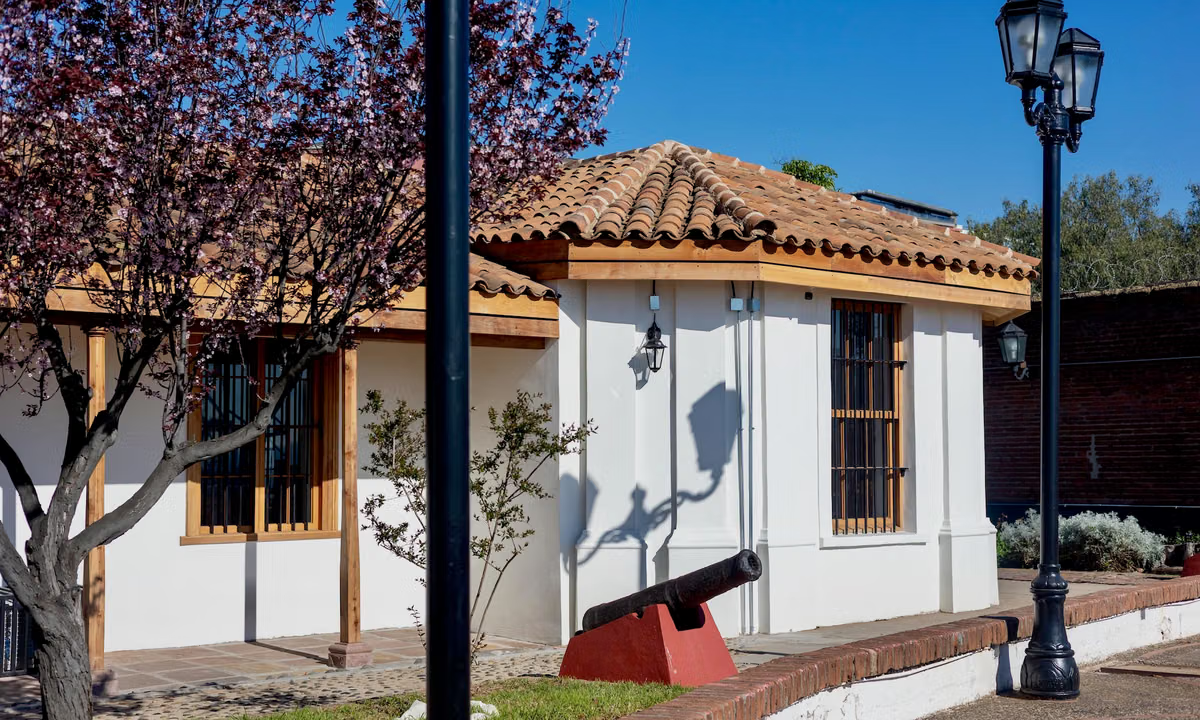
Casa Mouat, one of the most important homes in Valparaíso, Chile, will reopen to the public on 7 September after a major conservation project that lasted for more than a year. Chile’s National Service for Cultural Heritage led the $1m conservation of the 19th-century adobe structure.
Located in the middle of a Unesco World Heritage Site, the building recently housed the Lord Cochrane Museum of naval history. The municipality of Valparaíso managed the site, organising cultural and artistic activities until 2019. Since 2020, the cultural ministry has overseen Casa Mouat and its 2,325-sq.-m grounds.
“The conservation project involved preserving the doors and windows, the laurel-wood floorboards, the ceiling, baseboards, cornices, roof, exterior corridor columns made of raulí wood and interior larch pillars,” says Carolina Sepúlveda, the head of the service’s heritage project management department. The exterior work included the conservation of 18th-century cannons on the property, the remnants of an old fort.
“The most important thing was the replacement of the roof, which was damaged by the rains,” says Macarena Carroza, the director of the municipal corporation for the administration of the Valparaíso World Heritage Site. “It no longer leaks! This year, it withstood the worst storms and held up well.”
Inside Casa Mouat, Valparaíso, Chile Photo: Juan Guajardo, courtesy the Chilean Ministry of Cultures, Arts and Heritage
Overlooking Valparaíso Bay, Casa Mouat stands on land that was once the grounds of San José Castle, a 17th-century fort and one of the port’s most important defensive structures during the Spanish colonial era. An earthquake in 1822 destroyed the castle and, years later, the land was subdivided and auctioned off.
In the early 1840s, the Scottish watchmaker John Mouat bought one of the plots of land, where he built his home. He constructed the first astronomical observatory on the Pacific coast of the Americas on his property in 1843.
After Chile’s independence from Spain in 1818, Valparaíso became a financial, commercial and technological centre driving the country’s development. The Edinburgh-born Mouat had arrived at a thriving port, which attracted immigrants from Europe and the Middle East. He embarked on several projects, making contributions to astronomy, meteorology and navigation.
“Mouat’s observatory was the second on the continent after the Hopkins Observatory, completed in 1838 at Williams College in Williamstown, Massachusetts,” Luis Paredes Rojas, a former president of the Astronomical Society of Valparaíso and Viña del Mar, tells The Art Newspaper.
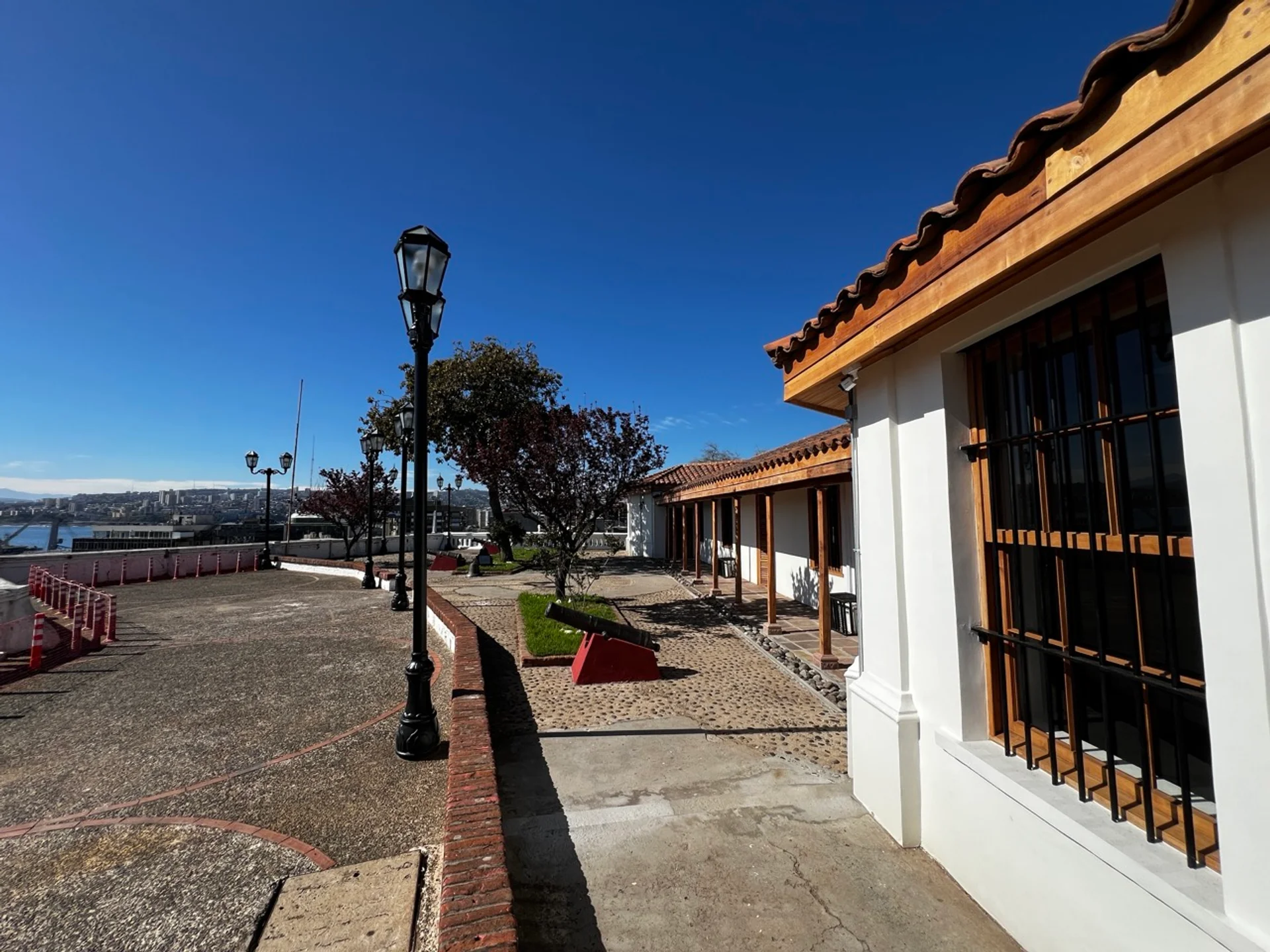
The grounds at Casa Mouat, Valparaíso, Chile Photo: Graciela Ibáñez
Mouat was committed to the progress of his adopted country, and his community in Valparaíso considered the sciences (particularly astronomy) an indicator of progress.
“From 1843 onward, the observatory provided detailed information on the port’s atmospheric conditions, which were communicated through small reports in El Mercurio de Valparaíso,” notes an article published in 2025 in the academic journal Revista 180. “These reports offered relevant data on weather, especially wind conditions. The information was fundamental for navigation, much of which was still carried out by sail. Thus, in supporting port operations, the observatory became strategic infrastructure.”
El Mercurio de Valparaíso, founded in 1827, is the world’s oldest Spanish-language newspaper still in circulation. In 1843, it published a story titled: “An Astronomical Observatory in Valparaíso!”
In 1863, Mouat went bankrupt and lost his colonial-style house and the observatory’s instruments. He fought to recover the instruments, even appealing to the supreme court, to no avail. Plunged into poverty, Mouat died in Valparaíso in 1871. His property went through more than ten owners, until it was declared a National Historic Monument in 1963 thanks to the effort of the Chilean poets Sara Vial and Pablo Neruda, who won the Nobel Prize in Literature in 1971.
The newly conserved Casa Mouat will temporarily host the Valparaíso Regional Archive before it moves to a permanent location in the port district. The building will also house an information centre about the broader Unesco World Heritage Site.
