


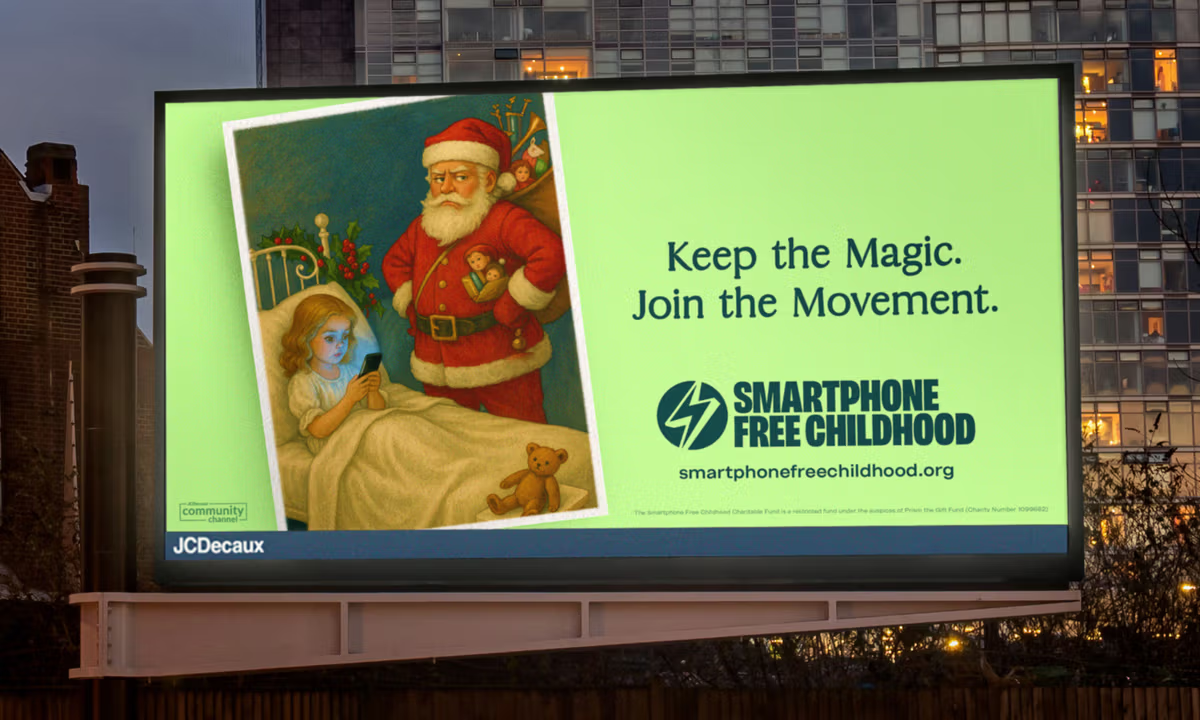
I suspect many New Year’s resolutions for 2026 will include spending less time doom scrolling on social media (I know mine will). In the art industry—where self-promotion and exhibitionism seem mandatory—it can feel impossible to resist the pull of social media. But people are becoming increasingly aware, and concerned, about the negative impacts of such online platforms on both physical and mental health, particularly on the younger generation. In the UK over the festive period, a nationwide billboard campaign from the advocacy group Smartphone Free Childhood showed vintage Christmas card-like scenes, but rather than children “with eyes all aglow”, their faces are absorbed in the glowing light of a mobile phone. Beside it are the words: “Keep the magic. Join the movement.”
Australia has made a major step forward in this movement with its recent ban on social media for children under the age of 16. “Being logged into an account increases the likelihood that [children will] be exposed to pressures and risks that can be hard to deal with,” says the Australian government’s website on online safety. “These come from social media platform design features that encourage them to spend more time on screens and make it more likely that they will see negative, upsetting or manipulative content.” Coming into effect on 10 December, online platforms—including Meta (Facebook, Instagram, Threads), TikTok, YouTube, X and Reddit—“will need to take reasonable steps to prevent Australians under 16 from having social media accounts”, according to Australian government guidelines.
For many Australian museums and art institutions, the new law will likely require a pivot in terms of social media content and strategy. “We expect that taking social media out of the picture will have an impact for some institutions,” says Katie Russell, the national director and chief executive of the Australian Museums and Galleries Association (AMAGA), noting that the effects will depend on the specific demographics and remits of institutions as well as how active or not they are with social media and which platforms they use.
However, Russell notes that “increasingly teenage audiences are a focus for museums and galleries in Australia,” adding that “some social media platforms are used strategically to engage these audiences—platforms like TikTok, for example, have offered museums and galleries opportunities to communicate their content and collections in new ways, often playfully, engaging younger audiences with cultural collections.”
An advert from Australia’s eSafety Commissioner on the new age limits for social media Courtesy of the eSafety Commissioner
While the negative impacts of social media, on children and adults alike, are well documented, there are upsides to online platforms. In December, the Queensland University of Technology published a report titled “Young Australians’ perspectives on the social media minimum age legislation” in which under-16s talked about the ways that social media has facilitated important relationships and supported their learning. Social media content at museums around the world has increasingly been moving towards innovative story telling and educational material geared particularly towards a younger demographic.
Some Australian art institutions have said that they expect the ban to have little effect. “Given that under-16s have historically represented a very small proportion of our social media audience (only 0.2% of our Instagram followers are aged 13–17), the new law is anticipated to have minimal impact on the art gallery’s current content strategy and social media engagement metrics,” a spokesperson from the Art Gallery of New South Wales tells The Art Newspaper. “Our priority is to ensure compliance with the law while continuing to deliver accessible digital experiences.”
Others that have larger numbers of young fans may have a different experience. The Museum of Contemporary Art Australia (MCA), for example, attracts a young demographic through its doors, with 50% of its visitors under the age of 35, according to a museum spokesperson. “Youth engagement is very important to MCA, and we provide options for all ages to engage across our platforms, programs and events—including our website, e-newsletters for families and parents, free access to the museum for under 18s, free group visits for school and tertiary students, and deep engagement through selected school and community outreach programs,’ they add. It will be interesting to see if the ban will materialise into a drop in overall numbers in Australia in The Art Newspaper’s annual tally of museums’ social media followers.
Interestingly, Russell says that the social media ban goes beyond access to, and for, teenage audiences. It “poses questions for museums and galleries about social media as museum objects—a generation of young people were using social media to connect with their friends and the world, to create communities and in many cases to form their identities and career pathways,” she says. “The realities of social media use are part of our society and history and speak to how communication and human connection has changed over time. As social media becomes regulated in different ways, museums and galleries have a role in collecting and representing the human experience of social media for future generations. This is the important role of museums and galleries, that should be considered when thinking about the ongoing and increasing regulation of social media.”
