


Editor’s Note: This is an excerpt from Street Style: Art and Dress in the Time of Caravaggio by Elizabeth Currie. It releases in December from Reaktion Books.
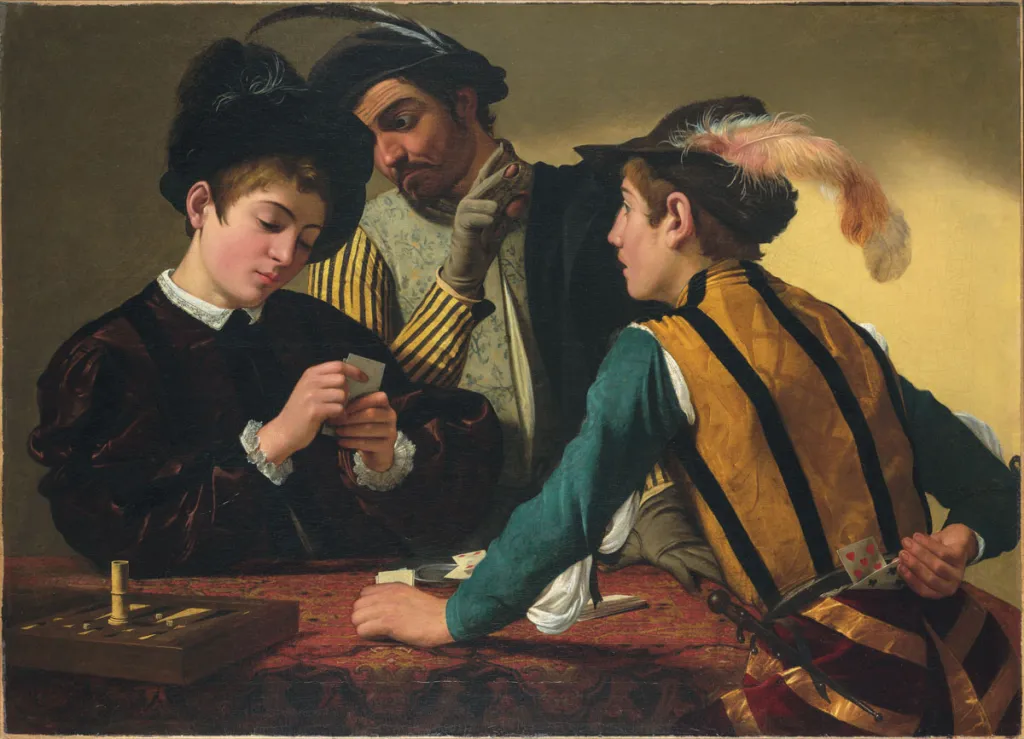
More than any other work by Caravaggio, closely observed fabrics and dress styles are fundamental to the narrative of The Cardsharps. The differences between the figures’ garments are juxtaposed to provide clues about their relationship and possible identities. Of the three, the naive youth on the left is shown in the finest, most luxurious materials. He is the only one to wear a doublet with set-in sleeves, generously cut from a deep mulberry satin and decorated with black velvet guards, restrained hues typical of the attire of elite men. He is further distinguished by his linen shirt with starched, ruffled cuffs and skilful embroidery, all emblems of refinement. Nevertheless, the other figures’ clothing also demands our attention. The painting illustrates fashion’s ability to complicate social hierarchies, making the marginalized more visible thanks to an increas- ingly dynamic clothing cycle that facilitated the circulation of garments through retail, recycling and exchange.
The figure with his back to us, described by Bellori as a ‘fraudulent youth’, is the most colourful.58 He is often identified as a bravo, based on possible similarities between his dress and Vecellio’s Venetian bravo. However, his striped, predominantly yellow doublet and breeches could imply he is a liveried servant, possibly even a footman.59 The fine hairs above his upper lip suggest that he is around eighteen years old and slightly more mature than his finely dressed opponent. Footmen were often relatively young and wore liveries because their role included escort- ing their employers as they moved around the city. Frequently doubling up as bodyguards, they were known for carrying weapons, as the card- sharp does here.60 Wealthy Romans were sometimes distrustful of the behaviour of lower-ranking servants, and tales circulated about serv- ants misusing or gambling away their liveries. It is likely, then, that the showy outfit in The Cardsharps would have prompted mixed reactions among viewers.
In Evitascandalo’s view, although liveries belonged to employers it was the responsibility of servants to keep them neat, clean and free from rips or stains. He claimed that some servants deliberately spoiled their clothing so that their old livery would be given to them to keep and be replaced with new garments. At the Florentine court, punishments were introduced for servants who lent their livery to other people who wanted to disguise themselves as members of the grand ducal household. The fictional Guzmán loses his livery after using it as collateral for his gambling debts. He reflects:
<block>Neither do I know that master that will give bread to that servant that is a gamester . . . For having spent a whole day and night in play, and having lost all the money that I had, and when that was gone, all my clothes, having nothing left me to cover my nakedness, but a poor thin doublet, and a pair of white linen drawers . . .</block>
After this incident, Guzmán is rapidly dismissed from his position. Of the three figures in The Cardsharps, the central player is the most dishevelled, with holes cut in the tips of his gloves to feel the surface of marked cards, his doublet unbuttoned and his ill-fitting sleeves stretching at the seams. He is usually referred to as a bravo, although it has also been suggested he is a Romani man.65 Depictions of these two groups often employed the same visual markers, and the ambiguity might well have been intentional, allowing viewers to interpret the image as they pleased. Bravi and Roma were conflated in some theatrical representations, while the character Spuletino, from the comedy The Theft (1544) by the Florentine dramatist Francesco d’Ambra, ‘is called Zingano [Gypsy] and is the best card cheat in Rome’.66 In the late sixteenth century, Roma appeared alongside bravi and vagabonds in public proclamations expelling them from Rome, and trial records provide evidence of Romani men joining groups of bandits in the surrounding countryside.67 The illustration of a Romani man in Desprez’s costume book has much in common with depictions of bravi. Unlike the other two men in The Cardsharps, the older figure is the only one to wear a cloak. It is an unnec- essary addition as the scene takes place indoors, but it compounds his rather menacing presence given the use of cloaks as disguises for criminal activities.
In Giulio Campi’s The Chess Game (1530–32), sometimes seen as a Lombard precedent for The Cardsharps, the figure in the background looking out at the viewer might also be a Romani man (see illus. 4).68 He has the same dark hair and moustache as another possible Romani soldier or bravo in Palma il Vecchio’s Allegory (c. 1510–15). Handlebar moustaches were often depicted on men belonging to both these groups, as in Jacques Callot’s Bohemians series, and were broadly associated with soldiers and bandits. Indeed, in 1600 police in Rome were ordered to cut off men’s long locks, such as ‘a mop or a forelock down to the ears on both sides, or a quiff like a bandit’s’. The fact that the older cardsharp’s sleeves are woven with stripes, as opposed to the usual appliquéd black bands, adds further weight to this view. Stripes had long been linked with lower social groups, illustrated by the parti-coloured stockings of household liveries or soldiers’ doublets and breeches. As striped fabrics were rare in Italian fashionable dress, they were also used to denote indi- viduals from another country, ethnicity, race or religion. Caravaggio’s The Cardsharps and The Fortune Teller belonging to Del Monte were painted close together. Although of different sizes and not conceived as a pair, they are complementary in terms of theme and composition. They were displayed together in the cardinal’s palace for decades, and the possible appearance of a Romani figure in both paintings, representatives of a social group that inspired so much fascination and myth-making in art and literature at the time, might have been an extra talking point among visitors.
The men’s caps and feathers are also meticulously differentiated. The two younger men both wear ostrich feathers. Usually imported to Europe from North Africa, the most prized examples were light and buoyant. In keeping with his more discreet outfit, the dupe has a restrained pair- ing of undyed black and white feathers, while the young cheat’s dusky pink and white feathers are fluffier and more mobile, increasing their desirability but also inviting criticism. Feathers were linked to soldiers and bravi, their flamboyancy often ridiculed by contemporary authors, and the 1532 sumptuary law attempted to ban men from wearing them in Rome. In Ripa’s Iconologia; or, Moral Emblems, the human senses are represented by a frivolous young man dressed in many colours with a feather in his cap ‘because the senses change easily just as a feather moves in the slightest wind’. For Garzoni, feathers implied the superfi- cial nature of the bravo, who thinks that looks speak louder than actions. In the morning, ‘they get out of bed and pull on their hose . . . with their plumes, whether black or white, they flutter fearlessly about, so that they will be taken for the boldest swordsmen on earth.’ Given their fragility, feathers needed careful handling and preparation, especially if they were dyed, and the younger men’s feathers might have been purchased from a specialist artisan. The cardsharp’s pink and white plumes are particu- larly prominent in the composition, occupying an otherwise blank area of the canvas. Like the Spanish soldier’s ‘puff’noted by Guzmán, these feathers projected swagger, as implied by the expression ‘to give oneself airs’. In contrast with the others’ luxuriant, undulating and fashionable feathers, the older cardsharp’s one is thin and pointed. It comes from a domestic bird, perhaps a raven or the black sickle feathers of a cockerel, suggesting it might have been scavenged from a hedge or byway, lacking any intrinsic art or value. Similar examples permeate Callot’s ‘grotesque’ figures and his Bohemians series.
It has been questioned whether individuals like these would have been able to afford the garments depicted in this scene. The implication that they might be wearing stolen goods contributes to their ‘lowlife’ image. Certainly, thefts of clothing were very common. In 1596 second-hand dealers were forbidden from buying goods from suspicious individuals, and there are numerous cases of garments being stolen from prostitutes. In 1644 Gigli recounted that soldiers were causing unrest and carrying out thefts in Rome, and it was ‘dangerous to go out at night because they were stealing “in ferraioli” [cloaks that could be used to conceal goods and weapons], and some people almost got stripped down to their undershirts’. He added that soldiers were hanged for these crimes but that certain members of the public defended them, saying that they were forced to steal ‘because they hadn’t been paid for four months and were dying of hunger’.
At the same time, many people of limited means were able to acquire second-hand goods relatively cheaply, spending as much as they could on their clothing, as reflected in the fictional escapades of Guzmán. Even Bartolomeo Manfredi, who struggled to make ends meet and was arrested for owing 7 scudi to a barber, could cut a dash when he needed to, with one of his biographers noting his ‘very good dress’. Caravaggio was not unusual in opting to have one good outfit made of silk over a number of cheaper ones. Clothing was a canny investment as it could be resold, exchanged or pawned for other goods, money or services. When the sculptor David de la Riche was murdered, his room-mate Valentin de Boulogne paid for the funeral by selling his friend’s clothing, includ- ing the garments he was wearing when he died. In 1623, instead of a monetary payment, Nicolas Régnier received 20 metres of silk valued at 31 scudi for paintings of the four evangelists.
It was also possible to obtain household liveries through the second- hand market, undermining their association with a specific family. In 1604 Alessandro Orsini of Pitigliano died leaving substantial debts. After his funeral in Rome, his relatives auctioned off many belongings to repay loans, and even their black and turquoise household liveries, which raised substantially more than any other clothing items. They included thir- teen black cloth cloaks decorated with turquoise and black lace, with matching breeches and cassocks, plus 56 pieces of velvet from unpicked livery garments and haberdashery, such as shoe roses, lace and hat braid. Sometimes servants held on to items from a livery after their employ- ment ended. In 1557 a Flemish man wanted in Florence for unspecified crimes was identified partly through his clothing, such as a belt of mul- berry velvet, a remnant of the livery he had worn in the service of the Marquis of Pescara, the Sicilian commander-in-chief of the Spanish army in Lombardy and Piedmont. The close attention paid to the different material qualities and value of the garments in The Cardsharps suggests that Caravaggio was concerned with the realism of the image, while leav- ing questions surrounding their acquisition and ownership tantalizingly open to debate.
The clothing of bravi in genre scenes is eye-catching and dynamic, and it is not surprising that this style was sometimes emulated by men further up the social scale. However, it also generated much criticism. Rogues were thought to embody the folly of fashion and vanity, themes explored in many artworks. One increasingly popular strand of imagery depicted small-scale figures overshadowed by the classical ruins of Rome. Tavern scenes could be seen as the counterpoint to these landscapes. Instead of foregrounding the city’s magnificent surroundings, they reveal the day-to-day hustle of Roman life. In many paintings, revellers crowd around an ancient stone slab, covering it with their cards, dice and drinking vessels. This dramatic juxtaposition of the ancient past and transient present is effectively reinforced by the players’ bright silks, laces and wafting feathers.
Reprinted with permission from Street Style: Art and Dress in the Time of Caravaggio by Elizabeth Currie published by Reaktion Books. © 2025. All rights reserved.
