


Portraits are crucial to understanding Frida Kahlo: both those she made and those others made of her. Together, they reveal how the Mexican artist transformed the defining events of her life: from her first love and near-fatal bus accident to her turbulent marriage, distinctive personal style, and enduring cultural legacy.
This year, Tate Modern’s major exhibition brings together more than 200 works—those by Kahlo herself as well as pieces by artists she inspired. Through self-portraits, photographs, and contemporary reinterpretations, the exhibition examines both the experiences that shaped her art and the lasting influence she has had on future generations of artists. These five works offer a compelling introduction to the loves, losses, ideas, and acts of self-invention that shaped Kahlo’s life and helped transform her into a global cultural icon.
Frida Kahlo, Self-Portrait (With Velvet Dress), 1926
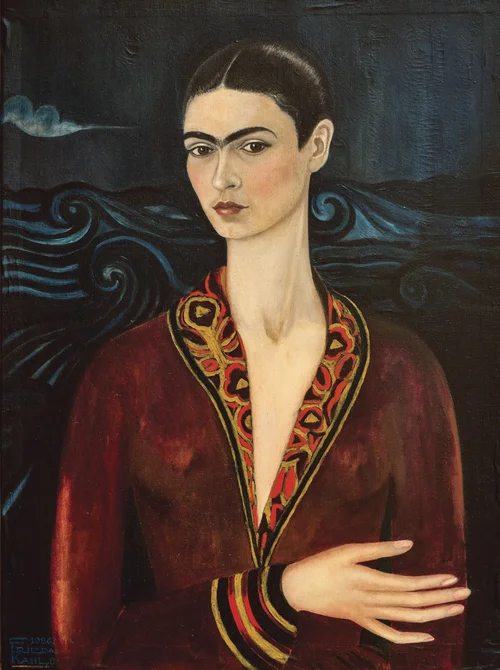
Painted when Frida Kahlo was just 19, Self-Portrait (With Velvet Dress) is widely regarded as her first self-portrait. The painting was made in the aftermath of the bus accident that changed Kahlo’s life. While studying at the National Preparatory School in Mexico City, Kahlo became part of the Cachuchas, a group of politically minded students and young intellectuals. Among them was Alejandro Gómez Arias, with whom she fell in love. It was during a day spent together that Kahlo boarded the bus that later collided with a tram, leaving her with life-altering injuries. After a month in hospital and a long recovery at home that forced her to leave school, Kahlo turned to painting and wrote often to Gómez Arias, sharing her fears about her injuries and uncertain future. When he failed to visit and their relationship began to fade, she created this self-portrait in the hope of regaining his affection.
The work reveals the influence of Renaissance portraiture, particularly Sandro Botticelli, whose paintings Gómez Arias admired. Kahlo presents herself with striking poise, her loose robe, embroidered collar, and low neckline projecting the image of a modern young woman. On the reverse, she dedicated the portrait to him and included the phrase “Today still goes on” in German, a message that can be read as an expression of endurance despite suffering. Her confident gaze and self-fashioned appearance already hint at the independence that would define her later work.
Frida Kahlo, Memory (The Heart), 1937
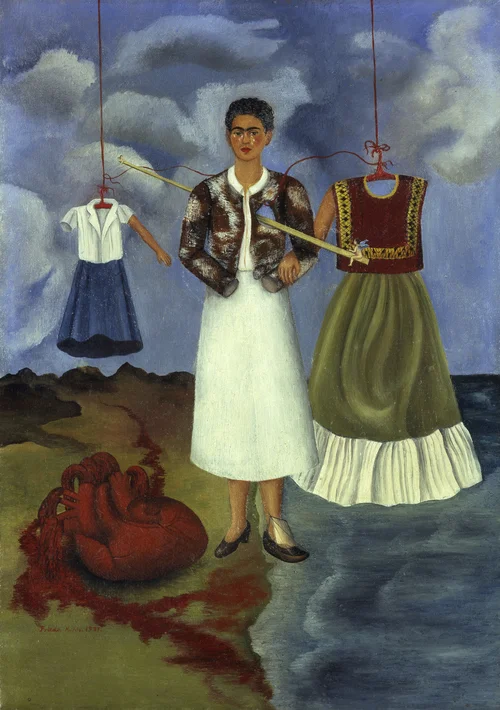
Diego Rivera was the great love of Frida Kahlo’s life and the source of some of her deepest pain. When the pair first met in 1922, Kahlo was a teenager and Rivera was already Mexico’s most celebrated muralist. They married seven years later, embarking on a relationship that took them from Mexico to the United States and would inspire some of Kahlo’s most powerful paintings. Yet beneath their public image lay a volatile relationship marked by mutual infidelities and recurring heartbreak.
The deepest betrayal of Kahlo’s marriage came in 1935, when she discovered that Rivera had been having an affair with her younger sister, Cristina. Painted two years later, Memory, the Heart depicts the artist standing between land and sea, tears streaming down her face. At her feet lies a giant severed heart bleeding into the water. On either side stand two empty versions of herself—a European-style school uniform and a Tehuana dress—each animated by a detached arm. One grasps a metal rod that pierces the hole in Kahlo’s chest, balanced by tiny Cupid-like figures at either end. Though Kahlo insisted that she painted her own reality rather than dreams, Memory, the Heart is a great example of her dreamlike imagery and psychological intensity that led many to associate her work with Surrealism.
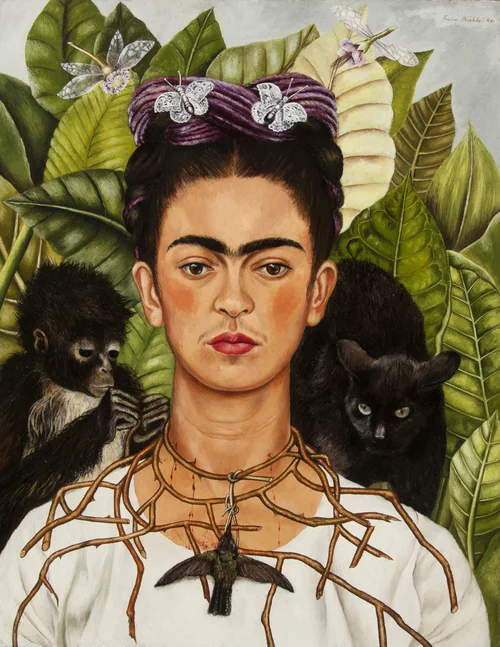
Frida Kahlo, Self-Portrait with Loose Hair, 1946
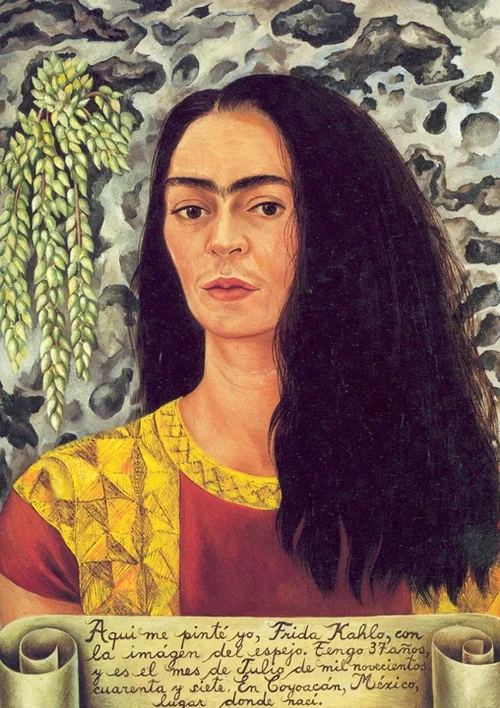
With its direct gaze, loose hair, and faint mustache, Self-Portrait with Loose Hair reveals Kahlo’s resistance to conventional ideals of femininity. Later, she would often depict herself with her hair arranged in the elaborate braids and floral headdresses that became central to her public image—or shorn off altogether in her celebrated Self-Portrait with Cropped Hair (1940), in which she appears in an oversized men’s suit. Here, however, she depicts herself with her dark hair flowing freely around her shoulders. Painted while recovering from spinal fusion surgery, the portrait presents an artist whose physical health was deteriorating but whose sense of self remained unwavering.
Kahlo’s self-portraits consistently blurred the boundaries of gender, combining traditionally feminine markers with features she refused to conceal, including her prominent eyebrows and faint facial hair. From the rise of feminist art in the 1970s to the present day, women artists across Mexico, the United States, and Europe have looked to Kahlo as a pioneering figure who challenged established ideas of femininity and used self-portraiture as a tool for exploring identity.
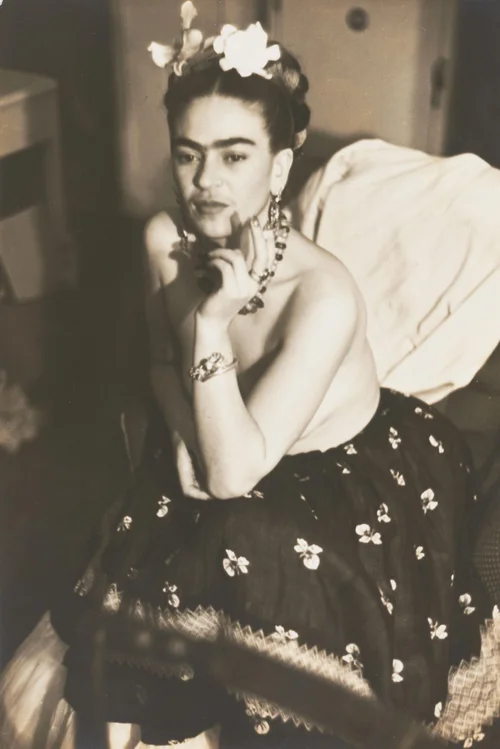
Nickolas Muray, Frida on White Bench, New York, 1939
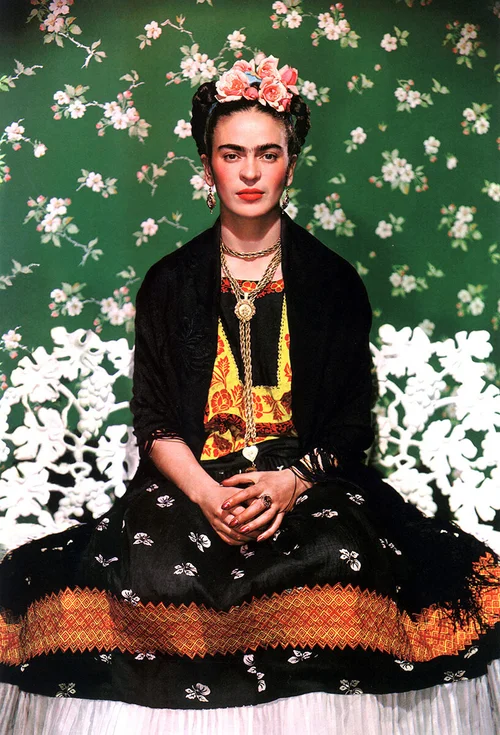
Frida on White Bench, New York, 1939
Nickolas Muray
PDNB Gallery
Frida Kahlo’s transformation into a global icon was propelled not only by her paintings but also by the remarkable photographic record she left behind. Kahlo’s rise from artist to cultural icon owes much to the extraordinary archive of photographs made of her throughout her lifetime, captured by friends, lovers, collaborators, and professional photographers.
One of the most memorable was made by her lover, the Hungarian-born photographer Nickolas Muray, whom Kahlo met in the early 1930s and with whom she maintained a passionate affair for nearly a decade. Muray photographed Kahlo repeatedly during the final years of their relationship, documenting a period when she was producing some of her most celebrated paintings and refining the distinctive public image for which she would become known. In Frida on White Bench, New York (1939), Muray captures Kahlo in Tehuana dress, which she adopted as part of her embrace of her mother’s Indigenous Mexican heritage. Favored by artists including Diego Rivera as a symbol of a distinctly Mexican identity, the style became central to Kahlo’s carefully crafted public image. Through her clothing, jewelry, flowers, and meticulous use of color, Kahlo transformed personal style into a powerful form of self-fashioning, creating an image that continues to define how she is seen in mainstream culture today.
Yasumasa Morimura, An Inner Dialogue with Frida Kahlo (Hand-Shaped Earring), 2001
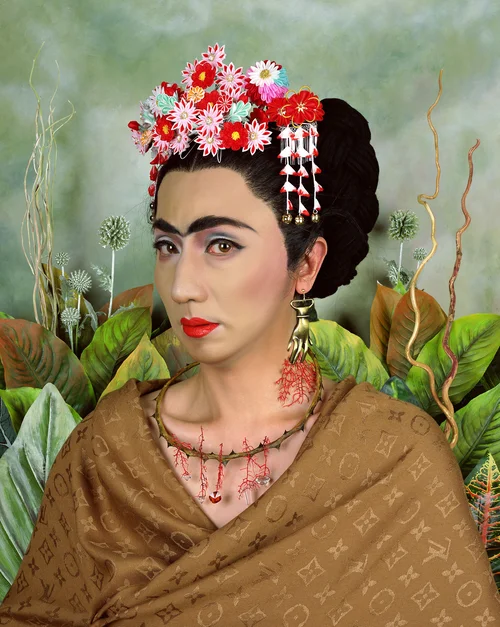
Frida Kahlo’s image has long transcended her own biography, becoming a cultural icon that artists continue to reinterpret through the lens of their own identities and experiences. Among the most celebrated examples is Yasumasa Morimura’s An Inner Dialogue with Frida Kahlo (Hand-Shaped Earring) (2001). In the photograph, the Japanese artist transforms himself into Kahlo, continuing his long-running practice of inhabiting figures from art history and popular culture through costume, makeup, and staged photography. Rather than creating a faithful reconstruction, Morimura reimagines Kahlo’s appearance: Her traditional Mexican shawl becomes a luxury designer wrap, while fresh flowers are replaced with artificial blooms. According to Carnegie Magazine, Morimura has described Kahlo’s art as a “fierce and intense manifestation of human sentiments and universal themes, such as joy, anger, sorrow, happiness, beauty, life, and love.” The result is both a tribute to Kahlo and a reflection on the enduring power of her image. Morimura is just one of many contemporary artists who have turned to Kahlo’s image as a means of exploring questions of identity, gender, race, sexuality, and disability.
