


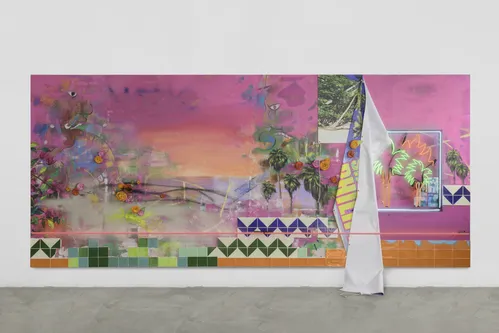
The group exhibition “Let Us Gather in a Flourishing Way,” on view at the Buffalo AKG Art Museum in Buffalo, New York, through September 6th, explores how contemporary Latinx artists have reshaped and subverted traditional painting genres in recent years. Their aesthetic innovations respond to shifting cultural narratives, government policies that demonize the Latinx diaspora, and their long exclusion from mainstream art history.
The show features 58 artists who approach painting as a flexible language. Some challenge the boundaries of the medium through unexpected materials, while others take distinct approaches to European traditions like landscape, portraiture, and still life. The exhibition will travel to the Des Moines Art Center, the Museum of Contemporary Art Denver, the Phoenix Art Museum, and the Frye Art Museum in Seattle.
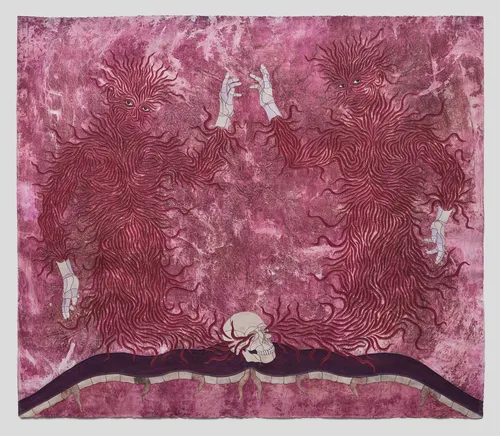
A bold new survey of Latinx painting
The curator, Andrea Alvarez, who has previously curated Latinx-focused shows like “Comunidades Visibles: The Materiality of Migration” from 2021, calls the exhibition the “boldest statement” of her career. “It is a declaration that we as Latinx people are here, that we take up space, that we are part of the dialogue of what is happening in contemporary art and in the contemporary world, and that it merits attention,” she said during the preview of the show. “More broadly, it means that all those individuals who have experienced displacement, who have migrated around the world, whose worldviews are shaped by those experiences, also deserve to be seen and represented in spaces like these.”
Alvarez emphasizes that the show is not a survey but aims to “think about Latinx painting in expansive ways,” and to “expand the disciplines that have been inherited and passed down to us from the European and white American traditions.” The exhibition is split into thematic sections, although many of the works could easily move between them. The paintings all fall under what Alvarez calls Pinturx, or the “Latinx lens” on “traditional, European-approved” genres of painting. The Chicano poet Juan Felipe Herrera, whose 2008 poem gives the exhibition its title, wrote an epic 68-page poem in response to the show that is excerpted throughout the galleries as a conceptual guide.
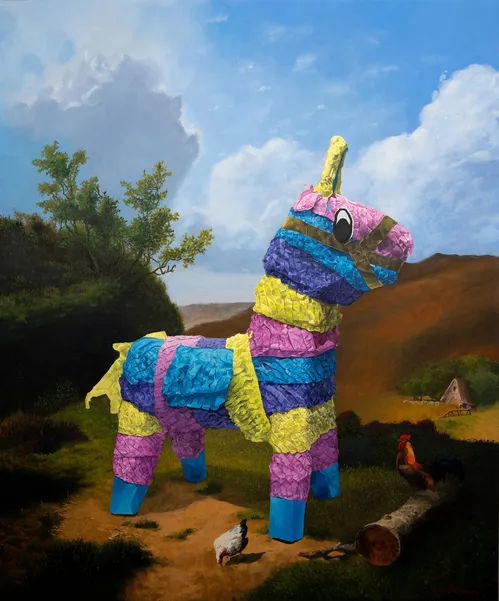
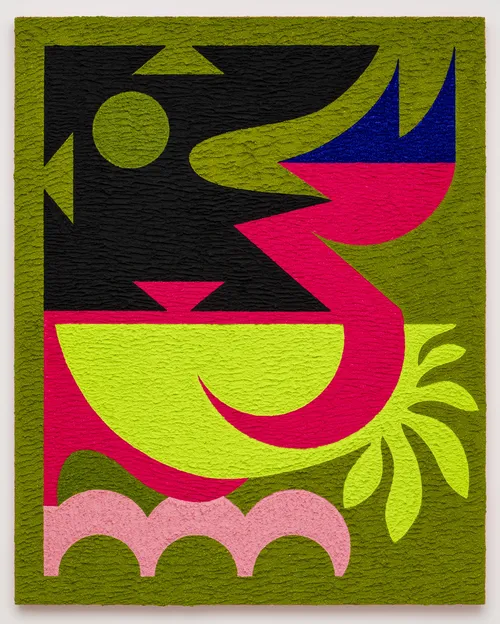
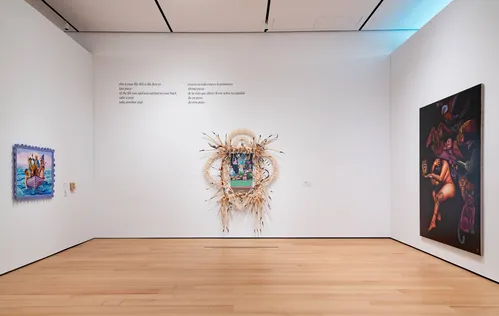
In line with Alvarez’s expansive curatorial approach, some of the included artworks are not paintings at all. Some reimagine folk and craft traditions, like Justin Favela’s St. Maarten (1972), After Marisol (2025–26), a mural made with the colored tissue paper often used to make piñatas. The piece references a seascape by the Venezuelan American artist Marisol, who features prominently in the museum’s collection. It continues Favela’s decades-long exploration of the piñata style, which he began as a student in protest of his professors urging him to make work about his Mexican Guatemalan heritage.
“No one else was being asked to do that,” Favela said. “I thought to make a symbol representing Latinidad that would be so corny they would think I was making fun of the art world. But the piñata has so many layers—it’s about celebration, it’s about destruction. It automatically ties into Latino culture in the United States and everybody understands what that symbol means.” He added that the inclusion of the work in a prestigious institution is also significant, since “a lot of gallerists and professors told me I would never get into museums using tissue paper.”
Political themes in Latinx painting
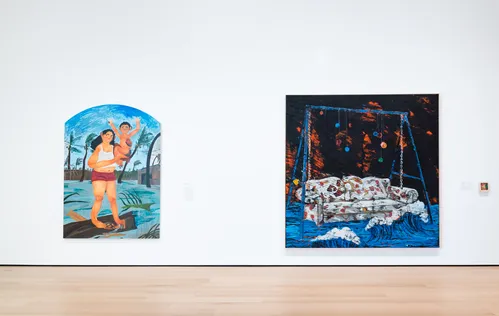
Some paintings in the exhibition address the plight of migrants crossing the United States border. Karla Diaz’s Uncle’s Crossing (2022) depicts the artist’s late uncle, who worked as a coyote, or someone paid to bring migrants across the U.S.-Mexico border. The work comes from her “Coyote” series, which Diaz says she began after her uncle’s death, as his profession, and the possible legal ramifications of speaking out about it, was a taboo subject in her household.
Other works deal with how the Latinx diaspora assimilates, like Guadalupe Maravilla’s Pupusa Retablo (2023), in which a small retablo, or devotional painting, framed by found objects, illustrates the artist’s migration from El Salvador to the United States in the 1980s. At eight years old, Maravilla traveled alone to the Texas border as he fled the Salvadoran Civil War. His vignette recounts an episode in Honduras when a woman flagged him as a migrant for eating pupusas with his hands rather than a fork and knife, as is the custom in the region. He feared he’d be sent back.
Some works consider the effects of imperialism and the exploitation of people and nature. Gamaliel Rodríguez’s painting Evolved Cavendish (2022) speaks to the slave trade in the Caribbean. Its subject is a rotting cavendish banana tree, a high-carb crop brought to Puerto Rico under Spanish colonial rule to feed enslaved people. Rodríguez uses the plant, which appears to be consumed with fungus, to draw parallels to Spanish colonization and consider how Puerto Rico has “changed and evolved” over the centuries, the artist said.
In addition, Angel Otero addresses the effects of climate change on Latinx communities in the large-scale painting Constellation (2024), which shows his grandmother’s couch suspended on a swing set and submerged in waves. The piece critiques the United States’s response to the widely destructive Hurricane Maria and the “ways in which memories and cultural heritage can be washed away by natural disasters,” Alvarez said.
Other works have socioeconomic undertones, like Kristopher Raos’s hard-edge painting Untitled (No Escaping the Housework, All Temperature!) (2023), which depicts fragments of a detergent box painted in geometric color fields, reflecting on the visual markings of domestic labor in Latinx communities with a Pop art–like quality. Raos likens the “methodical process of labor” to artistic process. No one can “conceptualize how much goes into a work,” he said.
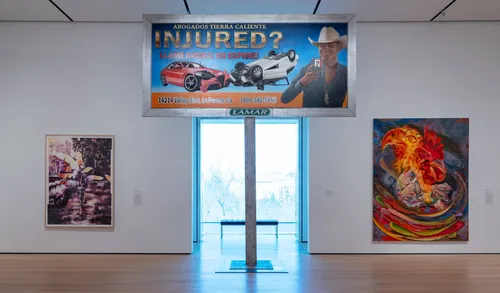
Alfonso Gonzalez Jr, a self-taught artist who previously worked as a commercial billboard painter, presents the striking Abogados Tierra Caliente (Billboard) (2024), a work mounted on a steel post in the style of a billboard. It reflects ads he saw in East Los Angeles for service providers like insurance companies and injury lawyers that very blatantly conveyed Latinx tropes and targeted Latinx communities.
Buffalo AKG’s monumental commission and more intimate work
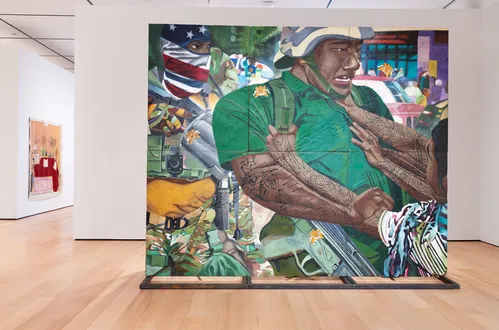
rafa esparza’s monumental Tratos (2025–26), commissioned specifically for the exhibition, is a six-panel painting on adobe blocks that is supported by a steel armature. On the back, the artist has created an assemblage that partly comprises a mangled American flag and laid adobe blocks on the floor.
The central image references a photograph of the 1997 Acteal massacre in Chiapas, Mexico, showing Indigenous women confronting soldiers. esparza adds collaged elements of ICE raids in Los Angeles and Chicago, drawing parallels between the atrocities. The figures’ arms are tattooed with symbols showing images like the Florentine Codex, a 16th-century manuscript documenting the culture and religion of the Aztec in early colonial Mexico, the Aztecs fleeing from Spaniards, and other scenes.
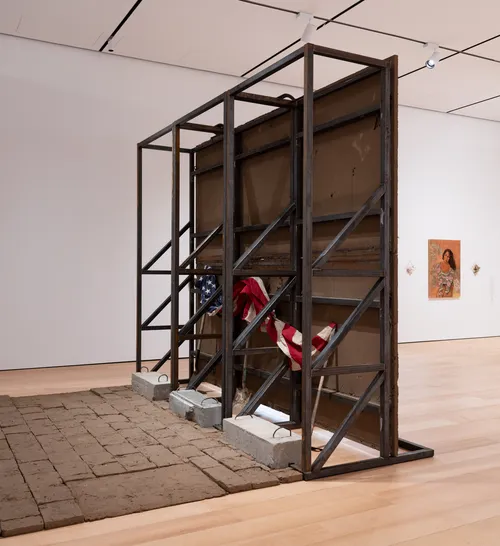
“I was thinking about drawing a painting showing a continuum of violence that’s colonial [and] that comes from globalization,” esparza said. “The look on the soldier’s face—a mortified look—said so much that I couldn’t draw a better expression. I was interested not only in state-sanctioned agreements but also in the personal agreements we make with one another as community members [and] people who care for each other. That image carries a lot of betrayal. There’s a heavy tension.”
Other works speak to the power of family and community, like Larry Madrigal’s Man on Trampoline (2023), which depicts an everyday scene rendered with the grandeur of Old Masters paintings. Madrigal’s figures ascend in midair and frenetically topple over one another as they conjure the balance and chaos of family life. The work references El Greco’s Resurrection (circa 1596–1600) to “amplify this sense of epic importance” that, at the same time, was “just a moment of play,” he said. Madrigal moved from Los Angeles to Phoenix as a child, where he said the cookie-cutter houses that stretched across the Southwestern landscape could have felt alienating were it not for his family’s deep bond and their connections with Latinx culture and community.
The complicated meaning of “Latinx”
In the process of organizing this sweeping exhibition, Alvarez acknowledged that the term “Latinx” has been widely contested and misunderstood since it was introduced in the early 2000s as a gender-neutral alternative. Some argue that it does not fit naturally in Spanish and that it imposes U.S. cultural politics on Spanish-speaking communities. Alvarez ultimately decided to use the term because it is widely accepted by Latin American art scholars at the moment, and language is ever-evolving.
“We use [Latinx] knowing that we stand on unstable ground as we use it,” she said. “And we, in some ways, are building the plane as we fly it. We use it as we critique it. We understand its complexities and the fraught histories that it carries with it, while also knowing its power and its ability to create a path forward, or forge a space for people. At this moment, we have not identified a better word. We use it knowing that it’s what we have, and we use it responsibly.”
Beyond their categorization as “Latinx artists,” the artists in this exhibition are united by a “deep sense of care and attention toward their work, toward their communities, and toward the histories they are engaging with,” Alvarez said. “Every gesture, every material choice, every word that they use when they talk about their work is not taken lightly. That’s very much shared across the board and something we can learn from.”
