


Danish museums have recovered well from Covid-19. The latest survey by Organisationen Danske Museer (ODM), an association of 170 museums, visitor centres and conservation centres across Denmark, published in February, shows that 2025 museum attendance was similar to 2024’s record levels: there were 9 million visitors to the 72 museums that responded, with one-third of institutions reporting an increase in visitors of 10% or more.
But as visitor numbers are booming, they are also becoming increasingly central to how museums are funded in Denmark. A new state-funding model, introduced by the government in January 2025, places greater emphasis on measurable outputs, including how many people come through the door.
There are now three criteria for an institution to secure—and retain—government subsidies. It must welcome a minimum of 10,000 annual visitors (or 8,000 where an institution is on an island with a population smaller than 10,000); have a minimum annual income of 4m kroner ($600,000) (3m kroner on islands with less than 10,000 inhabitants); and publish at least one peer-reviewed research paper every three years.
There are three types of subsidy: a basic grant, fixed for five years; one or more incentive grants, decided on annually; and what is termed “a priority grant”, a discretionary subsidy determined politically.
For the basic grant, institutions are ranked in five categories by the importance of their collections. Those in the lowest category, which account for nearly half (44%) of the 95 museums that receive state funding, now get 1.5m kroner ($230,000), as opposed to the lowest basic grant a museum could get before the reform of 1m kroner. “The smallest museums gain half a million [kroner] per year. In Denmark, that’s the cost of one extra employee,” says Ulla Schaltz, the director of the Lolland-Falster Museum in south-east Denmark. The highest category, meanwhile, nets an institution 23m kroner ($3.6m).
The incentive grants will be decided on a year-by-year basis, upon submission of the museum’s officially audited annual report. This must include visitor numbers, income raised (including sponsorship for temporary exhibitions and ticket sales), figures on children and young people engaged, and published research papers. In effect, these grants work out as rewards for institutions excelling in one or more of these areas.
Levelling the playing field
The changes to the funding model were not motivated by a desire to cut spending. When the culture minister, Jakob Engel-Schmidt, presented his reforms of the Museum Act in May 2024, he announced an additional 95m kroner ($14.8m) for the sector, taking the annual budget from 470m kroner to 565m kroner ($72.7m to $87.5m). The stated aim was to increase fairness and transparency in how state funds are distributed.
The previous funding model was brought in during local government reforms in 2007. For those museums that had depended on subsidies from the old municipalities and counties, the government simply promised to keep the same amounts coming under the new entities, without asking questions as to how they had been calculated in the first place.
This led to considerable unevenness. Until 2025, Arken Museum of Contemporary Art in Ishøj (south of Copenhagen) received between 30m and 34.9m kroner ($4.6m-$5.4m) annually while Brandts Art Museum in Odense got less than a tenth of that, around 2.3m kroner ($356,000). And yet, according to Danmark Statistik, the country’s official statistics body, in terms of annual visitor numbers, the two institutions are not that different: in 2023, Arken recorded 135,052 visitors, and Brandts 117,600.
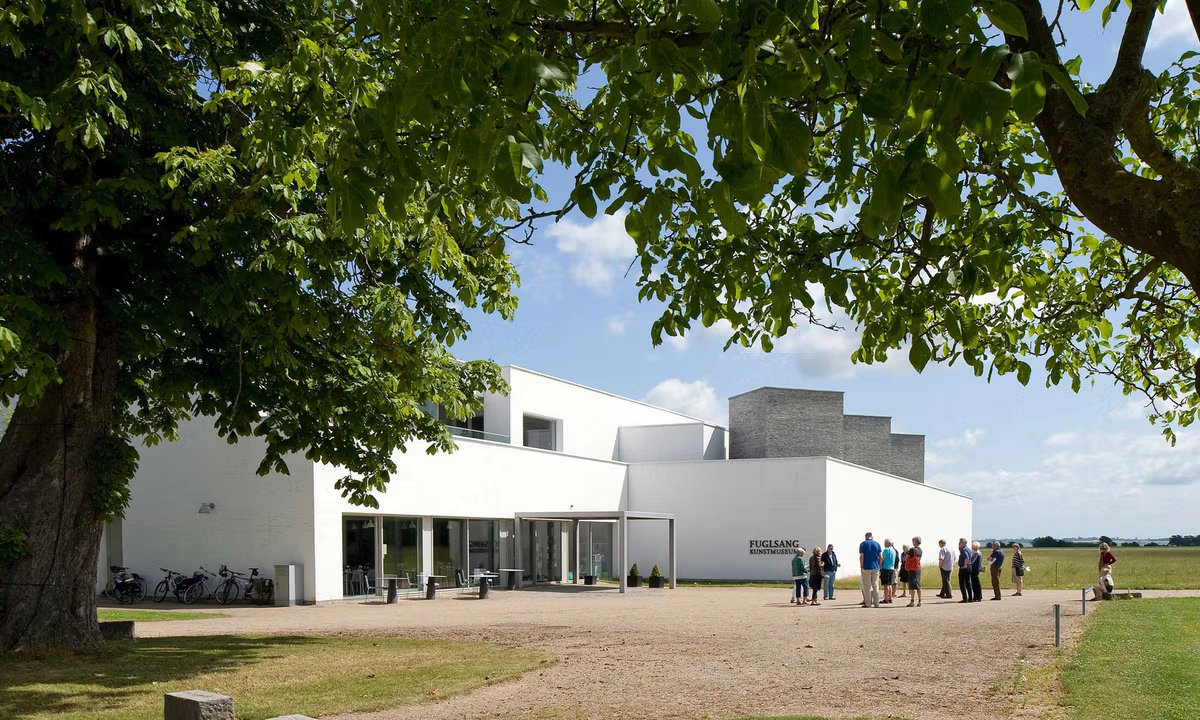
The Fuglsang Kunstmuseum got 4m kroner ($619,00), while similar museums got only 1m kroner ($155,000), despite being of similar stature. As Anna Schram Vejlby, the Fuglsang’s director and deputy chair of the ODM, says: “Getting ten times as much money actually does something, year in and year out. You can see what money does for a museum.”
Furthermore, until now, only those 95 museums already recognised by the state were eligible for government funding—none of the hundreds outside of this group could apply. “The government and all the museums wanted a way to get new museums into the group of state-recognised institutions,” Schaltz says, “because we have a lot of museums working very seriously, to whom state funding until now was not accessible.”
Happy, despite less money
The reform was passed in December 2024 and came into effect on 1 January 2025. Museums are now preparing their first set of annual accounts under the new regime. Claus K. Jensen, the head of the ODM, hailed the changes at the time of their announcement as representing a “much-needed economic boost for the industry”. He said in a statement: “The reform has been long-awaited. It seems that most museums stand to gain financially.”
However, some institutions have seen their subsidies considerably reduced. Under the new rules, Arken Museum will lose at least 19% of its subsidy—600,000 kroner ($93,000) in 2025 and 1.6m kroner ($248,000) annually over the next three years. Yet its leadership remains optimistic. “You don’t just lose 20% of your subsidy without it making any difference,” the museum’s deputy director, Arne Bjerre Hårbo, told the Akademikerbladet magazine in May 2025. “But we’ve been working on the change already, and we’re ready
for it.”
“The reform as it is, I think we are quite happy with it,” Schram Vejlby says. “It’s not completely transparent. But at least we have some clarity.”
However, other museum professionals highlight problems with the metrics by which the government is deciding on an institution’s worth and eligibility
for funding.
Mette Bjerrum Jensen is the director of the Ringkøbing Fjord Museer, located in an area of West Jutland that is sparsely inhabited but popular with tourists. With 300,000 annual visitors, the museum ranks 11th out of 95 in visitor numbers, but it has been placed in the lowest grant category. As Bjerrum Jensen puts it: “We are not recognised as a large museum.” As a result, her institution’s basic grant has dropped from 5.5m kroner to 1.5m kroner ($850,000 to $232,000). Incentive funding has effectively topped this up so that, in the first year under the new regime, the museum received roughly the same sum. But incentive funding is revised annually, whereas the basic grant is a five-year fixed agreement.
Others have pointed to potential problems in counting visitors for the new metrics. Guidelines from Slots- og Kulturstyrelsen, the Danish agency for palaces and culture that sits within the Ministry of Culture, specify that people have to redeem tickets of some kind to be counted. Those visiting cafés or museum shops, public spaces and venues such as historic buildings, ruins or gardens separate from the museum’s collection cannot be included. Thus Arken, which saw 163,000 visitors (including children) in 2025, can no longer count visitors to its sculpture park or its offsite video exhibition area, PULS, at nearby Vallensbæk railway station.
In terms of engagement with children and young people, “we all agree that it’s a good thing to have more children in museums”, Schaltz says. But she wishes this was accounted for in the new rules, proportionally to the local population. A big museum in a big city will by default get a lot of children because of the large community on its doorstep and a high influx of tourists, she says. To her mind, the excellent work a small museum does to attract 50% of local schoolchildren should be celebrated, even if that is 50% of a small community. Under the new rules, the number itself is all that counts for
incentive grants.
The museologist Janus Tobias Saito-Madsen says that without greater clarity and independent verification of how museums do their counting, and with institutions competing for incentive-based funding, there is the potential both for visitor numbers to be artificially inflated and curatorial programming to change to chase more visitors. He sees small museums in rural areas increasingly centring experiences, and he fears those doing good cultural-heritage work will gradually lose out to museums offering more entertainment.
Saito-Madsen would like to see a funding system that instead shows that centring local cultural heritage, for example, is in and of itself enough — a system, as he puts it, that “frees the museums and says: ‘We believe in you’”.
