


Art
Attendee at ART X ICON: An Exacting Eye featuring J.D. Okhai Ojeikere exhibition at ART X Lagos 2025. Courtesy of ART X Lagos. Courtesy of Art X Lagos.
Looking around a buzzing marquee in Lagos at the start of November, I was struck by how familiar it felt. I recognized so many curators, collectors, artists, and advisors from the U.K. who had flown in for ART X Lagos, one of the continent’s most well-known annual art fairs. Their presence highlighted how Nigerian art has gained significant global recognition over recent years. Leading figures in the art world are now, more than ever, willing to travel to see Nigerian art firsthand, underscoring its importance internationally.
When entrepreneur and art collector Tokini Peterside-Schwebig founded ART X Lagos in 2016, the art scene in the country looked markedly different. “Many of the young artists in Nigeria believed they had to leave the country to establish themselves globally,” she says. “I wanted to change that. I wanted to bring the world to us.” Nearly a decade on, and 10 art fairs later, her ambition is taking hold.
Dennis Osadebe, MASS (Devotion), ART X Lagos 2025. Courtesy of ART X Lagos
In Europe, last year saw the second-ever Nigerian Pavilion at the 2024 Venice Biennale. “Nigerian Imaginary,” curated by art historian Aindrea Emelife, brought together eight artists of Nigerian heritage who all created site-specific works that touch on different aspects of the country’s artistic and social identity. An expanded version of the exhibition has been curated for the new Museum of West African Art (MOWAA) in Benin City, Nigeria. “The act of bringing an exhibition from a global institution from the West to the continent is not an easy thing to do,” Emelife told Artsy, adding that while many touring exhibitions might go to institutions across the globe, African countries are often skipped. “But in doing so, it proves the concept that we can be part of a global art ecosystem.”
In October, Tate Modern opened “Nigerian Modernism,” co-curated by Osei Bonsu and Bilal Akkouche, a landmark exhibition exploring pivotal movements in Nigeria’s artistic landscape. The following week, at Frieze London and Masters, many of the booths were filled with highlights of Nigerian art, like Twins Seven-Seven’s pen and ink works at kó’s Frieze Masters booth, or contemporary oil paintings by Nengi Omuku at Pippy Houldsworth Gallery’s booth at Frieze London. Bonhams Modern & Contemporary African Art auction also took place the same week, and it included many of the names that featured in the Tate Modern show.
Clara Etso Ugbodaga-Ngu, Elemu Yoruba Palm Wine Seller, 1963. © Clara Etso Ugbodaga-Ngu. Hampton University Museum. Courtesy of Tate Modern.
“Nigerian art has gained global attention as a result of centuries of artistic innovation and cultural exchange, much of which has been sidelined by Western art museums and, at times, even within Nigeria itself,” Bonsu explained. The opening of the Tate exhibition was notably busier than usual—a sign of cultural pride and growing interest in the region. “To sustain this momentum, we need to see support for art spaces and organizations in Nigeria.”
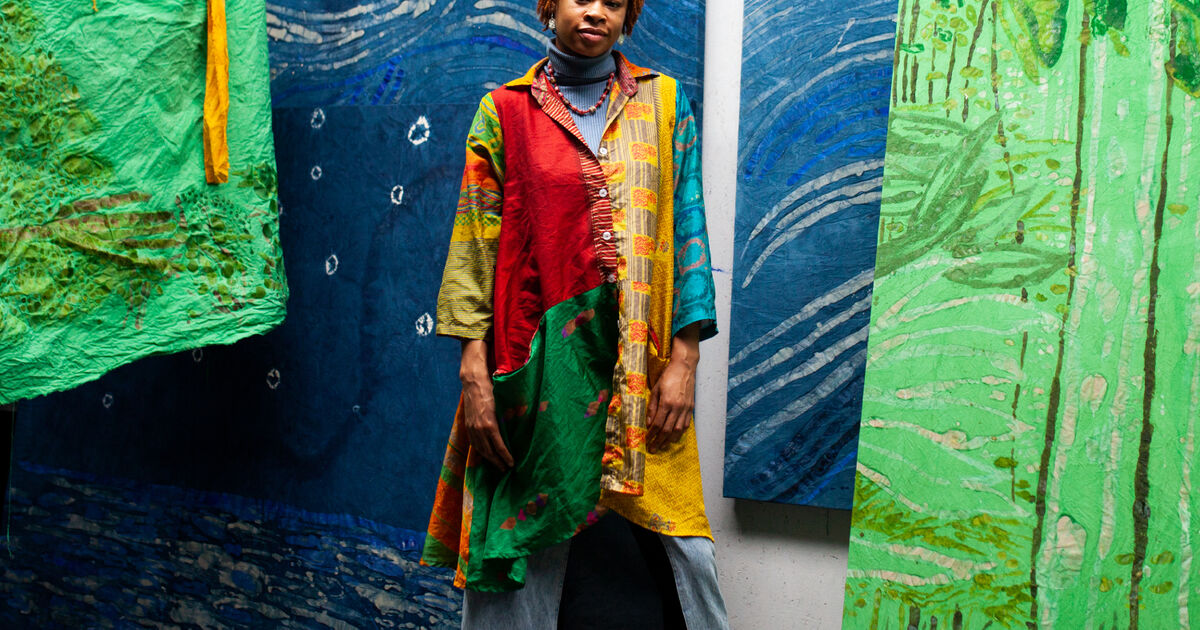
British-born and London-based Nigerian artist Sola Olulode, for example, says she has been eager to exhibit in ART X Lagos for years, having incorporated the country’s traditional textile practices into her work since 2017. Like many of her recent pieces, Olulode’s works presented by Wunika Mukan Gallery at ART X Lagos this year drew from adire, a textile-dyeing technique from southwestern Nigeria that uses tying, stitching, and painting to construct intricate patterns.
Portrait of Sola Olulode by Brynley Odu Davies. Courtesy of the artist.
Gallerist and solicitor Oyinkansola Dada also noted that many artists abroad are actively looking to exhibit in Lagos. Having founded the eponymous DADA Gallery in 2015, Dada chose to open her first-ever permanent space this year in Ikoyi, an affluent part of Lagos, despite initially holding many of her exhibitions abroad. “There’s been so much work that has been done, especially in terms of promoting the city culturally,” she said. “So many [Nigerian gallerists] do 1-54 and other art fairs in New York, London, Miami,” but when it comes to having a physical place, she preferred to “invest in building the ecosystem in Nigeria, rather than starting in London.”
But opening new spaces doesn’t always come without complications. MOWAA was initially set to unveil its first structure at the start of November. Instead, protests saw men storm the institution with donors, cultural figures, and foreign diplomats inside, forcing the opening week of its research, conservation, and heritage hub, MOWAA Institute, to be indefinitely postponed.
Portrait of Oyinkansola Dada by Ugochukwu Emebiriodo. Courtesy of DADA Gallery.
Critiques center around a range of issues, including the Benin Bronzes, name changes, and funding. The museum, which bills itself as an independent nonprofit, has been previously reported to have received contributions from the State government under its former governor, Godwin Obaseki. The Oba of Benin, the traditional leader of the Edo people, claims that the museum’s original concept, which he supported, centered around the building of a “Benin Royal Museum.” Obaseki, in his view, diverted donor funding by not sticking to this concept. “We wish to emphasise that MOWAA is an independent nonprofit of which the former governor has no financial interest,” MOWAA wrote in a statement.
But protests aside, MOWAA’s director, Philip Ihenacho, noted that his intentions for the museum are long-term. “With ART X Lagos, there’s an art season that has started to be established in Nigeria, and that’s fantastic, but, even though it’s fashionable now, how is it going to be in 10 years?” he said. “Museums are by definition long-term institutions [able to offer] support for curators, art historians, people who are going to be telling the stories and writing the narratives for future generations.”
Museum of West African Art (MOWAA) © Marco Cappelletti / Marco Cappelletti Studio. Courtesy of MOWAA.
Many organizations have also dedicated themselves to longevity with a focus on uplifting and training Nigerian artists, curators, and historians for a global stage. This year, ART X Lagos partnered with the Cité internationale des Arts in Paris and the French Embassy in Nigeria to launch RESONANCE, an annual residency program for visual artists, designers, and curators based in Nigeria. “They get to leave Nigeria, explore another art scene, meet hundreds of artists from around the world, and then bring all of that experience back home,” Peterside-Schwebig said.
Notably, the renowned British artist Yinka Shonibare opened Guest Artists Space (GAS) Foundation in 2019, a nonprofit in Lagos offering artist residencies and public programming by and for artists in the country and across the globe. “Our focus has always been on building long-term cultural infrastructure rather than short-term visibility,” Shonibare explained, pointing out recent initiatives including the foundation’s Ìmòra Arts Intensive, which trains 10 early-career artists in the city. “What I’m seeing internationally is a genuine shift,” he added. “Nigerian art and creativity is no longer treated as a peripheral curiosity, but as a central force in global culture—and that change is driven by the strength of the institutions and networks we are building in Nigeria.”
Olulode, who is currently a resident at GAS, added that “the interest in Black art in general has been increasing, but I have noticed in particular Nigerian artists standing at the forefront of that.”
Azagba Pavilion at the Black Muse Sculpture Park. Courtesy of the Black Muse Sculpture Park.
Portrait of Yinka Shonibare by Ademola Odusami for Laah Photography. Courtesy of G.A.S. Foundation.
Shonibare and Peterside-Schwebig are not alone in facilitating this shift. The internationally renowned artist and writer Victor Ehikhamenor founded the nonprofit Angels & Muse in 2018 to uplift African artists. This was later expanded with Black Muse, an artist’s residency (completed in 2024) and sculpture park (which opened in November) in Benin City. And, in October, British Nigerian artist and designer Yinka Ilori announced the launch of the Yinka Ilori Foundation in Nigeria, which will focus on how art and design can transform communities.
On a Monday evening, a day after ART X Lagos drew to a close, I sat down for dinner at “Edo on The Tongue,” a night of food and music designed to offer a taste of Edo culture as part of the inaugural Black Muse Art Festival. There, I met artists, curators, and aesthetes from across Europe and America, though I soon learned that these meal-goers were only a small fraction of the over 400 people from across the globe who attended the organization’s opening event the night before. “When you tell a story organically that is not [artificially] formed, that’s not PR-ish, that is well-communicated with good intention, people will come,” Ehikhamenor said of these events.
Portrait of Victor Ehikhamenor inside Black Muse Residency, Benin City, Nigeria, 2025.Courtesy of Angels & Muse and artist Victor Ehikhamenor.
As Nigerian art solidifies its rightful place at home and abroad, what also becomes clear is that Nigeria is not only producing great artists, but it’s authentically building the spaces, institutions, and confidence to support them now and in decades to come.
