


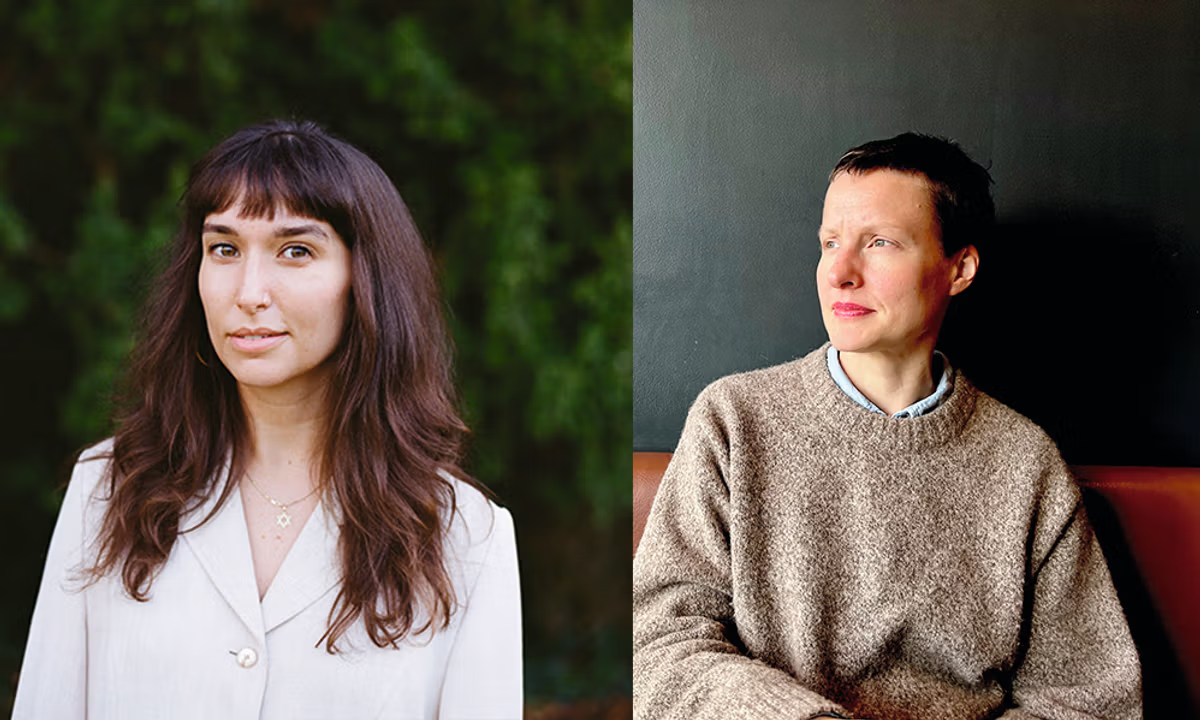
Soon after she started writing her sharp and gritty new novel, Exhibition, Alex Hyde went to see some of Tracey Emin’s early monoprints in the prints and drawings room at Tate Britain in London. “I very consciously used her work as a source, and I did a lot of writing in front of it,” she says. “I sought it out and would sit and feel and look and do as much as I could without touching. Then what happened very gradually, and very movingly for me, is that the writing of the book and my investment in the characters meshed with my response to those artworks.”
Exhibition is one of several new art-themed novels hitting shelves this summer. While Hyde’s absorbing story of loss and possession unravels during the heady days of the Young British Artists (YBAs) in 1990s London, Florenzer by Phil Melanson follows an ambitious young Leonardo da Vinci as he figures out who and what he wants to be in late 15th-century Florence. Lisa Rochon’s The Paris Thief tells the tale of a woman in the French capital tasked with keeping the Mona Lisa safe during the Nazi occupation. Contrapposto by Dave Eggers traces two artist friends from adolescence to old age. And Rebecca Birrell’s deeply felt debut, Venus, Vanishing, is about a young Jewish painter in 1930s Berlin.
Art in fiction is nothing new. In the 19th century, art stirred the imagination of French novelists such as Honoré de Balzac, Émile Zola and Marcel Proust. Entire novels have been born out of single works of art—from Tracy Chevalier’s Girl with a Pearl Earring (1999) to Donna Tartt’s The Goldfinch (2013)—while others have explored chapters of art history, such as My Name is Red (1998) by Orhan Pamuk. More recently, writers such as Ali Smith have used art as a jump-start and a structural device. (My first novel began with Édouard Manet’s last great painting, A Bar at the Folies-Bergère (1882); my second centres on a woman working in a museum’s conservation department.)
Alongside Hyde’s Exhibition and Birrell’s Venus, Vanishing, other novels inspired by art include Dave Eggers’s Contrapposto, Lisa Rochon’s The Paris Thief, and Phil Melanson’s Florenzer
One of Birrell’s first encounters with thinking about art was reading Virginia Woolf’s To the Lighthouse (1927). She felt haunted by the figure of Lily Briscoe—“an amazing image of frustrated female ambition,” she says—and other fictional female artists who have drifted in and out of texts by writers including Elizabeth Jane Howard and Iris Murdoch. In Venus, Vanishing, Birrell wanted to give more “voice and character and colour” to the woman artist figure, who, in the book, takes the form of Hannah, a runaway seamstress building a new life for herself in the city.
Lost generation
An art historian and a curator, Birrell had been grappling with what to do with a large quantity of academic research that she had amassed before she turned to fiction. In particular, she had been looking at a lost generation of Jewish women artists at work in the 1920s and 1930s, and trying to write about their lives and art—a challenge when most of their paintings have been destroyed and biographical details are scant. Birrell was thinking about artists such as Charlotte Salomon, who created an extraordinary series of multilayered gouache drawings before she was murdered in Auschwitz aged just 26, and Lotte Laserstein, who painted nudes of her lover that Birrell describes as “modern and sexy and queer”.
“At a certain point, I realised that the constraints of non-fiction were no longer serving the material, and that was when I decided to create this kind of fictional composite figure that is Hannah,” Birrell says. She describes her previous work of non-fiction, This Dark Country: Women Artists, Still Life and Intimacy in the Early Twentieth Century, as “a non-fiction book haunted by fictionality”, recalling that the parts she enjoyed writing the most were those that relied more heavily on imagination. “It made me wonder whether unconsciously I did have this deeper desire to write fiction.”
Photographic memory
While Birrell leaned into the lives of the artists she had in mind while shaping her protagonist, Hyde did not go anywhere near the biographies of the artists whose work inspired Exhibition. “I didn’t want to muddy the water by thinking that I wanted to reproduce the idea of any of them, but I took what was in the ether around them,” she says. “Things to do with living through that era of Cool Britannia, and the late 90s explosion of actually having some kind of zeitgeist to talk about culturally.”
The novel charts the relationship between a self-effacing photographer called Rabble Stone and a figurative painter from whom she rents a room in a shabby house in Brixton, south London. Rabble is captivated by the artist’s self-portraits—raw, unfiltered images of the female form—and begins to photograph her and her work. “I was thinking about the distinction between figurative art and photography, and I wanted to interrogate this idea of photography as a form of capture,” Hyde says.
Alongside Emin’s work, Hyde looked at the photography of Sarah Lucas, as well as artists beyond the YBAs, including George Shaw, Cindy Sherman, Nan Goldin and Sally Mann. She read Susan Sontag to get to grips with the technical side of things, and thought about the relationship between Diane Arbus and her daughter Doon Arbus, the custodian of her mother’s estate. Hyde says she is interested in the commercial value of works of art, and how that can be “so distant from the creative and emotional value of its production”.
Both Hyde’s Exhibition and Birrell’s Venus, Vanishing—a novel as richly detailed as Exhibition is spare—pose questions about muse and subject, and the paper-thin line between collaboration and ownership. Does Hyde, too, find inspiration in other art-themed novels? She quickly replies: “No. The inspiration was all visual.”
