


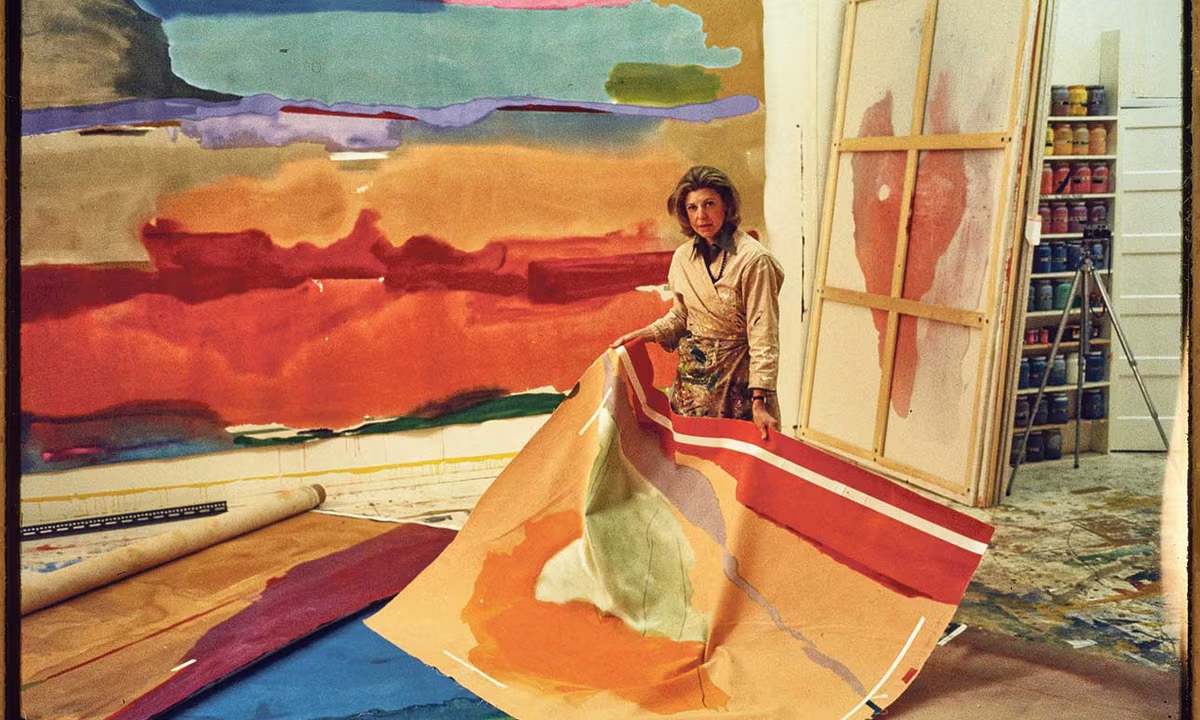
The US artist Helen Frankenthaler (1928-2011) came to Europe to look. In the summer of 1953, she sailed alone on the S.S. Constitution to Gibraltar and spent two months travelling through Spain and southern France. While in Madrid, she would return each day to the Museo del Prado and stay until closing. She had rejected André Malraux’s then-fashionable argument that reproductions made the physical encounter with painting unnecessary. A painter needed to stand before the work itself, absorbing its aura directly.
In 1954 she took a road trip from Sirmione on Lake Garda to Milan in a convertible with Clement Greenberg and Peggy Guggenheim. Two years later she was in Paris, at the Hôtel du Quai Voltaire, when Jackson Pollock—a major influence on her work—was killed. The Old World was a significant fact of her life and her work. Kunstmuseum Basel’s survey—the largest showing of Frankenthaler’s work ever staged in Europe and her first institutional solo exhibition in Switzerland—brings together more than 50 paintings across six decades, making the full scope of her achievement visible for the first time on this side of the Atlantic. It is also a decisive curatorial argument—that Frankenthaler was an artist formed as much by the traditions she crossed the Atlantic to absorb as by the ascendant New York world she returned to.
Among the highlights of the show is Eden (1956), an oil on unsized, unprimed canvas roughly as big as a king-size bed stood upright against the wall, is a standout. Trees root themselves into the lower half while colour—coral, blue, olive, yellow—pools and drifts across the surface with the lightness and grace befitting its subject of paradise. Then two forms at the centre demand our attention: written as “100” but readable as lines and ovals, or penises and ovaries, the garden’s generative logic made explicit.
“Pulled into abstraction”: Frankenthaler’s Europa, which she painted in 1957 a few months after seeing the Titians at the Musée du Louvre in Paris Photo: Rob McKeever, courtesy Gagosian; © 2026 Helen Frankenthaler Foundation, Inc./ProLitteris, Zurich
There are also some exceptional archival loans from the Helen Frankenthaler Foundation, which help to situate her personal story in Europe. Among these is a Prado guidebook from Frankenthaler’s 1953 Madrid visit—annotated across subsequent trips in 1954, 1958 (on honeymoon with Robert Motherwell) and 1973—with the page open on Tintoretto, her margin notes reading as a painter methodically working through the collection. A Musée du Louvre guidebook from 1956 finds her weighing the relative merits of Paolo Veronese’s The Repast at Simon the Pharisee against Titian’s The Pilgrims at Emmaus.
Art-historical forebears
One of the revelations of the exhibition is to see how consistently Frankenthaler returned to her art-historical forebears and reimagined them on her own terms. Hommage à M.L. (1962) is dedicated to Marie Laurencin, the early 20th-century French painter whose pastel palette and soft, lyrical composition Frankenthaler consciously absorbs. The painting sits within a critical context that repeatedly framed Frankenthaler’s work through her femininity—a characterisation she spent her career forcefully rejecting. In For E.M. (1981), she takes up Edouard Manet’s Fish (Still Life) (1864)—a work rooted in the 17th-century Dutch tradition but whose whole surface is too alive for a form premised on inertness—and subjects it to a process of expansion and abstraction. The white of the fish belly, the copper of the pot, the black knife: elements from the source, which is included in the show, remain faintly legible, but pushed to monumental scale, they shed their domestic purpose entirely. The lemon is displaced to the picture’s left edge. What survives from Manet is a sense of touch and gesture: the same dynamic animation that makes his still-lifes feel temporarily arrested rather than inert.
A few months after seeing the Titians at the Louvre, Frankenthaler painted Europa (1957). Titian’s composition is taken up and pulled into abstraction; reoriented into portrait format, its underlying architecture kept just legible. The white bull survives on the right. What Titian gave to the abducted figure’s body, Frankenthaler gives to the pink drapery, the colour carrying the visceral, messy weight of flesh. The paint’s velocity holds the myth’s spectacle of sexual violence without remotely illustrating it. In a nearby vitrine, a photograph of Frankenthaler in her Stamford studio from August 1983 shows a postcard of Titian’s Rape of Europa pinned to the wall behind her—something she kept as a memory aid, the source still present, still in view.
- Helen Frankenthaler, Kunstmuseum Basel, until 23 August
