


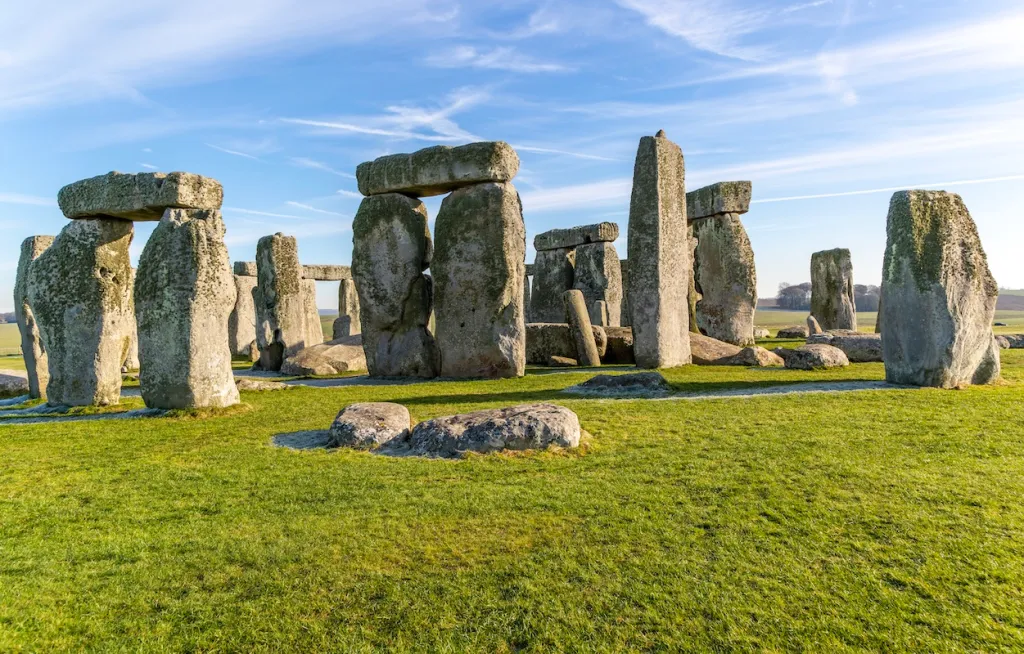
Researchers at Curtin University in Australia have presented evidence that humans, rather than glaciers, moved the rocks used in Stonehenge’s construction to England. Their findings were published January 21 in the journal Communications Earth and Environment.
Located on Salisbury Plain in England, Stonehenge was built in stages by Neolithic and Bronze Age peoples between around 3000 BC and 1500 BC. It consists of an outer circle and inner horseshoe of sandstone trilithons with inner arcs of smaller bluestones.
Geological evidence has confirmed that the monument’s sandstone boulders came from the Marlborough Downs, 20 miles away, while the smaller dolomite bluestones were quarried in the Preseli Hills in southwest Wales, 180 miles to the northwest. The average sarsen (sandstone block) at Stonehenge weights 25 tons; the average bluestone ranges 2 to 5 tons, and the largest weighs 40 tons. Stonehenge’s Altar Stone, weighing six tons, is now thought to have originated in Scotland.
Until this month, there were competing theories as to how the stones traveled such long distances, with some positing that humans moved them by land or by sea and others suggesting they were deposited by glaciers during the Ice Age.
Now it seems almost certain that the stones were moved by people. Scientists at Curtin tested sediments collected from streams around Stonehenge for mineral evidence of glacial activity. According to their findings, the area remained unglaciated during the Pleistocene, making direct glacial transport of Stonehenge’s megaliths unlikely.
Just how humans did move the stones, however, remains a mystery. “Some people say the stones might have been sailed down from Scotland or Wales, or they might have been transported over land using rolling logs, but really we might never know,” said Dr. Anthony Clarke, a geologist at Curtin’s Timescales of Minerals Systems Group and lead author of the study. “But what we do know is ice almost certainly didn’t move the stones.”
