


Good Morning!
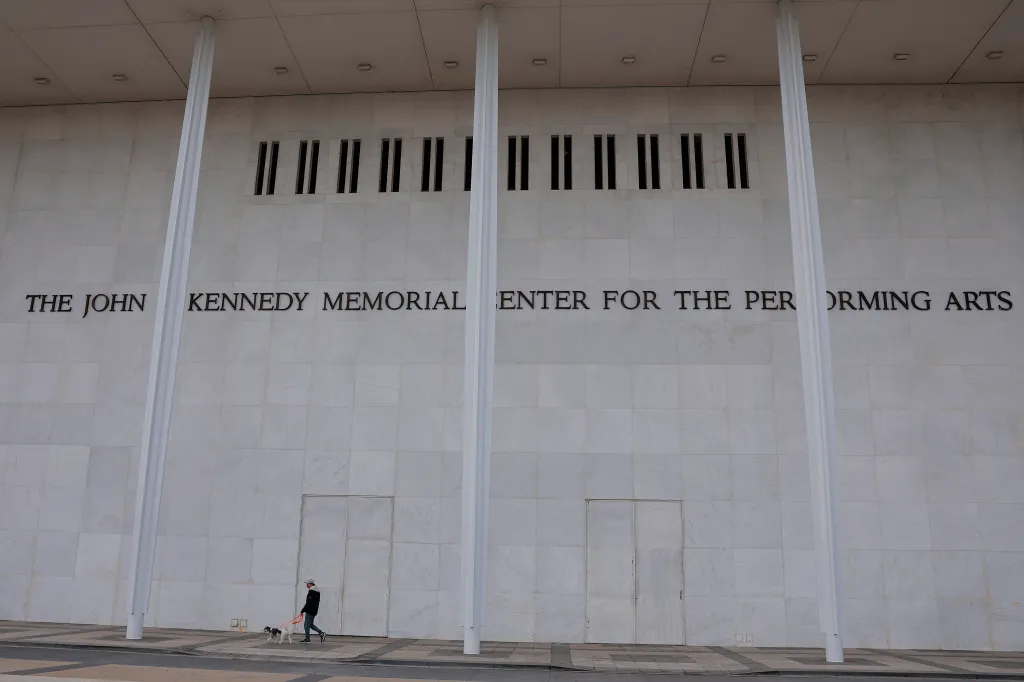
- Trump announced plans to close the Kennedy Center for two years of renovations following more canceled performances.
- The Centre for Contemporary Arts (CCA) in Glasgow is permanently closing amid financial woes.
- Icelandic artist Björn Roth dead at 64.
The Headlines
CURTAINS CLOSE. After several performers canceled shows and public patronage continued to fall, President Donald Trump announced on Sunday that he is closing the Kennedy Center for a two-year renovation beginning on July 4—America’s 250th anniversary, the Washington Post reports. The sudden move follows Trump’s unabashed takeover and renaming of the venue as the Trump Kennedy Center in December. In a Truth Social post outlining the plans, Trump made no mention of increasingly empty seats or artists severing ties with the institution, which was renovated as recently as 2019. Congress, Democratic lawmakers have noted, typically approves such projects. Instead, without offering details, Trump said the “financing is completed” for a renovation that “will take a tired, broken and dilapidated Center … and turn it into a World Class Bastion of arts, Music, and Entertainment, far better than it has ever been before.” In a related effort to put his stamp on U.S. landmarks, the Washington Post also reported new details about Trump’s desire to build a grand arch near Memorial Bridge in Washington, D.C. According to sources speaking on condition of anonymity, the president has opted for a larger-than-expected golden arch—already dubbed the “Arc de Trump” —that would rise 250 feet, dwarf surrounding monuments and views and become the tallest arch of its kind anywhere in the world.
GLASGOW BIDS GOODBYE. The city’s cash-strapped Centre for Contemporary Artswill close permanently, the BBC reports. One year ago, the venue was handed a lifeline of £3.4 million ($4.65 million) by arts body Creative Scotland, but it was not enough to fix its finances.The CCA informed staff of the closure during a recent online video call, with just one day’s notice, according to the Unite Hospitality union, speaking to BBC Scotland News . As a result, all upcoming events have reportedly been canceled. Creative Scotland said it would explore options “with the aim of reopening the centre as a cultural resource as soon as realistically possible,” but added that it will not make further payments to the CCA. Earlier this month, the CCA said it was reviewing its fundraising policy following protests criticizing its board for not taking a stance in support of the Palestinian Campaign for the Academic and Cultural Boycott of Israel (PACBI).
The Digest
The Kiran Nadar Museum of Art (KNMA) in New Delhi has appointed Manuel Rabaté as its first chief executive and director. The Frenchman joins from Louvre Abu Dhabi, where he has served as its inaugural director since the museum opened in 2016. [ARTnews]
Scientists have uncovered a nearly 500-year-old secret beneath the layers of paint in Anne Boleyn’s Hever “Rose” portrait at Hever Castle, her childhood home. It offers evidence that its artist painted a “visual rebuttal” to rumors that the beheaded wife of Henry VIII was a witch with a sixth finger on her right hand, as campaigners for the restoration of Roman Catholicism in England had claimed. [The Guardian]
The National Galleryin London has appointed Patrick Elliott as its curator of Modern paintings, as part of the museum’s Project Domani expansion into art from the 20th and 21st centuries. Elliott comes from the National Galleries of Scotland in Edinburgh, where he was chief curator of Modern and contemporary art. [The Art Newspaper]
As Art Basel Qatar gears up for its inaugural opening this week, Sheikha al-Mayassa bint Hamad bin Khalifa al-Thani, chair of Qatar Museums, who oversees the fair, spoke about the region’s developing arts hub and how “culture breeds tolerance.” “We’re very conservative as a society … But we are tolerant, we host people from all backgrounds, all faiths,” said Al Mayassa. [Financial Times]
The Kicker
IN MEMORIAM. Icelandic artist Björn Roth, who worked with his father, Dieter Roth, as well as his own sons to create provocative, unconventional, and sprawling installations, has died at age 64, reports the New York Times . The shared family art practice centered around the subject of “the relentless passage of time as manifest in fleshly and material decay — or, to put it more optimistically, the breathtaking creative power of sheer endurance,” writes Will Heinrich. After his father, Dieter, died in 1998, Björn continued expanding existing works, while creating new ones. Speaking in a 2013 interview about the creative process with his father, Björn said: “I think it is a little bit special, how close we were and how closely we worked together. And in the end we were like one in what we were doing.”
