


In its 2024 Year-in-Review, ARTnews noted a widening schism in the art world, defined by a moral fault: the continued support of Israel amid the destruction of Gaza. A year later—and more than three years into what a UN commission of inquiry determined this fall to be a genocide against Palestinians in the Gaza Strip—artists, critics, museums, gallerists, and audiences remain divided over what has become the ethical litmus test of our lifetimes. This year, that divide has shaped not just discourse but practice, determining exhibits, funding, and, in turn, what stories cultural institutions choose to tell.
This rolling censorship crisis was further amplified in 2025 by Donald Trump’s return to the White House. His tenure so far appears like a successful second act of the marquee mission of his first presidency: The ideological overhaul of the United States’ arts and cultural landscape. Leveraging a brazen expansion of presidential power, Trump and his team have targeted museum leaders and aesthetic movements while undermining the federal government’s grant-making capabilities—leaving the local organizations that form the bedrocks of American arts floundering for funds or permanently shuttered.
As the year progressed, the civil struggle for America’s ideals reverberated abroad: art workers versus authoritarian intervention; institutions enforcing a controversial definition of dissidence; and an unusually politicized selection process for the forthcoming Venice Biennale. This year may go down as the dawn of a dark age for artistic expression—though artists, as ever, will insist on the light.
Below are several episodes of censorship and defiance that made headlines in the art world this year.
The Smithsonian Institution.
Photo Alex Wroblewski/AFP via Getty Images
Trump Versus the Smithsonian
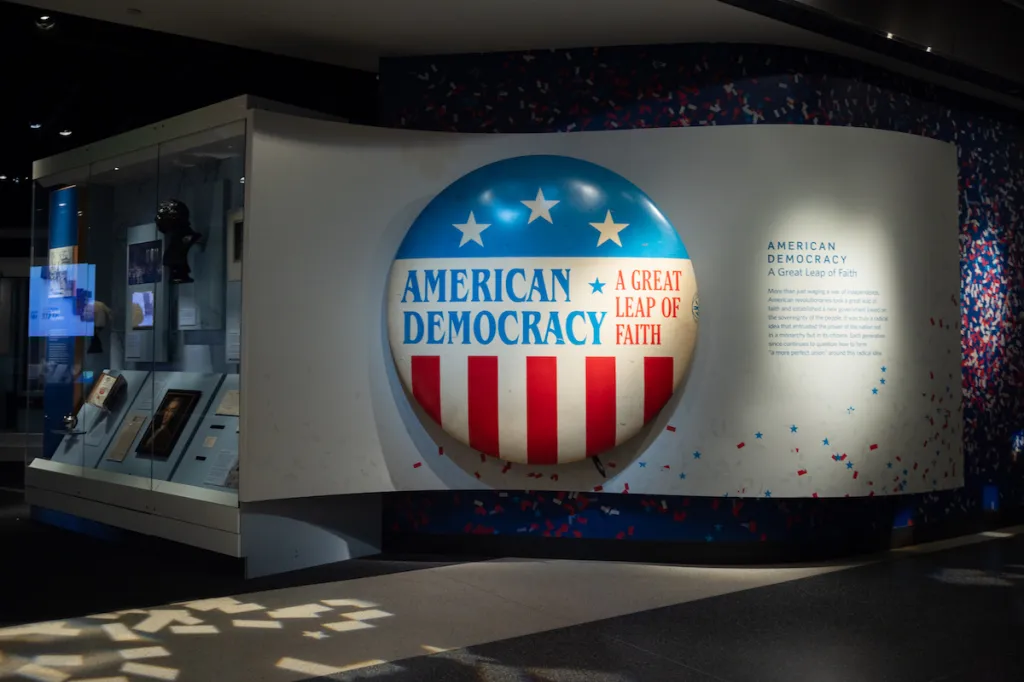
In 2025, Trump opened war on the Smithsonian Institution, the consortium of Washington, D.C. museums and archives that includes the National Museum of American History, the National Portrait Gallery, the National Museum of the American Indian, and the National Museum of African American History and Culture. After retaking office in January, Trump issued an executive order intended to combat what an accompanying fact sheet called “anti-American ideology” at the Smithsonian, whose network was already in the process of disbanding its diversity offices when the order was signed.
The Smithsonian is not a federal agency, and as such is not under direct White House purview, however federal funding comprises nearly two-thirds of its $1 billion annual budget. Additionally, its Board of Regents includes the Chief Justice of the United States, the Vice President, three Senators, three US Representatives, and nine citizens, making it vulnerable to government overreach.
And indeed, it became obvious just how vulnerable the Smithsonian really was. In May, Trump said he fired Kim Sajet, director of the Smithsonian’s National Portrait Gallery, moving legal experts to question whether he had the power to make that call. Sajet then clarified in a public statement that she would depart the post she had held since 2013, closing the confusing and concerning chapter.
JD Vance, the Vice President, had by this point already been deputized by Trump to ensure that “future appropriations” continue to flow from Congress to the Smithsonian, and by the summer, an internal review of the Smithsonian was opened. Under this directive, every aspect of the Smithsonian’s programming—including its didactics, the art itself, and grants awarded to artists—were judged to see if they aligned with the new values outlined by the executive order, which spoke of a “divisive, race-centered ideology” at the Smithsonian.
In response, Smithsonian leadership publicly reiterated the network’s nonpartisanship and independence, however critics alleged that the overhaul was already underway. The National Museum of American History, for example, was scrutinized for editing Trump’s two impeachments out of its related display. That institution subsequently put that display back on view—with altered text, echoing an earlier incident in which content on African American history was temporarily removed from government websites.
Doubling down on its directive, the White House website published a list of artworks and shows that did not match the administration’s values, such as one exploring sculpture as a signifier of power at the Smithsonian American Art Museum. The National Museum of African American History and Culture language regarding “white dominant culture,” already denounced in the executive order, was again blasted.
Artists Take a Stand Against Federal Overreach at the Smithsonian
Mounting concerns of government overreach at the Smithsonian erupted in July when Amy Sherald, the painter who skyrocketed to fame with her 2018 portrait of Michelle Obama, canceled her exhibition set to open this fall at the Smithsonian’s National Portrait Gallery, where it would’ve been the first solo presentation by a Black contemporary artist at the institution. Sherald said she made her decision after she learned that her painting of a Black transgender Statue of Liberty might be removed from the show in a bid by Smithsonian leadership to avoid President Trump’s ire. (The painting had appeared in previous versions of the show at other museums, and went on to feature on the cover of the New Yorker.)

Amy Sherald, Trans Forming Liberty, 2024.
Kevin Bulluck/©Amy Sherald/Courtesy the artist and Hauser & Wirth
“When governments police museums, they are not simply policing exhibitions,” Sherald wrote in a MSNBC op-ed. “They are policing imagination itself.” Her protest appears to have moved other artists to act similarly.
In September, another controversy hit the Smithsonian when artist Nicholas Galanin withdrew from a symposium related to “The Shape of Power: Stories of Race and American Sculpture,” an exhibition at the Smithsonian American Art Museum that Trump denounced for promoting “the view that race is not a biological reality but a social construct,” a view confirmed by modern science. Galanin was to speak at the Smithsonian American Art Museum on Saturday as part of a two-day symposium, an event not publicly listed on the Smithsonian’s website at the time of its occurrence.
“The decision to make the symposium a private event with a curated guest list and request that we not record or share it on social media effectively censors those of us who would be participating,” Galanin wrote at the time. A Smithsonian American Art Museum spokesperson denied any censorship.
The Whitney’s Storied ISP Program Shutters Over Pro-Palestine Performance
Next to the Smithsonian, no American museum weathered a greater political storm in 2025 than the Whitney Museum in New York, which canceled a pro-Palestine performance planned as part of the Whitney’s 2025 Independent Study Program in May, then went on in June to dismiss Sara Nadal-Melsió, the program’s associate director since 2024. (Artist and writer Gregg Bordowitz had already been demoted to the status of director-at-large at the ISP, though the circumstances of that shift remain unclear.)
According to a statement posted to Instagram from Nadal-Melsió, the performance, titled No Aesthetic Outside My Freedom: Mourning, Militancy, and Performance and conceived by Fadl Fakhouri, Noel Maghathe, and Fargo Tbakhi, was canceled by the Whitney Museum after its leadership viewed a recording of its initial presentation at the Poetry Project. Originally commissioned by the leftist Jewish magazine Jewish Currents, the performance was preceded by a request that attendees only remain in the audience if they “love Palestinians wholly and completely.” Viewers should leave if they “believe in Israel in any incarnation,” they were told. According to the artists, the Whitney version did not include this call to action.
The Whitney said in May that its decision to cancel the performance was “clear and necessary.” Many disagreed. ISP curators and artists publicly protested the cancelation, and in July, more than 100 artists and scholars, including Emily Jacir, Hans Haacke, and Michael Rakowitz, signed an open letter in support of Nadal-Melsió, whose position was eliminated. “Her dismissal is one act of patriarchal institutional violence among many, yet another symptom of the entangled violences that suffuses the present climate of suppression in the United States,” the letter reads. Its signatories also reiterated a request from the Artists at Risk Connection (ARC) for the museum to “convene an independent investigation into the termination of the ISP’s Associate Director and its implications for academic and artistic freedoms at the museum.”
Pro-Palestine demonstrators occupying the Whitney Museum lobby on May 23.
Tessa Solomon/ARTnews
Nadal-Melsió also spoke openly on the matter, publishing her own letter in which she said that the ISP “has always been unapologetically engaged with the politics of its times,” noting that participants were currently addressing “fascism at home and the relentless genocide being carried out in Gaza.” Now, she wrote, “we also face unprecedented censorship and a threat to our foundational independence because of our pursuit of the very dialogue that makes the ISP what it is.”
Sally Mann Warns of Censorship After Police Raid in Texas
The conservative campaign against the arts reached Texas at the start of 2025, when a selection of photographs by Sally Mann in a group exhibition at the Modern Art Museum of Fort Worth was seized by police on suspicion of child pornography. The controversy surrounded images of her rural Lexington, Virginia, home taken in the 1990s that featured her nude, underage children. The images are not sexual, however they have been characterized by conservative critics over the years as “child porn.”
Scrutiny escalated into action later in January, when Fort Worth police raided the exhibition on the basis of an investigation into the images, exacerbating tensions around freedom of artistic expression in Texas. The incident was explicitly referenced in relation to a bill proposed that April that would introduce civil penalties up to $500,000 against any museum showing “certain obscene or harmful material.” (The Texas Penal Code defines “obscene” as any kind of performance or material that depicts sexual acts without literary, artistic, political, or scientific value.)
The Fort Worth Police Department ultimately returned the contested photographs to Sally Mann’s gallery, Gagosian, following an investigation that cost the state nearly $7,000. Speaking later to NPR, Mann said: “We’re entering a new era of culture wars, I’m quite sure. And I think the people who are pursuing this are much more sophisticated and have many more tools at hand.” She suggested social media as one such tool.
Australia’s Venice Biennale Pick Is Dropped, Then Reinstated
At the world’s premier international art event, when scores of curators, collectors, and journalists descend on the lagoon city, every aspect of the artist chosen to represent a national pavilion—their identity, past accolades, and practice—becomes a proxy for the aesthetics and ideals a nation values at that moment in its history. This dynamic was illustrated with damning clarity in the case of Lebanese-born artist Khaled Sabsabi and curator Michael Dagostino, who were selected to helm Australia’s 2026 Venice Biennale pavilion, only to have the appointment abruptly rescinded by Creative Australia, the organization that makes the Australian Pavilion in Venice possible. Although the pair was ultimately reinstated, the episode spurred multiple resignations at Creative Australia, one of the largest funding bodies in the art world, and deepened fears that artists perceived as critical of Israel are subject to censorship.
Curator Michael Dagostino and artist Khaled Sabsabi.
Anna Kucera
The controversy began in February, just days after Creative Australia announced Sabsabi’s selection. A column in the Australian labeled the pavilion a “creative approach to racism,” singling out You, Sabsabi’s 2007 video installation that includes manipulated footage of Hezbollah leader Hassan Nasrallah addressing a crowd after the 2006 Lebanon-Israel war. The article also accused Sabsabi and Dagostino of having “favored boycotts of Israel,” a reference to Sabsabi’s 2022 Sydney Festival withdrawal over its Israeli government sponsorship. Days later, the board of Creative Australia unanimously reversed their selection, citing the risk of a “prolonged and divisive debate.”
The fallout was swift, with senior Creative Australia staffers Mikala Tai and Tahmina Maskinyar resigning in protest. Simon Mordant, formerly the international ambassador for the Australian Pavilion and a major cultural philanthropist, later tendered his own resignation, describing the situation as “a very dark day for Australia and the arts.” Artists and institutions also rallied behind Sabsabi, including Palestinian artist Emily Jacir, a former Golden Lion winner at the Biennale. “Shame on Creative Australia,” Jacir wrote on Instagram. The five shortlisted candidates for the pavilion issued an open letter demanding Sabsabi’s reinstatement.
Amid this outpouring of support, Sabsabi told the Guardian that Creative Australia’s sudden reversal was “dismantling” his career. “Nobody should have to go through this torture,” he added. Then, on July 2, following an independent review and months of backlash, Creative Australia reinstated Sabsabi and Dagostino to Australia’s 2026 Venice Biennale pavilion. In a joint statement, the pair called the reversal “a sense of resolution” after “significant personal and collective hardship,” and thanked the creative community whose “unwavering support” made it possible.
Documenta Adopts a Controversial Definition of Antisemitism, Spurring Backlash
Israel’s war in Gaza has generated some of the most pressing political debates waged in Germany in recent history, pulling its cultural sector into a long-simmering existential crisis over antisemitism, racism, xenophobia, and the legacy of the Holocaust. Thus far, German cultural institutions have landed on what might generously be described as the side of caution—often opting out of the forum by canceling the condition for it all together. Throughout 2024 a wave of cancelations, defundings, and resignations rippled through the sector, including the departure of the entire Documenta 16 finding committee, following a scandal at the quinquennial’s 2022 iteration over an antisemitic artwork.
Documenta 15, the 2022 edition, has come to define this ongoing cultural reckoning, as underscored by a high-profile incident this December: the cancellation of an exhibition of work by Arte Povera artist Marisa Merz, which has been scheduled to open at the Fridericianum, Documenta’s historic anchor. (The institution mounts major surveys during the periods between editions.) Beatrice Merz, the artist’s daughter and the president of the Fondazione Merz in Turin, told Monopol magazine that she withdrew the exhibition in protest of Documenta’s adoption of the International Holocaust Remembrance Alliance (IHRA) definition of antisemitism, a framework that artists and academics in Germany have argued is politically divisive as under its guidelines, which state that criticism of Israel or Zionism may be construed as antisemitic. The German Bundestag formally adopted the IHRA’s definition of antisemitism in 2024, despite opposition.
“A collaboration with the Museum Fridericianum would have meant accepting the museum’s code of conduct, which uses the IHRA definition of antisemitism—a definition with which I don’t agree in every respect,” Merz said. “In my view, it would have been more appropriate to use the JDA, the Jerusalem Declaration on Antisemitism. For this reason, as president of the Fondazione Merz, I felt it was right to cancel the exhibition project. I am convinced that art should not be restricted by borders and, above all, must be free of prejudice.”
In response, Andreas Hoffmann, managing director of Documenta and the Fridericianum, said in a statement that the Documenta Code of Conduct is binding for the institution’s employees, not for exhibition artists or associates: “Insofar as Documenta deems artistic expressions incompatible with the principles set out in this Code of Conduct, it reserves the right to comment on its resulting position and, if necessary, to explain it in the immediate visual context of the exhibited artworks.”
A Curator Flees Bangkok After China Censors His Art Exhibition
Beijing flexed its influence over dissident artists beyond its borders. In September, the curator of a show critiquing authoritarianism in China at the Bangkok Art and Culture Center departed for London amid fears of arrest and deportation.
Three days after “Constellation of Complicity: Visualising the Global Machine of Authoritarian Solidarity” opened in July, Chinese embassy staff, accompanied by Bangkok city authorities, “entered the exhibition and demanded its shutdown,” the show’s curator—an artist from Myanmar who goes by the name Sai—told Reuters. The exhibition featured work by exiled artists from countries including China, Russia, Iran, and Burma, and set out to illustrate how authoritarian regimes “collaborate, affirm one another, and reproduce forms of violence under the guise of sovereignty and order,” according to the museum’s website—a goal it ultimately fulfilled, though not by the intended means.
The entrance to the Bangkok Art and Culture Centre.
Photo by: Jeff Greenberg/Universal Images Group via Getty Images
The New York Times reported that the directors of the BACC told Sai in an email that the museum had received warnings from the Chinese embassy, the Thai Foreign Ministry, and Bangkok city officials that the exhibition could cause “diplomatic tensions” for Thailand with China. The show remained on view, though multiple edits were made to the display, including the redaction of names of Hong Kong, Tibetan and Uyghur artists, as well as portions of the description of their homelands. Also removed at Beijing’s behest were Tibetan and Uyghur flags, postcards featuring Chinese President Xi Jinping, and a postcard examining links between China and Israel.
The BACC’s directors described the locations targeted for removal as “politically sensitive places where the Chinese government has been tightening its control,” according to the Times. The museum also reportedly removed materials addressing Beijing’s treatment of ethnic minorities and Hong Kong from the show.
“It is tragically ironic that an exhibition on authoritarian cooperation has been censored under authoritarian pressure,” said Sai, cofounder of Myanmar Peace Museum, in a statement. “Thailand has long been a refuge for dissidents. This is a chilling signal to all exiled artists and activists in the region.”
