


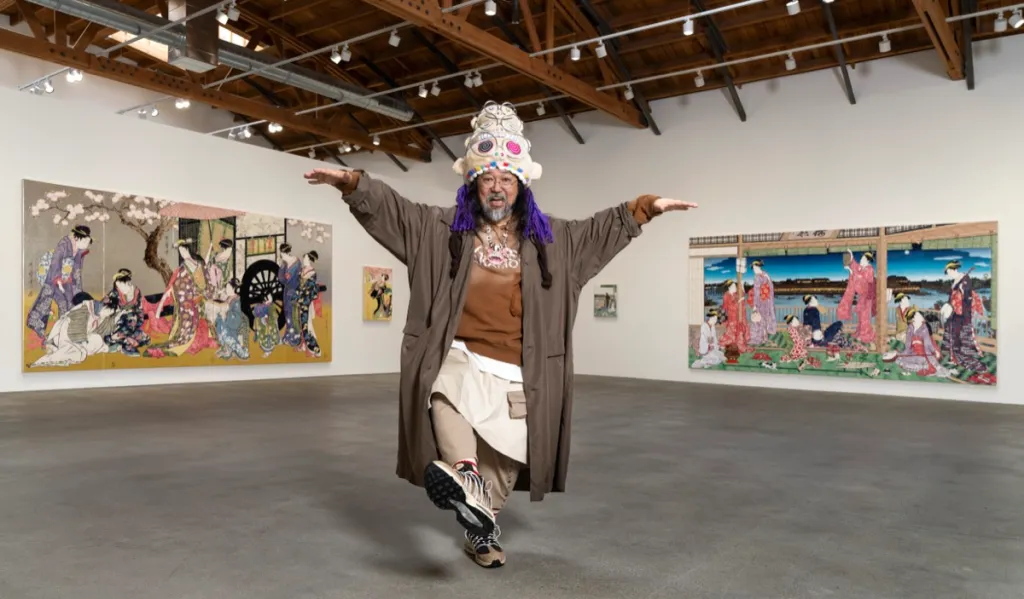
Takashi Murakami closes his eyes when he speaks. Still, this makes him no less animated: his hands gesture wildly, the pitch of his voice rising and falling. The artist is speaking in Japanese, but even before his translator intervenes, I can glean some of the sentiment from the proper nouns and the range of intonations. We are sitting in the center of Perrotin’s Los Angeles gallery amid a crowd of stylists, videographers, and representatives from both the gallery and Kaikai Kiki, Murakami’s Tokyo-based production studio. He sweeps his hands toward the four monumental canvases on either side of us, which collectively took more than three years to complete, and explains why, for him, time doesn’t move linearly.
“I’m 64,” he says. “I often wake up not feeling great. A little depressed, a little bored.” But then, in January, while he was down with the flu, his daughter received her acceptance to a prestigious school. The elation was so sudden and so physical that he felt as though he were inhabiting two moments simultaneously: the present joy and the memory of his own acceptance letter arriving 40 years earlier. “I felt like I was reborn,” he says. “And the flu? It was cured.”
This belief that time folds back on itself—that the past is not distant but available, habitable—animates much of Murakami’s practice, including the 24 compositions comprising “Hark Back to Ukiyo-e: Tracing Superflat to Japonisme’s Genesis.” Long concerned with post–World War II anime and manga culture, he has recently expanded his attention to include historical Japanese paintings. Here, inspiration spans Edo-period woodblock prints, nineteenth-century Impressionism, and Pokémon cards, proving that influence, like grief and joy, doesn’t travel in only one direction.
This is not, in fact, Murakami’s first critical engagement with nihonga, or traditional Japanese painting. He began his career studying the historical style at Tokyo National University of Fine Arts and Music, eventually earning his PhD. Despite his stated indifference toward the subject, he admits that the “history sank into body and skin.” Upon graduation, Murakami pursued manga instead, hoping to translate otaku culture into contemporary art and erode the distinction between commodity, mass media, and work considered worthy of a museum. The resulting work—superflat, candy-colored, populated by doe-eyed anime characters oscillating between innocence and menace—introduced a new visual language, described by The New York Times critic Roberta Smith as “radiantly beautiful” and “an art of extreme articulation in which everything is pushed toward its opposite.” Adopting the studio-factory model favored by Americans like Andy Warhol, he launched Kaikai Kiki, which currently employs more than 300 people and produces, along with labor-intensive silkscreen paintings, an extensive line of branded merchandise: trinkets, trading cards, multiples, publications, and housewares.
An installation view of Kitagawa Utamaro’s “Parody of an Imperial Carriage Scene” Cherry Blossoms Dancing in the Air – SUPERFLAT, 2025 – 2026, by Takashi Murakami.
Photo Guillaume Ziccarelli; ©︎Takashi Murakami/Kaikai Kiki Co., Ltd. All Rights Reserved; Courtesy Perrotin.
Then, in 2011, the Tohoku earthquake and tsunami killed nearly 20,000 people. Murakami had been preparing for an exhibition in Doha, Qatar, and asked the curators if he could pivot toward something more metaphysical in scope. The result was The 500 Arhats (2012), four murals that cumulatively span nearly 330 feet in length, depicting five hundred enlightened disciples of Buddha—the eponymous arhats—in the style of a 100-scroll series created by the Edo-period artist Kanō Kazunobu. A desire to contend with human suffering and offer a vision of hope and healing is legible in the mesmerizing collection of time-worn elders and sacred animals pitched against swirling winds and unfurling flames. “So many people abruptly and violently lost their loved ones, and they can’t live without a sort of a story,” he said. “I realized then, that’s why religion exists, to tell a story you can live with.” It was, in many ways, a form of rebirth for the artist’s career: not into another world, but back into this one. The nihonga he had spent eleven years absorbing without necessarily wanting to had resurfaced with a purpose.
The impulse to look to the past to understand the future informs many of the canvases in the Perrotin exhibition. Formally, Murakami quite literally replicates masterworks as a way of learning from and revering those who came before him. Two enormous works, Kitagawa Utamaro’s “Flowers of Yoshiwara” Dogs and Cats Intoxicated by Cherry Blossoms – SUPERFLAT (2025–2026) and Torii Kiyonaga’s “A Party Viewing the Moon across the Sumida River” UFO, Flower Parent and Child, and Many Cats – SUPERFLAT (2025–2026), are based on famous examples of the ukiyo-e genre bijinga, which idealized women, particularly courtesans from the “floating world” pleasure districts. The works are and are not copies. They are based on high-resolution photos of the originals and utilize the same devices to convey sensuality and evoke desire. But they are also unique compositions, reimagined in Murakami’s distinct style, with chromatic outlines, built-up metallic backgrounds, and the occasional inclusion of his signature smiling flower figures. Rather than using woodblock, each composition is built from layer upon layer of silkscreened acrylic paint and coated in a high-gloss veneer. The meticulous finish belies the complexity of the process, which is both the point and a problem.
“It’s like watching Shohei Ohtani hit a home run,” Murakami says. “It looks so effortless, you have no idea what goes into that.”
Conceptually, the Edo period—especially toward its decline—offers a kind of reflecting glass. On the surface, it was an era of unusual prosperity, as captured by the highly stylized ukiyo-e prints of the hedonistic lifestyles enjoyed by the leisure class. But that calm was precarious. The American black ships would arrive by the 1850s, forcing open a nation that had been secluded for over two centuries and toppling the government. The artists making those serene bijinga compositions, Murakami suggests, must have felt the tremors of what was to come. The parallels to this particular cultural moment—with its compound anxieties, willed ignorance, and appetite for easy, instantaneous pleasure—are not belabored. Still, it’s possible to see in the fulsome tea-service scenes and women dressed in luxurious kimonos an echo of our own brunch culture and all the apathy it foretells. The decision to pursue a more modest form of sexuality, especially when compared with past exhibitions in L.A. that featured works like My Lonesome Cowboy (1998), a life-sized, nude anime-inspired man creating a lasso with his semen, might also register the censorship and conservatism enforced by the current administration in the U.S.

Installation view of the paintings Camille Doncieux Painting Outdoors, 2025 – 2026 (L), Claude Monet’s “Woman with a Parasol – Madame Monet and Her Son” A Spacetime of Awareness – SUPERFLAT, 2025 – 2026 (C), and Flower-Chang on the Hill, 2025 – 2026 (R).
Photo Guillaume Ziccarelli; ©︎Takashi Murakami/Kaikai Kiki Co., Ltd. All Rights Reserved; Courtesy Perrotin.
In the second of the two galleries, Murakami traces the direct visual genealogy from the bijinga women to the Impressionists, in particular Monet and his seminal painting Woman with a Parasol – Madame Monet and Her Son (1875). His copy of the portrait—with its tilted ground, windswept skirt, sensual silhouette, and cloudlike flurry of cherry blossoms—all but confirms the possibility posed in the press materials that Monet saw many of these works firsthand when the famed collector of Japonisme art, Siegfried Bing, brought them to Paris in the late 1800s. Like flipping an hourglass mid-fall, the flow of influences rushes back in the opposite direction before the viewer’s eyes. In the final series, Murakami thins the partition between past and present further still. Both Camille Doncieux Painting Outdoors (2025–26) and Contrail and Flower-Chang on the Hill (2025–26), depicting anime figures on grassy hills beneath a flat, airbrushed blue sky, are based on trading card designs. Though the ultra-simplified, deliberately flat aesthetic stands in tension with the ornate, obsessively detailed Utamaro-derived paintings, Murakami makes the case for their similarities: both are popular, mass-produced, and intended to manufacture desire for another world.
There is a version of Murakami that is easy to misunderstand: the brand, the factory, the entourage, the commercial collaborations, the gift shop currently doing brisk business in the next room. That version has always been at least partly strategic, a kind of funhouse mirror held up to the art market, which has long rewarded this kind of self-aware spectacle. But the works in this exhibition resist easy consumption—even as they court it—all while remaining accessible to a wide audience. To follow the thread from the floating world to the gardens of Giverny to Pokémon cards is to understand that nothing in culture originates; everything recurs, and the distance between then and now, both in art and in life, is mostly just a story we tell ourselves in order to move onward.
Before I leave, I spy a rainbow-colored face peering out from behind the hem of a voluptuous kimono. For a moment, I can’t decide whether he’s from the 1800s or from 2026, or perhaps, like his creator, from both at the same time.
