


One winter night a few years ago, I joined a motley group of about 35 people gathered in the walled courtyard of a former cosmetics factory in Aubervilliers, a commune just north of Paris. The derelict space had been taken over by artists, and low-income housing projects lit the skyline.
The Sydney-born, Paris-based artist Angelica Mesiti had invited people of different generations and backgrounds to participate in a midnight filmed performance. She outfitted the group with headpieces and a few long staffs made of dried plants and flowers. We knew little about the project but had a vague understanding that we were needed for a carnivalesque ritual celebrating the nearing end of winter. We were not wrong.
Angelica Mesiti.
Photo Pati Grabowicz, 2026 Museum Tinguely, Basel
During the over-three-hour performance, Mesiti kept her distance, half-hidden behind a large camera. Meanwhile, a small group of women began singing in breathy, blended vocals that felt both ancient and futuristic. Guided by their pulsing notes that grew into brisker “aiy-ahh-ehhs,” we coalesced into a slow-moving procession and lumbered forward as the night grew colder. Unknowingly, we began to step in rhythm to their chants, creating a kind of slow-walking dance. Eventually, we formed a circle around a bonfire, with the night culminating in fireworks exploding from a makeshift papier-mâché donkey.
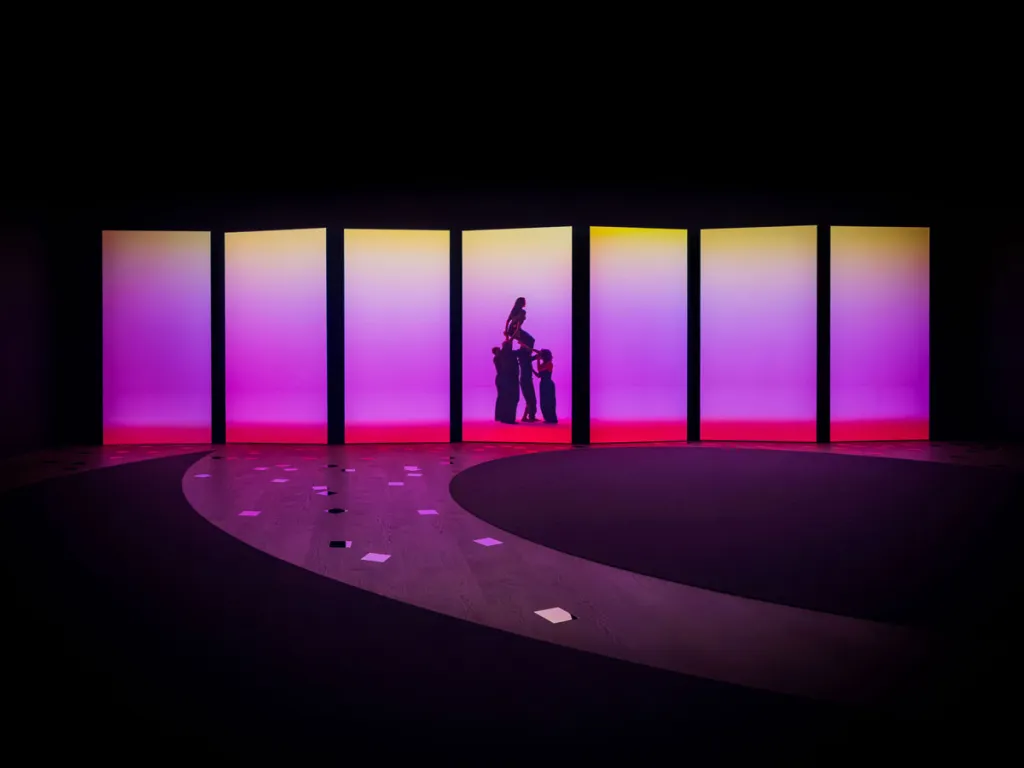
The performance was partly inspired by the Italian patron saint processions Mesiti grew up attending with her immigrant Calabrian family in Sydney. And it eventually formed one chapter of The Rites of When (2024), a “quasi-science fiction, utopian, speculative adventure about our out-of-sync world,” as Mesiti, who has become a friend, characterized it to me recently. The film’s title nods to Stravinsky’s ballet, Rite of Spring, and also references “everywhen,” an Aboriginal word referring to the Australian Indigenous concept of non-linear time. The Rites of When now serves as the centerpiece of Mesiti’s current solo exhibition, “Reverb,” at the Museum Tinguely in Basel, Switzerland (through August 30).

Angelica Mesiti, The Rites of When, 2024, installation view, at Museum Tinguely, Basel, 2026.
Photo Pati Grabowicz, 2026 Museum Tinguely, Basel/©2026 Angelica Mesiti and ProLitteris, Zürich/Courtesy the artist, Galerie Allen, Paris, and Anna Schwartz Projects, Melbourne; Commissioned by the Art Gallery of New South Wales
On a recent visit to Basel, I was finally able to see the film in its completed form, a seven-channel configuration (for the seven most visible stars in the Pleiades), installed in a room designed to reflect the 3,600-year-old Nebra sky disc, thought to have served as an agricultural calendar. Seeing the final work, now with its connections to the celestial alignments for the solstice, I began to think back to the ritual we performed that winter night, and how I had eventually forgotten about the peculiarity of our moonlit escapade in its urban setting, leaving me with a sense of openness to whatever strange magic might come of our pilgrimage together. As the film’s dance sequences played in front of me before ending in an ecstatic, cathartic rave-release, I was reminded again of that hopeful feeling for what the future may hold.
Across the museum and alongside Tinguely’s moving mechanical sculptures, Mesiti, who represented Australia at the 2019 Venice Biennale, is showing four other multichannel works made since 2012. Throughout her practice, Mesiti probes unusual ways of communicating, both naturally occurring or performed, doing so without making use of audible words. Her subjects range from the humming of trees conversing through underground fungi to the iridescent call (invisible to humans) that flowers make to fluttering bees. She has explored forms of whistling languages and signed speech, which she then recontextualizes. The Colour of Saying (2015), for example, shows a choir both singing and signing, while elsewhere, seated elderly ballet dancers soundlessly indicate the movement of a pas de deux from Swan Lake with their arms and hands. In Relay League (2017), on view in Basel, we experience different musical, sign, and dance interpretations of the final Morse code message the French Navy ever sent, in 1997.
Angelica Mesiti, Relay League (still), 2024.
©2026 Angelica Mesiti and ProLitteris, Zürich/Courtesy the artist, Galerie Allen, Paris, and Anna Schwartz Projects, Melbourne; Commissioned by the Art Gallery of New South Wales
In works like these, Mesiti seems to ask how we reach across space and silence to speak to each other, reminding us why such communication can feel so good—essential even. “We’re so out of tune, so how do we re-tune? Is it even possible?” Mesiti asks in a catalog essay about The Rites of When.
In a way, The Rites of When, which debuted in 2024 at Sydney’s Art Gallery of New South Wales, represents an evolution of Mesiti’s documentary-style approach into an experimental, more fictionalized, musical film in which she reframes existing material she discovers. This is all done with an eye toward our current climate crisis, and she is also specifically asking whether it’s possible to invent new, inclusive forms of secular rituals that might bring us closer to the environment and its natural cycles.
Angelica Mesiti, The Rites of When (still), 2024.
Photo Pati Grabowicz, 2026 Museum Tinguely, Basel/©2026 Angelica Mesiti and ProLitteris, Zürich/Courtesy the artist, Galerie Allen, Paris, and Anna Schwartz Projects, Melbourne; Commissioned by the Art Gallery of New South Wales
Deliberately choreographed sequences with rhythmic, theatrical narrative arcs are intermixed with aerial views of “unnatural nature,” like rows of uniform trees that are farmed monocultures, preventing biodiversity and using up precious resources. In another sequence, vast acres of parched, golden wheat fields suddenly combust into flames while being industrially harvested. (The fire was completely unplanned and spontaneous.)
“That is the moment we’re living in. One of the weather extremes, of more fire, more rain, more floods,” Mesiti told me during a walkthrough of the Basel exhibition.
The choreographed sequences in The Rites of When draw on Mesiti’s training in classical ballet, as well as her childhood obsession with movie musicals from the 1940 and ’50s, like The Red Shoes, An American in Paris, or Daddy Long Legs. Dance “is the connecting point for many different parts of my life,” she said.
Angelica Mesiti, The Rites of When, 2024, installation view, at Museum Tinguely, Basel, 2026.
Photo Pati Grabowicz, 2026 Museum Tinguely, Basel/©2026 Angelica Mesiti and ProLitteris, Zürich/Courtesy the artist, Galerie Allen, Paris, and Anna Schwartz Projects, Melbourne; Commissioned by the Art Gallery of New South Wales
After unlearning some of her classic dance training while studying at the Laban Dance Centre in London, Mesiti enrolled in Sydney’s College of Fine Arts (COFA), where she discovered performance art and soon joined an all-women collective called the Kingpins. Their live performances in Sydney’s drag scene parodied hyper-masculinity and soon moved into artist-run spaces with installations and video works. (Their collaboration ended around the time when Mesiti moved to Paris in 2009.)
“I wanted to do other things in my own language, and started developing my own voice,” she said of that period. But it took years before she felt ready to break from the act of documenting, and work with choreography, dance, and musical sequences, to produce a film like The Rites of When, that expresses her ideas. “I think I’ve always been trying to make a musical. I’m still trying to make a musical,” she said.
For the moment, however, Mesiti said she is on to other things. For one, she has been contemplating the effects of AI and new technologies on how we process imagery that can no longer be clearly understood as reliable fact or fiction, while coming at us simultaneously from different, multiple realities. To that end, “linearity seems pre-Internet,” she told me. “I feel like we, as artists, need to look or construct elsewhere, or rethink what we’re doing with images.”
