


In the 1990s, the Hong Kong–based artist Wallace Chan purged all his earthly possessions to live as a Buddhist monk for six months. But since then, he has swapped austerity for exuberance, channeling his spirituality into glittering works of art. After studying metal intently for eight years, he found himself pioneering new techniques in titanium. And for his two-venue summer show, “Vessels of Other Worlds”—on view both in Venice at the Pietà Chapel and in Shanghai at the Long Museum—he’s gone fully maximalist.
Three incredibly intricate vessel-shaped works, comprising over 5,500 individual titanium parts, are assembled using 22,000 screws. A livestream connects both shows: The vessels in Shanghai are larger versions of those in Venice, reaching nearly 10 meters (roughly 3 stories) high. Buddhism is so often imagined in austere aesthetics, but as Francesca Tarocco writes in Art in America, much of today’s Buddhist-inspired art rejects this reductive read, reminding that “while the Buddha’s narrative certainly highlights renunciation … renunciation is often met with splendor.”
Intricate in form and maximalist in style, each of the thousands of parts in Chan’s sculptures have specific meanings that he considers carefully. In Venice, he told ARTnews about his symbols below.
Wallace Chan at work in his workshop.
Two years ago, I saw a stone carving in another church in Venice, at the Church of St Anthony. I recognized its symbols as part of not just Christianity, but of different religions: You can find oil vessels in both temples and churches. I thought I would take its iconography and blow it up to a monumental scale. I wanted to use symbols from different religions and cultures to reflect on my own existence, and to understand how to create something that is universal, that responds to the very essence of why we are here.
“Vessels of Other Worlds” centers around three vessels: The first one is birth, the second one is growth, and the third is rebirth. I wanted to fuse all the symbols and phenomena I’ve observed related to how humans try to understand our existence, as well as the passing of time and the essence of life. That’s why there are clocks with numbers: Of course, before rebirth, there is death, but that doesn’t have to be sad. It can be something to celebrate. Energy is only transformed; it’s never destroyed. To die is to embrace a new life, which is a reason to celebrate.
While studying symbols and trying to arrive at a common language for people from different backgrounds and cultures, I landed on bells. The vessels are in the shape of bells because you have bells in churches, in schools, and in temples. Bells ask for a moment of your attention.

View of Wallace Chan’s 2026 exhibition “Vessels of Other Worlds” at Pietà Chapel, Venice.
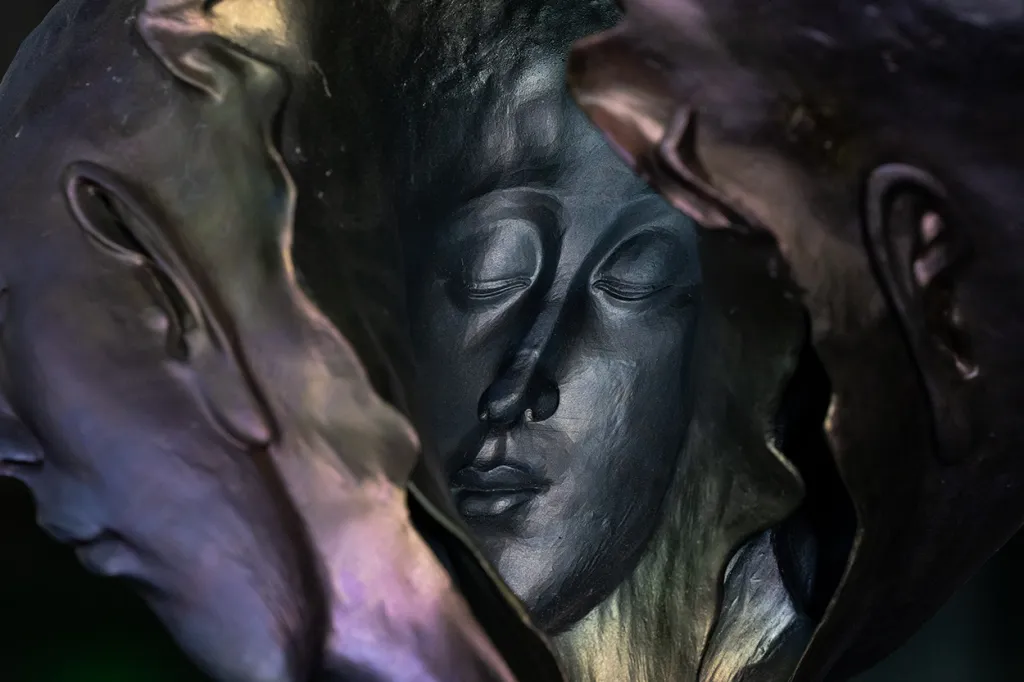
The vessels are embossed with both Western Zodiac signs and Chinese Zodiac animals: They’re connected in this DNA-like structure. For me, it shows that West and East are very connected, and are not so different. The Zodiac characters appear on lotus leaves like the ones the Buddha meditated on. You’ll also see lotus flowers and human faces that are very calm. For me, the faces I sculpted represent my ideal phase of existence, the face of the universe. They’re not female nor male, neither old nor young. They’re always calm, even when the facial form is torqued and twisted.
Water is what Venice and Shanghai have in common, and I found myself imagining what it’s like for water to come all the way from the sky to Earth, then wanting to capture that sense of motion. I wanted to incorporate a live transmission connecting both shows because I’m trying to create portals, and thinking about the ways that religions have helped humans to try to understand what’s beyond them. I wanted viewers to be aware of the presence of other worlds.
Detail from Wallace Chan’s 2026 exhibition “Vessels of Other Worlds.”
I was drawn to working in titanium because it’s super light. It can also be installed in our bodies—as with a pacemaker, or when setting bones—because it’s bio-friendly and can be made to have antimicrobial properties. I spent eight years learning about titanium and trying to innovate, looking for a metal that could work as an armature for my elaborate creations. But then I realized that titanium is also used in rocket building, that it can be so small as to go into our body but also so big as to go into outer space. Soon, I started using titanium for bigger and bigger pieces.
Like me, titanium is very stubborn. Its melting point is 1,700 degrees Celsius [over 3,000 degrees Fahrenheit]. So even when facing high heat, it can refuse to melt. That means I’m creating work that will outlive me, that can become an embodiment of my existence and time. I feel quite confident that in 1,000 years, they will still stand.
