


“Let them eat cake,” the anonymously-run X account @PatriotTakes declared earlier this month. Following its stated mission of monitoring “right-wing extremism and other threats to democracy,” the account issued this declarative alongside found footage of a rather peculiar party. A husky in a pistachio overcoat and breeches spins his flouncy bulldog lover around a patch of overly green golf grass to the croons of a knockoff Sinatra. On the edge of a night-lit pool, a pink-suited pitbull sporting an extravagant cravat shimmies beside a Saint Bernard whose rose- and ribbon-covered pannier swings in time to “Valerie.” It’s a palm tree pastoral, a fête galante à la Landseer. Or it would be, if the bland black tuxedos of the gala-going class didn’t keep edging into the frame.
It’s an image almost too perfect for parody: within the gauche glamour of a pool house palazzo, the tweet continues, “Entertainers wearing dog masks and Rococo-era 18th-century European aristocratic court costumes danced for Mar-a-Lago guests.” Dancers done up as decadent dogs might seem more a threat to taste than to democracy, but in the Trump era, the point of crying “Rococo!” is to fashion the former as the latter. Critical Cassandras (guilty as charged) have found in Trump’s particular brand of gilt interior the smoke-signal of power wielded both arbitrarily and absolutely.
Screengrab from a video of a Humane Society benefit at Mar-a-Lago.
But if the past year has proved those political predictions correct, the stylistic attribution—as the Rococo’s stalwart defenders argue—is off the mark. To reduce the Rococo to Trump’s stodgy gold schemes is to misunderstand a style that emerged out of a time when vulgarity was as philosophically voluptuous as it was aesthetically so. The Mar-a-Lago Furries performing for their “passionate audience of animal lovers” (the event was hosted by the Humane Society) are a better fit for the libertinism associated with the century that produced Marie Antoinette and the Marquis de Sade, Casanova and Candide. Couching their refusal of dogma in the language of kink, both Rococo artists and libertine lifestylists turned pleasure into a tactic of transgression.
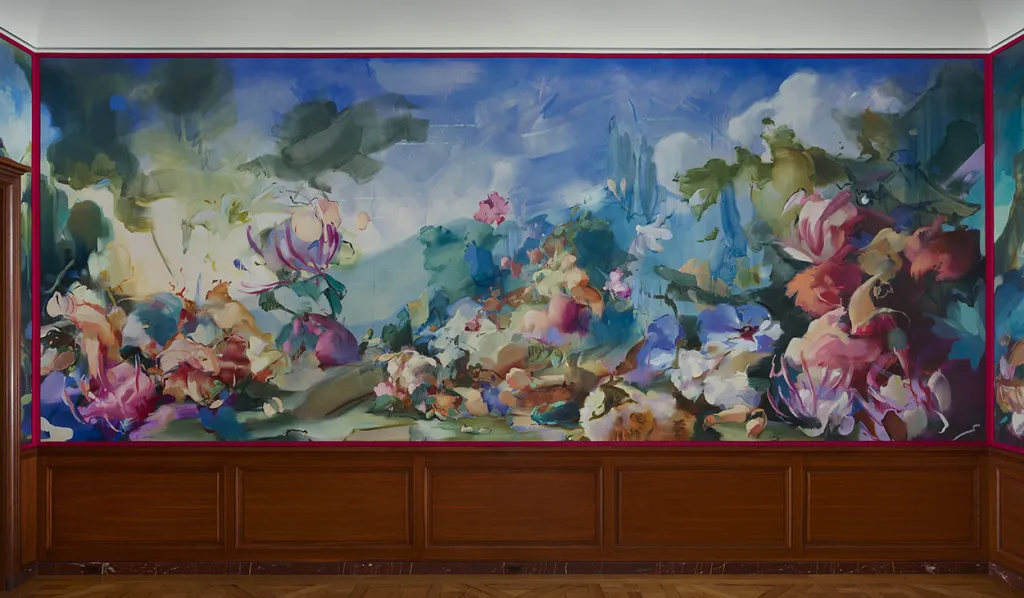
Enter into this picture Flora Yukhnovich, the Hauser & Wirth-stamped British painter who has made her name translating the most canonical confections of the Rococo into latter-day Abstract Expressions, and whose Four Seasons (2025)—an homage to François Boucher’s 1755 series of the same title—is on view at the Frick this spring. As her recent exhibition at the Wallace Collection in London—“Flora Yukhnovich and François Boucher: The Language of the Rococo”—suggests, Yukhnovich has lashed her brand to a historical style whose reputation has, in the past year, became even thornier than it already was. If the Rococo used to be dismissed as frivolous, feminine, and decorative—a misstep in the development of European painting—it now suffers from a confused cultural prominence. And though Yukhunovich claims to see the style everywhere—in Barbie dolls and Disney films, Instagram filters and highlight reels—her eye seems to have glided right past its more topical—and politically-loaded—hooks in things like cottagecore and the Oval Office.
Running around the four walls of the Frick’s Cabinet Room, Yukhnovich’s Four Seasons is installed in what had been, up until the recent renovation, the “Boucher Room.” In a move that might confuse some visitors, her cycle is not named for the paintings that used to hang there—the pudgy prodigies who toot horns, shoot guns, and chase ducks across Boucher’s eight-canvas series known as The Arts and Sciences—but rather for four unassuming canvases that the artist made for the marquise de Pompadour, on view in a nearby hallway. Likely conceived as overdoors, Boucher’s Four Seasons feature licentious pairs—and one trio—frolicking in various states of undress through a landscape so obviously contrived that the Enlightenment philosopher (and hard-hitting art critic) Denis Diderot complained that Boucher had put parsley in his backgrounds. We are the privileged voyeurs of pastoral pleasures: In Spring, a hopeful shepherd ignores his goat to weave flowers through the hair of a buxom companion; in Summer, three nude women loll about a verdant grotto, bathing in the abundant drool of a gawking stone fish.

Flora Yukhnovich: Four Seasons, 2025.
Photograph-Joseph Coscia Jr.
In excising the figures from Boucher’s cycle, Yukhnovich’s Four Seasons nullifies any sense of narrative to underscore instead the extent to which Boucher’s pastorals were always already painterly, the sexuality of their subjects reflected in the sensuality of their brushwork. The man who pushes his luxe lady in Winter, for instance, is enamored not of her low neckline but instead by a strip of blue paint flapping in a frosty gust. In Yukhnovich’s cycle, too, fragile lines float like ink dropped in water: a swoosh of red in her Winter could be the climb of a cardinal; a lick of lavender suggests the way the moon pierces a gloaming blue like a glimmer of light through cut-glass. Specks of white shake off great strokes of purple like a snowfall just disturbed—perhaps by the smears of brown and beige that suggest a deer, maybe two, and a hare, who observe the drift of curious cream snowflakes with nipple-pink centers.
Yukhnovich is a superb painter—there’s no question about that. But her Four Seasons are pastorals not of, but about, paint, and I’m not sure that’s enough to hang her intervention on. On the one hand, they remind us that the Rococo was not always about flashy metals, and that oil could also disorient. On the other hand, they take the charged questions the Rococo has always raised—about art and money, fantasy and power, convention and subversion—and whitewash them in the saleable strokes of abstraction, neutering a style which has always been divisive.
François Boucher: The Four Seasons: Winter, 1755.
Photo Joseph Coscia Jr. Courtesy the Frick Collection
The Frick bills Yukhnovich’s murals as a “new period room—albeit from the twenty-first century.” And yet, what this cycle says about our fractious present remains frustratingly elusive. Sure, I see Disney in the hyper saturated colors and twirly contour lines, and maybe there’s something of Barbie in a pair of bulbous orbs so taut they seem on the cusp of bursting. But what of it? These sources seem at once outdated and defanged, which is a shame, because the Rococo does seem to have a unique, and as yet unarticulated, purchase in our present.
During my visit, I overheard one visitor remark, “It’s giving AI-generated… Do you know what I mean?” I do—it’s the way that one style is grafted onto another, shifting its look without engaging its structure. Were it not for the insistent red tassels bracketing one wall from the other, Four Seasons might feel like a computer-generated immersion—the kind of “panoramic wallpaper” that Yukhnovich describes in her catalog essay. But panoramas—the invention not of 18th, but the 19th, century—were powerful political tools, and this is just ambient art.
