


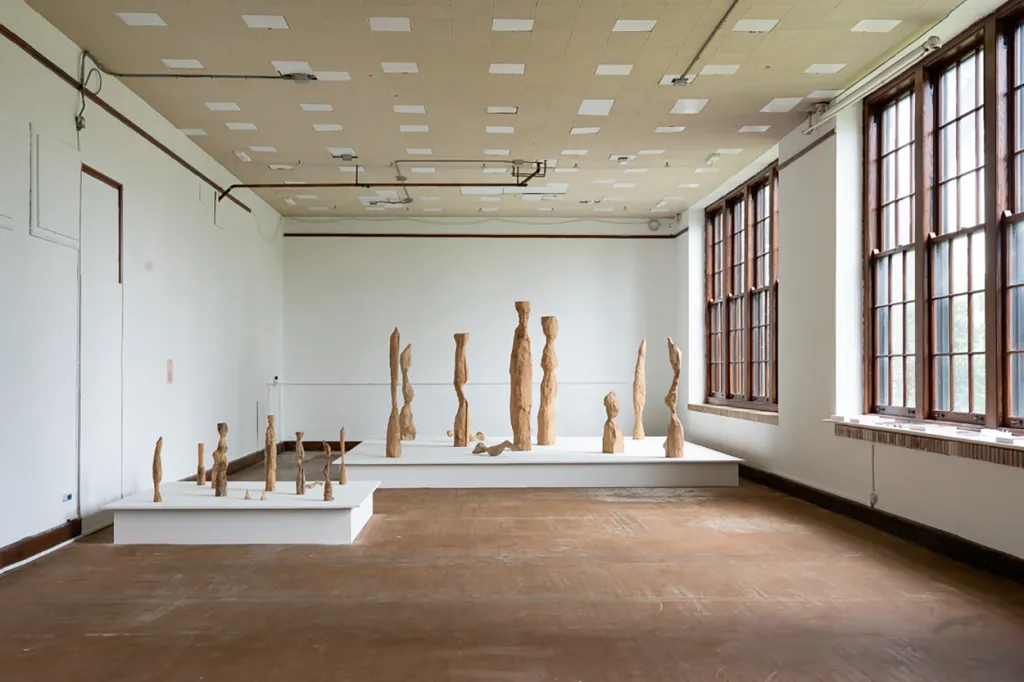
Biennials, triennials, and their ilk perennially ask: What does it mean to make art today? A new triennial in Medina, a rural village in Western New York, tackles the hard question: What does it mean to make art in an age of waning material comfort for all but the world’s richest?
While the baby boomer generation rode waves of economic growth, particularly in the United States, everyone else must now grapple with decline as the economy and environment continue their downward spiral. This reality affects nearly every artist working today, but for those in “All That Sustains Us,” it’s not the background but the subject of their work.
Yet this inaugural edition is less a show of doom and gloom than it is one of resourcefulness: Set in a post-industrial town, artists in the show attend to the sorts of systems that are easy to take for granted when they are working well, like supply chains, food supply, and ecosystems.
Mierle Laderman Ukeles is the show’s oldest living artist, and her video both greets visitors to the triennial’s main site—a former high school—and sets the terms. An animation relays the text from her Manifesto for Maintenance Art, 1969!, a by now iconic document that she wrote after becoming a mother and noticing just how invisible the labor of upkeep had become at every scale. She has been working with sanitation workers around the world ever since.
Hers was hardly a professionalized practice—she was an unpaid artist in residence in the New York Department of Sanitation for about 40 years—and she never worked as a lone agent. Rather, she enlisted art to attend to “all that sustains us,” to quote the show’s title. Many works take up this mantel in more material terms: Where does X come from? is a question frequently posed.
Where do clothes come from? Victoria-Idongesit Udondian pays homage to immigrant textile laborers, gifting them new coats in exchange for their old work clothes, which she has transformed into a sculpture. Dirty black jackets, stiffened to look half alive, appear to crawl along the floor—evoking the racialized abjection of Pope.L while framing global supply chains as a labor issue and as neocolonialism.
Where does food come from? Deirdre O’Mahony interviews Irish farmers who’ve likewise watched their labor and craft ravaged by capitalism, but turns their woes into a memorable libretto set to striking aerial views of their fields. They sing, “Nature shrinks as capital grows.
Where does energy come from? Michael Wang offers a locally sourced supply, having worked with Medina maple tree tappers to craft a natural energy drink called Sugar Bush Energy. (It’s surprisingly effective and delicious.) This is “Think global, act local” at its finest, for not only are local supplies more ecologically sustainable, but often, an issue of labor. Wang’s gesture echoes the abolitionists in the region who once boycotted sugar, replacing it with maple in their diets. After all, 70 percent of all African people kidnapped as part of the Transatlantic Slave Trade were enslaved on sugar plantations.
Capitalism works, according to Marx, through alienation, black boxing supply chains and distancing workers from the material world and from one another. By seizing the means of production—or, by learning to make our own stuff—we put the power back in the hands of the people. Indeed, for Dionne Lee, knowing how things work—getting beyond the black box—is nothing short of a survival skill. The artist takes analog photography and all the hands-on processes it involves as a kind of metonym for self-reliance. Her black-and-white photographs on view show spiral paintings on rocks, marks left perhaps for navigational purposes, be they matters of the spirit or of survival.
Beyond the high school, the show continues, with real small-town charm, at a church, a train station, a theater, a YMCA, a Railroad Museum (with an enormous, unmissable model train inside), and at the show’s “hub” on Main Street. The scale is wonderfully humane, Medina charming and walkable; it’s about 40 minutes from both Rochester and Buffalo.
While the exhibition enlists art to model the kind of creative resourcefulness that we’ll need for the sake of resilience, this isn’t to say it’s all solutions oriented. Taysir Batniji offers space to mourn all that is being lost: he photographed keyrings now rendered useless, for they all belonged to homes in Gaza that have been destroyed.
Biologists have observed that in times of crisis, species collaborate with one another to increase their chances of survival. In Medina, you’ll find wood gnawed at by beavers in an installation by Aki Inomata, who has recreated and enlarged their forms. She included the originals, too, naming her collaborators at a Tokyo Zoo: Yuzu, Komeko, Genie, and Taiyo. Anne Duk-Hee Jordan, meanwhile, created a barnacle-shaped outdoor sculpture from materials like biochar that filter and collect rainwater, a gift to the birds and the bees.
Walking about, one can feel the world slowly ending, and yet thankfully, this is not a show with last-man-standing prepper energy or a survival of the fittest vibe. (Who wants to live alone?) It is punctuated, rather, by tender acts of care, as with Finnegan Shannon’s handwritten homages to The Sisters Against Disablement (S.A.D), an organization of disabled women formed in London in 1981. Shannon borrowed language from their memorable accessibility flyers, field guides for caring for one another, and for adapting and collaborating, too—those key component of survival, per Lynn Margulis.
At the center of it all is the Erie Canal, a remarkable feat of human intervention that several artists contend with. Asad Raza has rerouted its flow into the triennial’s hub. There, Canal water is run through filters and visitors are invited to cool off and wade around. From this Canal, Medina sandstone was sent around the world: It comprises even the Buckingham palace. James Beckett salvaged chunks from around Western New York and installed them in front of the high school, where they are sandwiched between layers of limestone. As the limestone’s natural acids slowly leach into the softer sandstone, the structure will erode over time.
Great show as it is, any new triennial inevitably begs the question: Do we need another one of these things? For the show’s co-funders—the New York Foundation of the Arts, the New York Power Authority, and the New York State Canal Corporation—it is part of a vaguely described effort to “revitalize the Erie Canal.” Where gentrification was once an unfortunate side effect of art, “revitalization” is now a strategy—though it’s also true that the Canal could benefit from maintenance, and that plenty of post-industrial towns need resources.
Art-wise, as the world grows oversaturated with -ennials of all kinds, I find myself increasingly impressed by those at smaller scales like Medina. They’re focused enough to make a real proposition, nimble enough to support artists’ wacky ideas, and taut enough to offer a meaningful experience to a visitor without wearing them down.
In fact, traipsing among it all, a question hit me: Has there ever been a good survey of today’s eco art before this one? I struggled to think of an example, then ran the question by a friend, and then another. We wracked our brains, and decided that certainly, it matters how one defines “eco art,” then threw around shows more narrowly defined, like “Sex Ecologies” at Kunsthall Trondheim in 2021. Still, we failed to think of an example, feeling we must be missing something all the while.
Precedented or otherwise, “All That Sustains Us” sure is good. The thing about the word “eco” is that the colloquialism truncates the second set of syllables, “system,” missing the most important part. Medina gets it right in showing that the ecosystem is all that sustains us, and that it is totally inseperable from everything else.
