





Jenny Calivas had built her own darkroom in high school and trained at the Salt Institute for Documentary Studies as well as the International Center of Photography, yet when she entered the graduate program at Yale, she wondered if photography was still the best fit for her. “I wanted to experiment with other mediums,” she told me. “I had been getting more interested in sculpture and performance. I had a burning desire to use my hands.”
She tried new approaches in the darkroom, crawling up on the counter and manipulating her body and work in the space. She photographed her hands covered in clay. Trying to make photography tactile became her “guiding problem,” both a motivation and a hurdle.
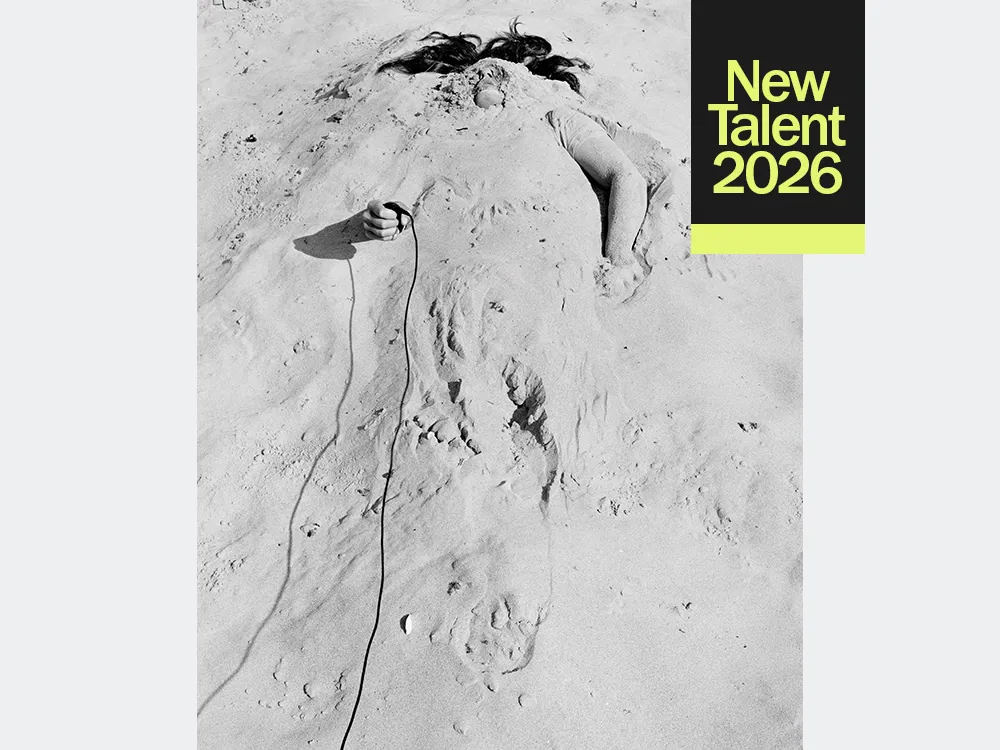
Shortly after earning her MFA in 2018, Calivas returned to her home state of Maine and made a breakthrough series of black-and-white photographs: “Self-Portraits While Buried” (2019–2021). In each image, she is submerged almost entirely in the sand and tidal mud of the familiar shoreline she had explored as a child. Her hand, holding the cabled shutter release of her camera, is often the only part of her body above ground.
Calivas had been steeping herself in the art and politics of ecofeminism at the time and wanted to counter the way female bodies had been represented in the landscape throughout photo history—as both over-identified with nature and available for the taking. “I was always very physical, and using my own body comes naturally,” she said. “I was always out in nature, lying in a field and taking a nap or spending hours poking something on the ground. Once I could connect that natural way of being in the world with photography, it opened up my imagination.”
A postcard from Calivas’s mail-art project with graphic designer Matt Wolff.
Photo Marissa Bergquist
There is a faint glimmer of humor in the pictures, even as they tap into dark memories of a violating incident at the beach when Calivas was a teenager. The photographs feel primal—not just emotionally, but in terms of reconfiguring the fundamentals of the medium. When creating her “Self-Portraits While Buried,” Calivas could not see what she was making. Vision took a backseat to other senses. The temperature of the sand on her skin helped determine the moment of exposure, for instance, since a sudden cooling indicated that the sun had retreated behind a cloud, diminishing the available light. The photographic instant slowed down and “a shifting of perception, a more entangled and embodied sort of agency” came into play, she said.
Working out of a garage studio in the Highland Park neighborhood of Los Angeles, Calivas continues to invent different ways “to push how physical photography can be, to break photography down and build it back up in a way that works for me.” She brings to the pursuit experience gained in a range of performative genres—puppetry, dance, clowning, and “screaming” as the vocalist in a punk band.
Becoming a mother has prompted her to probe ever more deeply into questions about the boundaries of the self and reinforced her connection to the world by way of touch. A mail-art project she recently worked on (in collaboration with graphic designer Matt Wolff) was inspired by her 1-year-old daughter’s hands-on eating. Calivas distributed printed postcards that asked participants to select a particular food, listen closely to how it sounds as it is assertively pawed, and then write out the results on the back of the card. The final instructions were to smear the chosen food across the words and drop the card in the mail.
“The world is hard,” Calivas stated at the top of the card. “I am looking into squishier options.”


