


After decades on the margins of art history, Jimmy Tsutomu Mirikitani—a collagist of singular, inimitable vision—is finally having his story told, though not in any linear fashion.
The late artist is currently the subject of a solo exhibition on view through June at the Spencer Museum of Art in Kansas City—among the first serious institutional examinations of his practice. Co-curators Maki Kaneko and Kris Imants Ercums have organized the exhibition thematically rather than chronologically, echoing Mirikitani’s collage-like life: an accumulation of pivotal events in which the past continually presses upon the present, from the atomic bombing of his hometown, Hiroshima, to his incarceration at Tule Lake following the bombing of Pearl Harbor, and finally to his arrival in mid-1950s New York, on the cusp of a changing art world; multiculturalism was gaining currency and street art would soon enter the city’s galleries.
For much of her curatorial career, Kaneko has focused on researching art made during World War II, with an eye toward Japanese artists. “But Jimmy’s art told me something I had never heard,” she said. “The way he narrated his life was totally novel,.” Kaneko and Ercums have spent the six or so years devoted to learning whatever they could about his life, with visits to the parks in New York City where he was encamped, as well as Hiroshima.
Unidentified photographer at Seabrook Farms, untitled (Mirikitani looking at his painting), late 1940s.
“Over the course of putting together this show, the collage became this organizing principle,” Ercums said. “It links to the way that Jimmy created his biography through found documents and art, through which he asserted himself as an artist to be recognized.”
By design and circumstance, he died a myth of his own making. Overlooked by the art market, he often hawked his art—collages rich with eyewitness interpretations of major world events, sometimes hidden in symbolism—across the street from blue-chip dealers in Manhattan. As the curators tell it, he often donned a beret and proclaimed his own genius, literally, on a sign (to no avail). They came to know him through Linda Hattendorf’s 2006 documentary, The Cats of Mirikitani, named for the playful felines that grace the pages of his diaries. In it, Mirikitani reflects, “I tell everything… Passing through, passing through memory.”
But as the show and film attest, a great deal more scholarship stands between him, us, and everything.
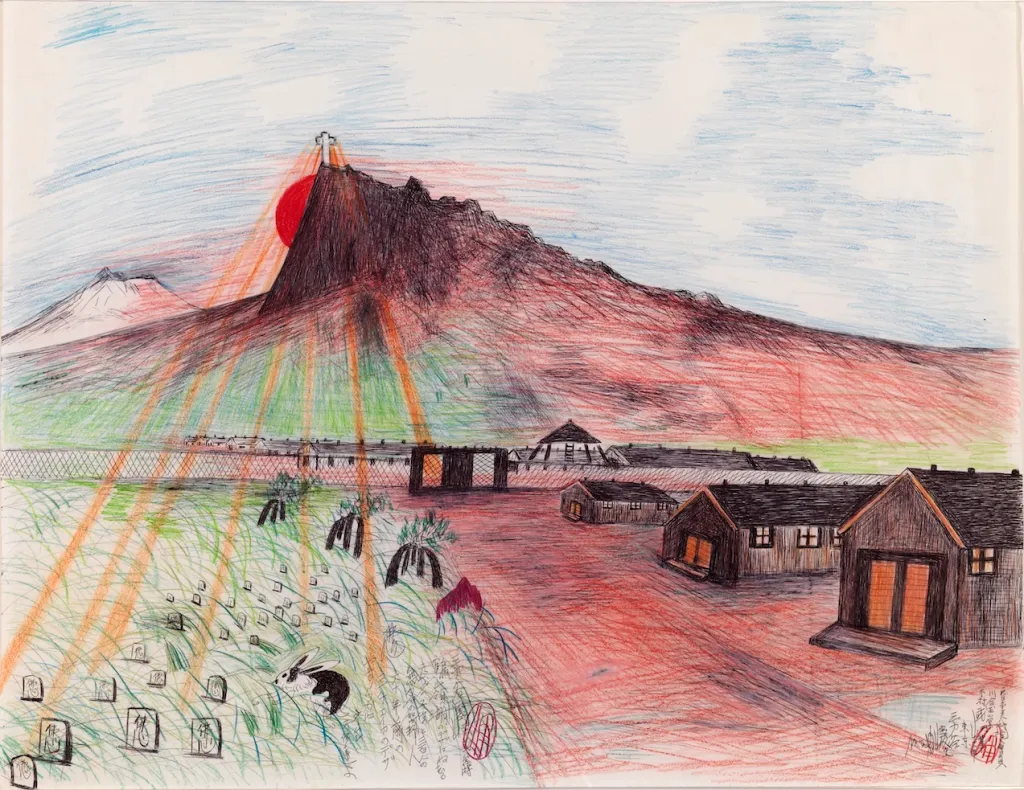
Mirikitani, who died in 2012, was a street artist in the basest sense. Between the late 1980s and 2001, he lived and worked in Washington Square Park and other public spaces across Lower Manhattan, enticing passersby with finely drawn koi fish and cats—then springing the real pitch: wounded collages fusing together political photography, diary, and drawing that chronicled major world events and personal ones, too, like Imperial Japan’s demise; the bombs raining over Hiroshima; a red sun rising above the Tule Lake incarceration camp; and his renunciation of US citizenship.

untitled (cat with blue peony), circa 2001 .
Museum purchase: R. Charles and Mary Margaret Clevenger Art Acquisition Fund, 2020.0220
Mirikitani urged his patrons to add their signatures to his untitled collages, sometimes in exchange for a photocopy of the day’s newspaper or a donation of art supplies). Over time, the margins filled with multilingual signatures— English, Japanese, Chinese, Korean—that mingled with his own visual biography. One particularly potent collage combines his portrait and fingerprint with the Japanese imperial chrysanthemum. A typed line declares, “Imperial Artist Grandmaster, 1920, Sacramento, California.”
Beneath it sits an inscription in Japanese with a hand-drawn seal: “[I studied] under numerous Nihonga artists, Kawai Gyokudō for landscape painting and Kimura Buzan for Buddhist painting, in Tokyo for 12 years.” The work was signed, in reference to his Japanese painter’s name: “M. Setsuzan,” “a Hiroshima native.” Mirikitani called these works his “education papers,” presenting them to police, pedestrians, and neighbors when asked about himself, many of which survived thanks to his friends and patrons.
Undocumented and transient, he tapped the purest vein of collage: the ability to articulate layered time. War chewed him up, and trauma makes a hack job of memory. Even still, he was unluckily lucky—endowed with compositional ingenuity, symbolic fluency, and charisma, that can only be described as an “ineffable Jimmy-ness.” He spun his great, terrible life into a captivating read.
In the years following his death, his talent has not gone entirely unnoticed: his work has been collected by major institutions, including the Smithsonian and the American Folk Art Museum. Yet he has remained largely absent from the canon of American art and, at the very least, from the broader story of New York.
“Jimmy fell in this gap between Japanese artist and Japanese American artist. But Jimmy belongs to all these places, so art historians and curators must develop a new framework — a new language— to articulate the true integrity of his art,” Kaneko said.
That oversight is now being corrected, thanks to grassroots efforts by his surviving kin in Japan, who preserved his work; Hattendorf, the filmmaker whom Mirikitani ultimately entrusted with a trove of his works; and his contemporaries, with artist Roger Shimomura playing an especially crucial role. A third-generation Japanese American and nearly two decades his junior, Shimomura found in Mirikitani a sense of kinship and the two regularly met in Washington Square Park during the elder artist’s lifetime.
He was also central to a key aim of both the exhibition and the film: to release him from the persistent pigeonhole of outsider art, a category loosely applied to artists who learn, live, and work outside market and educational institutions and are presumed indifferent to them. Even if the mythology of Mirikitani as a zany diamond-in-the-rough, scavenging art materials in self-imposed isolation, remains, the Spencer exhibition proves that his art is much more than that.
untitled (Atomic Bomb Dome and Kannon), 2001
Smithsonian American Art Museum
In their research, curators Kaneko and Ercums have also uncovered a major misconception about Mirikitani, that he was self-taught. Nearly all of his work created after the late ’90s, they argue show his training in Nihonga, a style developed in late 19th-century that sought to safeguard and modernize Japanese painting traditions just as the country was reopening to the West. In some of his most striking pieces, Buddhist imagery intertwines with his personal biography, strengthened by the training he received from Gyokudō, a master of landscapes, and Kimura Buzan, a specialist in Buddhist painting.
Curation has also rightfully stressed that working outside the art institution is not always a choice, and Mirikitani’s itinerant lifestyle was largely shaped by political forces. One of the biggest challenges in narrating Mirikitani’s career is that the majority of his collages are untitled and his works are difficult to date because of his displacement and transpacific migration. His works are also challenging to date precisely, due in part to his displacement and transpacific migration, and the Spencer show reflects this by abandoning a chronological framework in favor of a thematic exploration of his own mythologies.
“It links to the way that Jimmy created his biography through found documents and art, through which he asserted himself as an artist to be recognized,” said Ecrums.
Kaneko added: “He belongs to all these places, so we ourselves needed to develop a new framework and a new language to capture the true integrity of Jimmy.”
Another challenge came in the form of how to describe three and a half years, beginning in March 1942, that Mirikitani spent at the Tule Lake incarceration camp in Northern California, alongside thousands of other Japanese American citizens. Tule Lake, one of ten camps established under Franklin D. Roosevelt’s Executive Order 9066, is often referred to as an “internment camp.”
Ercums and Kaneko’s curatorial rhetoric, however, takes pointed aim at this terminology. They favor the word “incarceration” over the more commonly used “internment,” the latter of which has historically been used to describe the state-sponsored imprisonment of civilians—semantics that can serve a politically convenient memory rather than the reality of those held behind bars. This is the power of curation: to measure the past against the present, revealing the continuity of atrocities.
“How can the past remain usable?” Kaneko asks, a question extended in the exhibition catalogue: “Can we rethink materials and tools for creative work as a context through which artists effect change?”
