


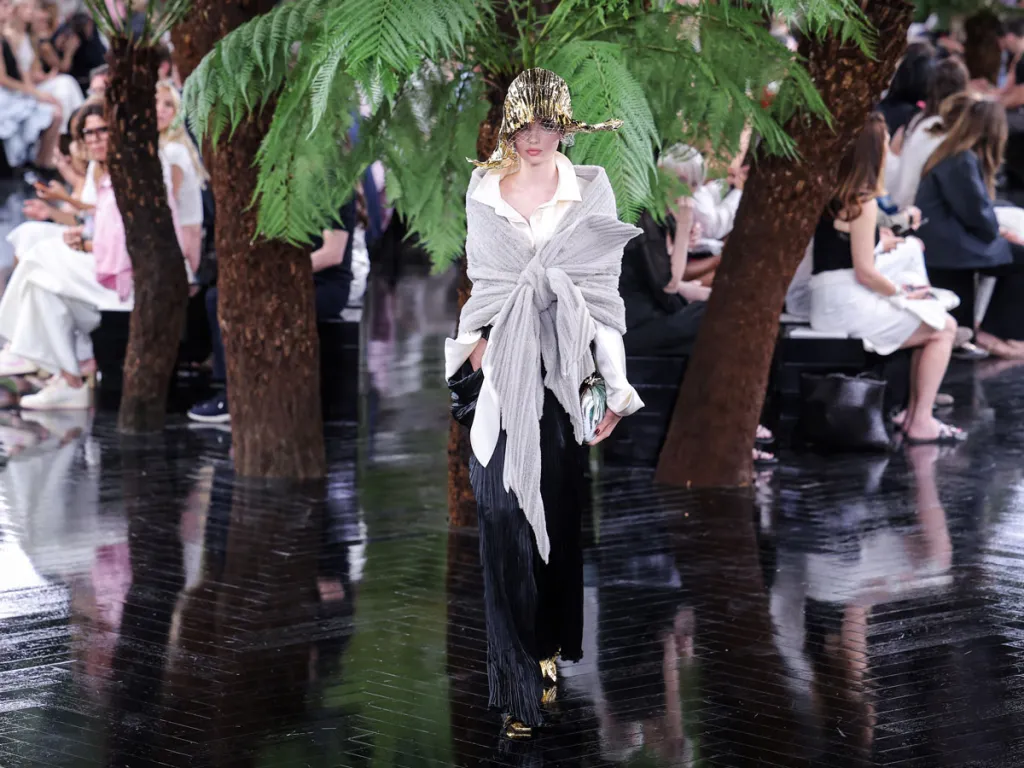
Designer Jonathan Anderson has once again taken inspiration from the work of sculptor Lynda Benglis for his latest fashion show.
The creative director of Dior since 2025, Anderson presented the house’s Fall Winter 2026-27 Haute Couture Show at the Musée Rodin in Paris on Monday, marking his second haute couture collection for Dior.
“The collection responds, in the language of couture, to the work of American sculptor Lynda Benglis,” a description published on Dior’s website reads. “Many of the artist’s works begin in two-dimensional materials that are transformed, through knotting, pleating or moulding, into three. The art of couture enacts a similar shift: fabric is given sculptural form, accentuated when worn.”
The Benglis-inspired pleat work is visible in several garments in the collection, like a gray shawl, a bronze-and-gold top, and a silver gown that all employ the knotting to create an off-kilter bow. Several models also wore headpieces that resemble some of Benglis’s sculptures. Benglis also collaborated on some of the handbags featured in the show, according to WWD.
A detail of the 24th look of Dior’s Haute Couture Fall/Winter 2026-27 collection, which translates Lynda Benglis’s Zanzidae, From the Peacock Series (1979) into a garment.
Kenzo TRIBOUILLARD / AFP via Getty Images
Another point of inspiration is “Benglis’s longstanding relationship with Ahmedabad in Gujarat, India,” per Dior. That city and the birds she saw there informed the artist’s “Peacock” series from the 1970s, which feature “brightly-coloured floral and beaded embellishments.” The collection’s 24th and 30th looks, in which a large fan decorated with such embellishments, are almost a one-to-one translation of Benglis’s Zanzidae, From the Peacock Series (1979).
Anderson last took inspiration from Benglis three years ago for Loewe’s Spring/Summer 2024 show. In addition to tapping her to make jewelry for that collection, Anderson also displayed several of her sculptures as part of the runway show.
In addition to her notorious advertisement for a gallery show in a 1974 issue of Artforum, showing her nude brandishing a dildo, Benglis is known for her pioneering approach to sculpture during the late 1960s and ’70s. Her most famous body of work involved her pouring pigmented latex directly onto the floor, and later onto walls and into corners, to create sculptures marked by their heft and shape. In the ’70s, Benglis would begin to make wall-hung sculptures that feature taut knots that she would then paint. She once described them as “decadently excessive” to her dealer at the time, Paula Cooper.
Benglis’s most recent major exhibition paired her work with that of Alberto Giacometti, which ran January to May at the Barbican Centre in London.
“She’s a genius, and I think there’s something about how she looks at form where it nearly becomes in a way muscular,” Anderson told WWD of Benglis. “She was well before anyone’s time, and it’s only in the last 10 years that people have started to realize what she had done.”
