


A new exhibition at Museum Tinguely surveys more than a century of art exploring women’s relationship to machines and technology. Just as women’s work, often unwaged and of the domestic and caring sort, has remained invisible, so too has much of the art it inspires. Alongside artists including Helen Chadwick and Mary Kelly, who in the 1970s were working at the sharp end of second wave feminism, the exhibition introduces artists who decades earlier were tackling similar injustices.
Just as women’s work, often unwaged, has remained invisible, so too has much of the art it inspires
Featuring 36 artists, from the turn of the 20th century until today, Labouring Bodies takes up Jean Tinguely’s interest in the relationship between humans and machines, and considers female labour in all its guises—in offices and factories, in the home, in the biological sense—depicted in paintings, film, photography and more.
The exhibition’s inspiration was a short film by the Swiss artist Alexandra Navratil, titled The Night Side (2016), says the curator Sandra Beate Reimann. In it, the former worker Gundula Brett returns to the Agfa-Orwo photographic film factory, years after it was shut down and turned into a museum following the reunification of Germany in the 1990s. The factory prized the “nimble fingers” of its female employees, who worked in the dark by touch alone, manufacturing light-sensitive material.
It is these long-remembered movements that Navratil captures in her film, as Brett reacquaints herself with machinery she knew intimately for 25 years. “Her body remembers the movements,” says Reimann, pointing out how the tenderness of her touch evokes the gamut of female labour as it extends beyond the workplace into the home and the family. “I thought that could be an interesting way to look at the relationship of body and machine, by looking at the female worker, not just the male worker, as it has always been done. When you look at women working in factories, you immediately come to the unpaid work, and then reproduction work, and care work.”
Arranged broadly thematically, the exhibition takes care to avoid reinforcing false boundaries, Reimann says. “The point is that reproductive labour is the foundation for productive labour. So I didn’t want to recreate this gendered work division.”
The points of similarity and overlap between different facets of female labour are the subject of a lesser-known work by Mary Kelly from the mid-1970s, which has been specially reconstructed for the exhibition. The installation, which was presented just once before its constituent films went on to become other works, features recordings of a female factory worker at a machine, alongside footage of the artist stroking her own pregnant belly—distinct areas of female labour, united by poor pay and repetitive actions.
Domestic drudgery
Such inequality is further entrenched by the apparently still lingering expectation that women shoulder the burden of housework and in Helen Chadwick’s germinal performance In the Kitchen (1977), where women effectively wear domestic appliances as a sign of their subjection.
These concerns feel distinctly post-war, but the work of two little known German artists, Sella Hasse and Alice Lex-Nerlinger, shows that they were on the agenda from the beginning of the 20th century. Hasse’s exhausted women are fused with machinery in Female Industrial Workers (around 1915), while in Lex-Nerlinger’s The Seamstress (around 1928), the home is a site of double drudgery for piece workers who were likely also looking after children.
Similar patterns of labour persist today, Reimann says: “A lot of female data workers do this kind of work, on the side, at home, on their own computers, while also watching their children.”
Juliana Huxtable’s disturbing vision of lactating females as sexualised, industrialised farm animals is an extreme interpretation of how breastfeeding and milk production can make the link between care and commodity. But though Ani Liu’s installation Untitled (Feeding Through Space and Time) (2022) is a less hyperbolic vision of mechanised reproductive labour, it presents the breast pump as both help and trap that implicitly hastens a mother’s return to the paid workforce.
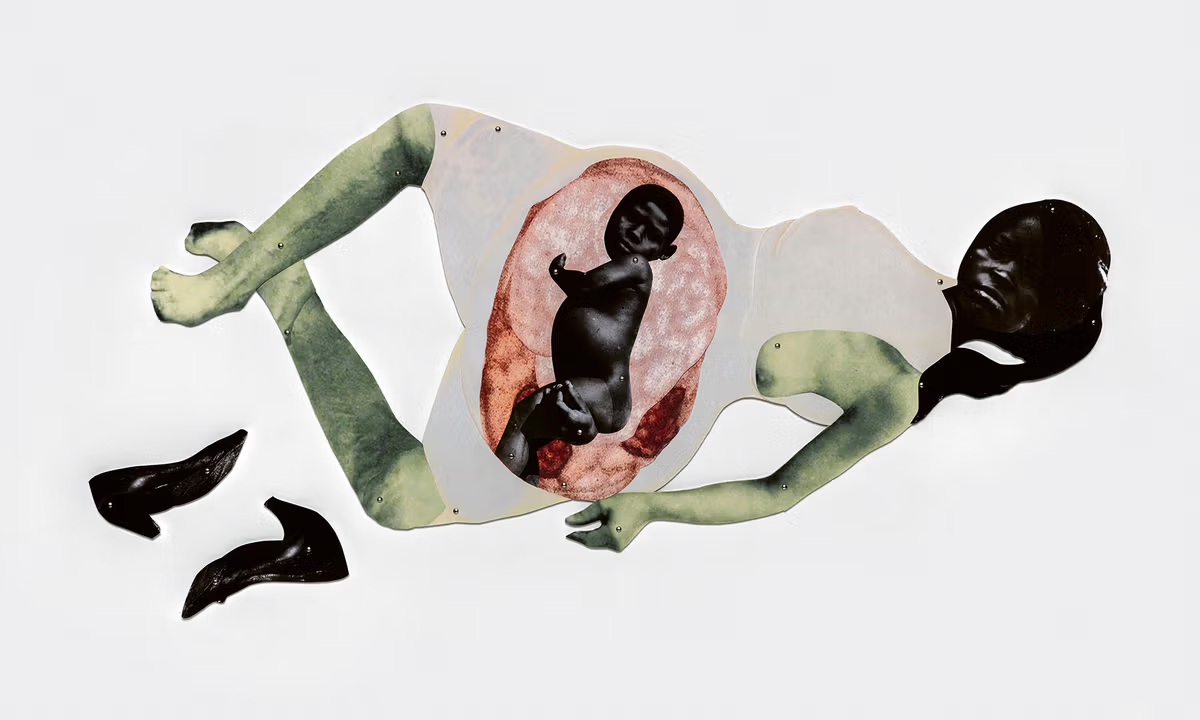
Pregnancy and childbirth is a moment of particular vulnerability for all women, but in her collages made from historical images, Frida Orupabo considers her own experiences as part of a longstanding history of inequality and prejudice against pregnant Black women. The high-heeled shoes kicked off next to the pregnant woman in Baby in Belly (2020) hinting at the racist and highly dangerous assumption made by medical staff that Black women have a high pain threshold.
Featuring work by only two male artists, Tinguely and John Heartfield, Labouring Bodies presents an area of uniquely female experience, repeated generation after generation.
• Labouring Bodies, Museum Tinguely, Basel, until 8 November
