


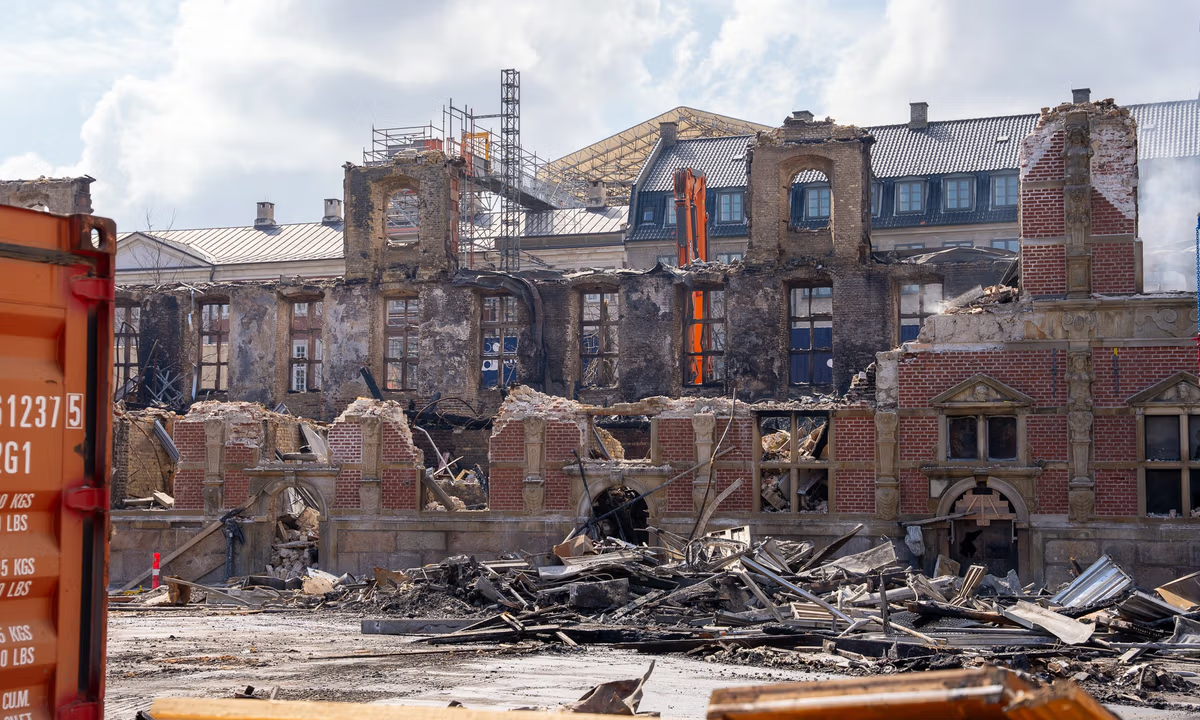
Lars Daugaard Jepsen remembers vividly the morning of 16 April 2024, when fire tore through the historic Copenhagen stock exchange. “It was a beautiful morning and our Queen’s birthday, so our flag was up everywhere,” says the deputy director of the Danish Chamber of Commerce, which owns the building. At 7.36am, an alarm sounded at the 400-year-old site, which was undergoing its largest ever restoration. Within three minutes, the fire department was there; within half an hour, 180 firefighters were working to put out the flames.
The fire destroyed more than half of the red-brick exchange, which is a popular tourist attraction and a “landmark for Copenhagen”, Daugaard Jepsen says. A sizeable part of its copper roof was lost, as was its spire, which was carved in the shape of four intertwined dragon tails and visible from all around the city. In a tragic irony, the symbol of the dragon had been believed to protect the building from fire.
30,000 Danes gathered around the fire were crying
Staff from the chamber of commerce worked with firefighters, members of Denmark’s Royal Life Guards and brave passers-by to remove hundreds of works of art from the burning building—98% of which were saved. Nevertheless, the emotional impact of the disaster, the cause of which remains unknown, was significant. “The estimate is that 30,000 Danes gathered around to see the fire and a lot of them were crying,” Daugaard Jepsen continues.
Firefighters tackle the blaze at the stock exchange in 2024
Photo: Marcus Stoltze Dansk Erhverv
The chamber of commerce and a network of other experts have been working intensely ever since to bring the Old Stock Exchange, first opened in 1624 as a commodity trading post, back to life, with the aim of reopening in full in 2029. The total budget for the reconstruction remains undisclosed, but it has largely been funded by insurance, and Daugaard Jepsen says that “Danish funds” such as foundations have given DKK200m (£23.1m).
Two architectural firms, Leif Hansen and Praksis, were brought in to oversee the work. In December, part of the first floor opened to the public, while in April a section of scaffolding was removed to reveal some of the exterior, on which restoration had continued. In August, the emergency responders will be celebrated at a reception, when they can “see the building they saved”. That month, the chamber of commerce hopes to have the permits needed to begin reconstructing the areas that were lost.
Lessons from Notre-Dame
Insights from other organisations affected by fire—most prominently, Notre-Dame in Paris—have been critical to the progress of the project. “Within the first week, we visited the Notre-Dame site to learn from their management and architects,” Daugaard Jepsen continues. “Their most important piece of advice was: make a clear plan, communicate it and then start sourcing your materials right now.”
This task has not been simple. As the Dutch Renaissance-style exchange is heritage listed, according to Danish law it must be rebuilt as close to the original as possible. A total of 886 pine trees had to be sourced from within the former kingdom of King Christian IV, including a selection from Gotland in Sweden, the same region in which the original timber was acquired in the 17th century. The production of 800,000 handmade bricks, mimicking the originals, is currently being planned, while copper debris from the burned roof has been recycled in Finland for re-use.
Opportunities for young craftspeople
Craftspeople with the necessary skills are thin on the ground, too. There are only two companies that can recreate the spire, and they are “also fixing all the churches in Denmark”, Daugaard Jepsen explains. A family-owned company in Thyholm will undertake the task of recreating the lead-clad spire with the dragons. The reconstruction project is a fitting chance, Daugaard Jepsen says, to promote the next generation of these experts, and the chamber of commerce has been asking contractors to ensure young craftspeople are included in the project.
There is a jovial sense of competition with France. “We want to beat them,” Daugaard Jepsen says. “They rebuilt the Notre-Dame in five years; our idea is to rebuild faster.” Yet another key piece of wisdom passed on by their counterparts in France, with whose government Denmark signed a co-operation agreement in 2025, was the need to be practical, and realistic, about the future. “[The idea is] if you want to have a church that lasts the next 1,000 years, there will be a fire. But how do you make it as small as possible?” The proposed answer, in Denmark, includes dividing the building into a greater number of sections, secured by fire walls, to contain any possible fire. Several other fire suppression measures are under consideration.
The operation to salvage the works of art has been equally remarkable. A list of works, ranked in importance, was drawn up a decade ago, so staff knew exactly what to save. On the day of the fire, members of the National Museum’s conservation team rushed to the exchange, assessing objects as they were carried out and sending many of them to their storage facilities, to await conservation. “We are neighbours; it felt natural,” says Eva Bøje Nielsen, the museum’s head of conservation.
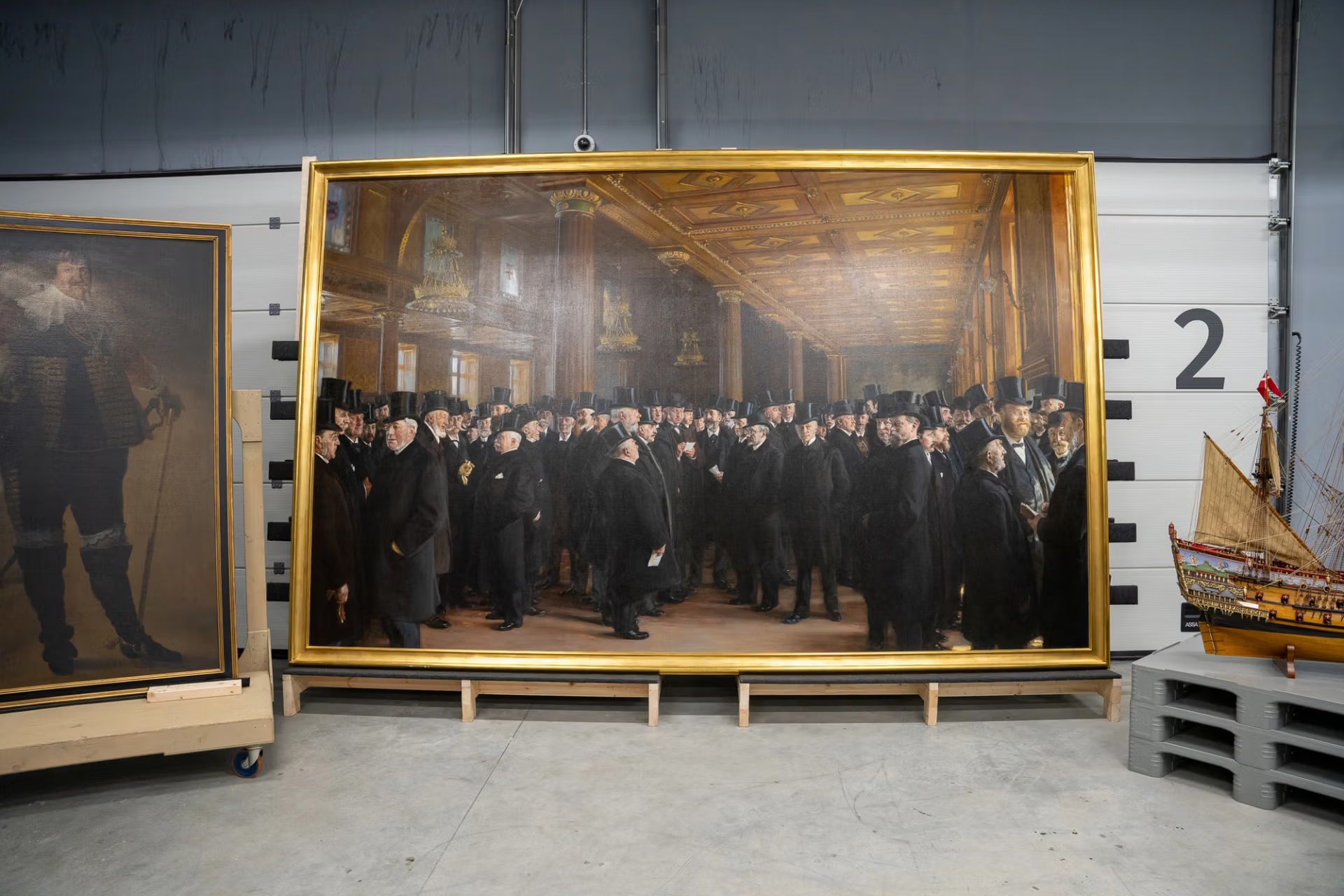
The skill of the National Museum’s conservation team helped to minimise permanent damage to works such as Peder Severin Krøyer’s painting From Copenhagen Stock Exchange (1895, centre)
Photo: Sarah Mølsted, Dansk Erhverv
At the museum, water-damaged works were subjected to a slow, controlled drying process or frozen to avoid the risks posed by thawing, moisture and mould. The speed and efficiency of the whole operation meant that most objects suffered little to no damage, including one of the most famous: Peder Severin Krøyer’s painting From Copenhagen Stock Exchange (1895), which shows “all the Danish trade leaders from the beginning of the 19th century in one picture”, Daugaard Jepsen explains. It was subsequently sent on tour around Denmark.
Some works were less fortunate: a marble bust of the financier and industrialist C. F. Tietgen was covered in soot and dirt, and needed to be steamed, cleaned and latex-treated, Bøje Nielsen explains. A small collection of objects were destroyed, including a zinc statue of the former Danish king Christian IV, of which only a piece was recovered. But several restored paintings have made their way back to the exchange, the first being a grand portrait of that same monarch, which was the last to be evacuated.
Return of the dragon
Daugaard Jepsen adds that new art will be shown in the building, including work depicting the fire, and a sculpture of a baby water dragon. “The idea is that it protects the building until 2029, when the big water dragon is back on the roof.”
Daugaard Jepsen hopes this can be a “new beginning” for the stock exchange. “It has been part of Danish history for 400 years,” he says. “Our ambition is that it will part of it for the next 1,000 years, too.”
