


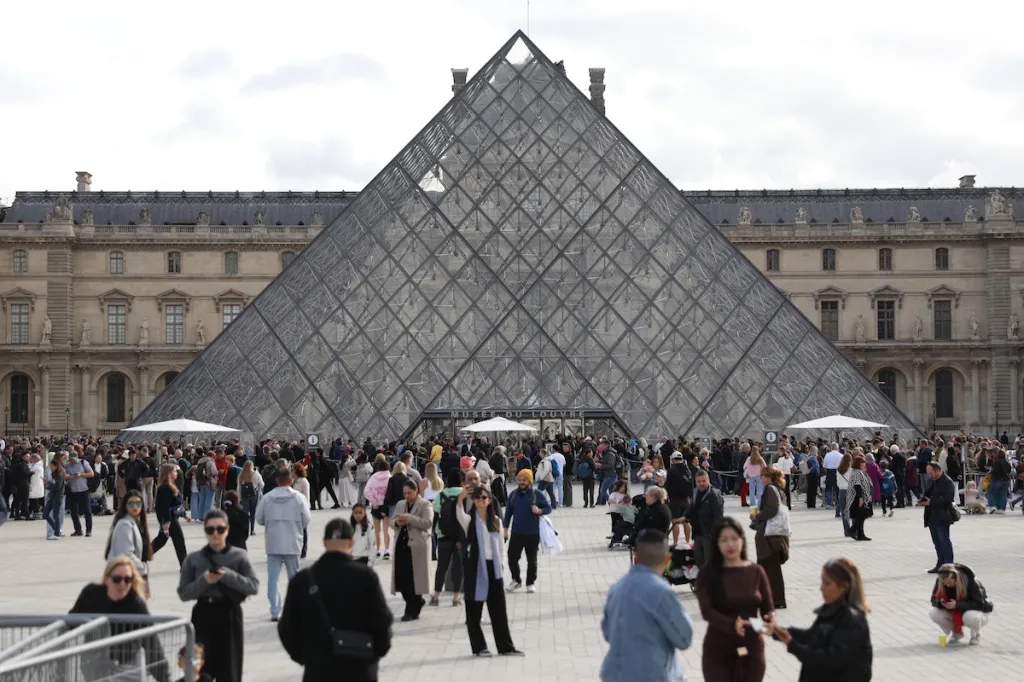
Following the heist of France’s crown jewels that captured global attention, foreign tourists will pay the cost.
The Louvre Museum board voted on Thursday to raise its ticket prices by 45 percent for visitors outside the European Economic Area, the New York Times reported. The increase is part of a larger effort to raise funds to support infrastructure changes at the institution.
Starting on January 14, tourists will pay €32 ($37) up from the current price at €22 ($25). This will impact Americans, Britains, and Russians, as they are not part of the European Economic Area, which includes countries in the European Union, along with Iceland, Liechtenstein, and Norway.
While roughly one quarter of the Louvre’s visitors are French, the remainder travel from around the world, primarily hailing from the United States, China, and European countries. In 2024, for example, the famed institution reported 8.7 million visitors, with 77 percent foreigners.
Visitors from the US are likely already familiar with the idea of increased entry fees, with a number of institutions like New York’s Metropolitan Museum of Art and Solomon R. Guggenheim Museum charging $30 to out-of-towners. Foreigners to the US will also face a $100 surcharge to visit the country’s most popular national parks starting on January 1, the New York Times first reported.
France’s CFDT-Culture labor union, which represents some Louvre workers, however, has called the situation “absurd and unjust”, as “people from the Middle East will pay a higher price to access foundational and symbolic works of their own culture” than their French counterparts, the union said in a statement. “The very public you are targeting will experience this as discrimination.”
Other French institutions like the Palace of Versailles and the Château de Chambord are reportedly expected to follow suit.
The ticket increase comes as the Louvre tries to update its facilities and security measures, related to such issues as the theft and overcrowding.
On Sunday, October 19, around 9:30 a.m., robbers broke into the Parisian museum‘s Apollo Gallery using a cherry picker and an angle grinder to steal nine pieces of jewelry worth an estimated $102 million in less than eight minutes. CCTV footage captured the thieves descending from a gallery window before fleeing the area on scooters. One of the nine pieces, a crown once belonging to Empress Eugénie, was subsequently recovered outside the Louvre and is expected to undergo conservation efforts.
In a hearing with the French senate, Louvre director Laurence des Cars said that alarms functioned properly and went off during the heist. But she admitted that the museum has “very inadequate” and “outdated” security systems in place.
Though the Louvre recently rolled out a set of emergency security measures, the full extent of the recommended security changes, according to a French national audit, are “not expected to be finished until 2032.” However, some 100 surveillance cameras and anti-intrusion systems are set to be installed at the museum as part of increased security measures.
A fifth suspect was charged in relation to the burglary last week, while three men and one woman were previously charged. Some of the latter have been identified in media reports as Ayed G, Slimane K, and Abdoulaye N. One suspect’s cousin also spoke out about the theft. Of the four, one is a taxi driver and another is a delivery man and garbage collector, the latter of whom was arrested at Paris’s Charles de Gaulle Airport while allegedly trying to flee on a one-way flight to Algeria. The other two are a man and woman who have been identified as domestic partners with two children together; the woman was previously released from police custody and placed under judicial supervision. The thieves are all reported to be locals.
The missing jewels are listed in Interpol’s Stolen Works of Art database, but the search continues as they have yet to be recovered by authorities. In light of the heist, the Louvre has transferred the remainder of its most precious jewels to the Bank of France for safekeeping.
