


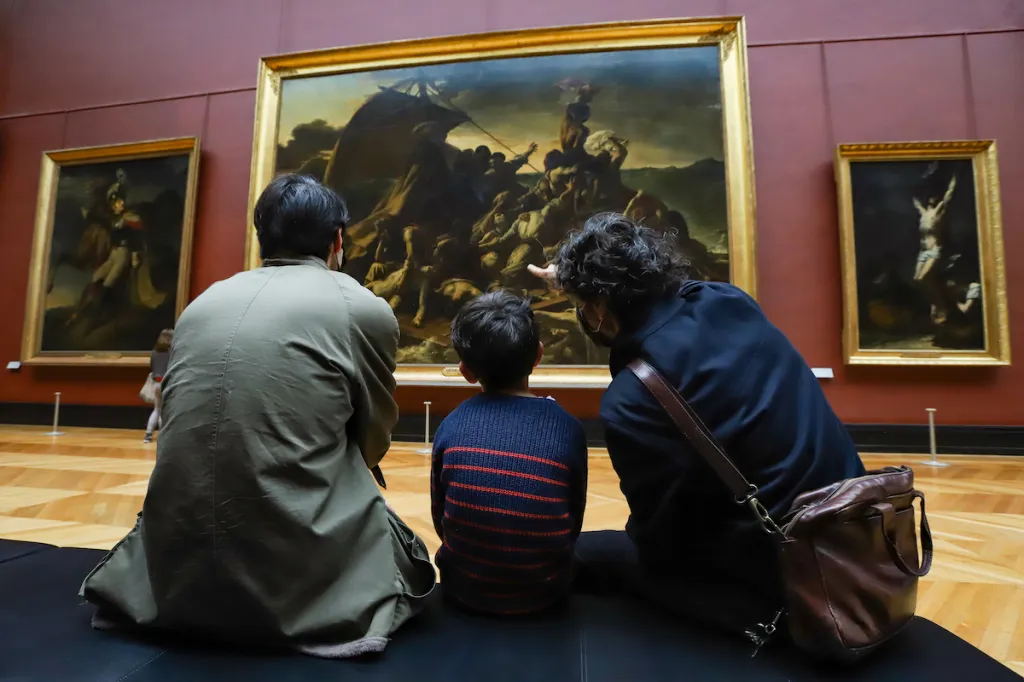
The Louvre’s Denon Wing, an area of the Paris museum that hosts masterpieces by Leonardo da Vinci, Eugène Delacroix, Théodore Géricault, and many more, sprang a leak on Thursday night, marking the latest difficult turn for an institution that is facing fallout from last year’s heist, scrutiny over its infrastructure, and continued work stoppages.
A union spokesperson told Reuters on Friday that the leak happened in Room 707 of the museum, which reportedly holds works by artists such as Bernardino Luini and Charles Meynier. The French broadcaster BMF TV also confirmed news of the leak, reporting that the Louvre had internally labeled it an “emergency situation” and a “major water leak.”
The Meynier painting, an 1820 work called Triumph of French Painting: Apotheosis of Poussin, Le Sueur and Le Brun, was damaged as a result of the leak, which caused “two micro-tears” and the “slight lifting of the paint layer,” a museum spokesperson told BFM TV. The artwork will undergo further investigation as the museum seeks to repair it.
Notably not contained in that room is the museum’s crown jewel, the Mona Lisa, which is safe from any damage. According to BFM TV, the Louvre closed Rooms 706, 707, and 708 of the Denon Wing, which otherwise remained open on Friday.
It is not the first time that water has unexpectedly entered the galleries of the Louvre, which is still reeling from a heist that took place in October. In November, a pipe burst at the Louvre, resulting in a flood that impacted 400 documents relating to Egyptian history and moving workers at the museum to strike. The New York Times reported that the documents, which were held in a library, were mostly from the late 19th and early 20th centuries, and were often utilized by Egyptian art experts at the museum.
Even before tragedy befell the Louvre last year, the museum’s director, Laurence Des Cars, had warned of the possibility of leaks in early 2025. There was a “proliferation of damage in museum spaces, some of which are in very poor condition,” Des Cars wrote to Rachida Dati, the French culture minister, in January of that year. Des Cars added that parts of the museum “are no longer watertight, while others experience significant temperature variations, endangering the preservation of artworks.”
Her words came true in May, when rain came in through the museum’s roof, just barely sparing a Cimabue exhibition that was on view nearby.
The leak came as Louvre leadership was working to shift the perception that the museum’s infrastructure is weak. Not long after the heist, the museum said it would undertake a $92 million effort to beef up security. And after news of the burst pipe emerged in December, the Louvre said in a statement that its response was “rapid and efficient,” noting that no artworks were damaged.
Still, workers at the museum have warned that more work is needed. In December, Gary Guillaud, a union representative, said, “Fragile infrastructure, a lack of strategic visibility on the work being carried out, and poor working conditions mean that the protection of the collections and the safety of staff and visitors remain insufficiently guaranteed.”
