


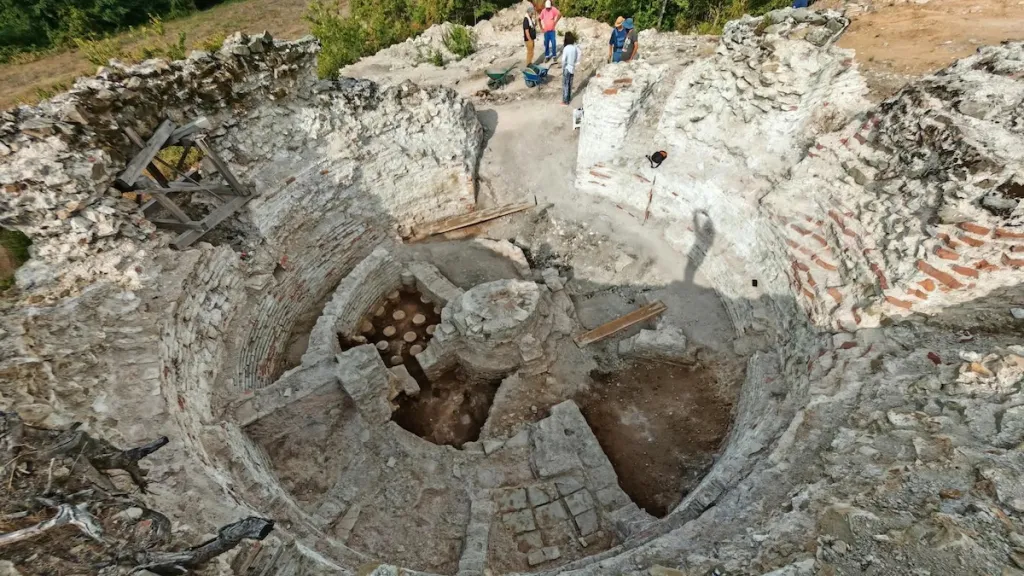
An archaeological dig in Serbia turned up remnants of a uniquely constructed bathing complex thought to have been used by a Roman emperor.
As reported by Live Science, “The suite of rooms—which included heated floors, three bathing pools, and a sauna—was uncovered at the bottom of a tower within an imperial palace, a design archaeologists had never seen before in the Roman Empire.”
The bathing station was discovered at the archaeological site of Vrelo-Šarkamen, a fourth-century residential complex that was occupied by the Roman emperor Maximinus Daza during his reign from 310 to 313 CE. The finding by the Serbian Institute of Archaeology “revealed that the palace was even more complex and luxurious than previously thought.”
As Live Science described, “archaeologists were surprised to find a circular bath complex on the lowest level of the tower, as most ancient balnea were oriented linearly, with rooms in a row. This bath area had a domed ceiling with six windows, which shows a high level of engineering knowledge.”
In an equipment room next to the bathing complex, the archaeologists found a furnace that would have been used to heat the floors of the building, as well as remnants of a boiler to heat the water used. In the emperor’s area were three pools and a sauna.
According to a statement issued by the Institute of Archaeology, “The complex was not simply a space intended for personal hygiene, but a carefully designed private bath intended for high-status residents of the palace, in which architecture, technical infrastructure and comfort formed a single functional whole.”
