


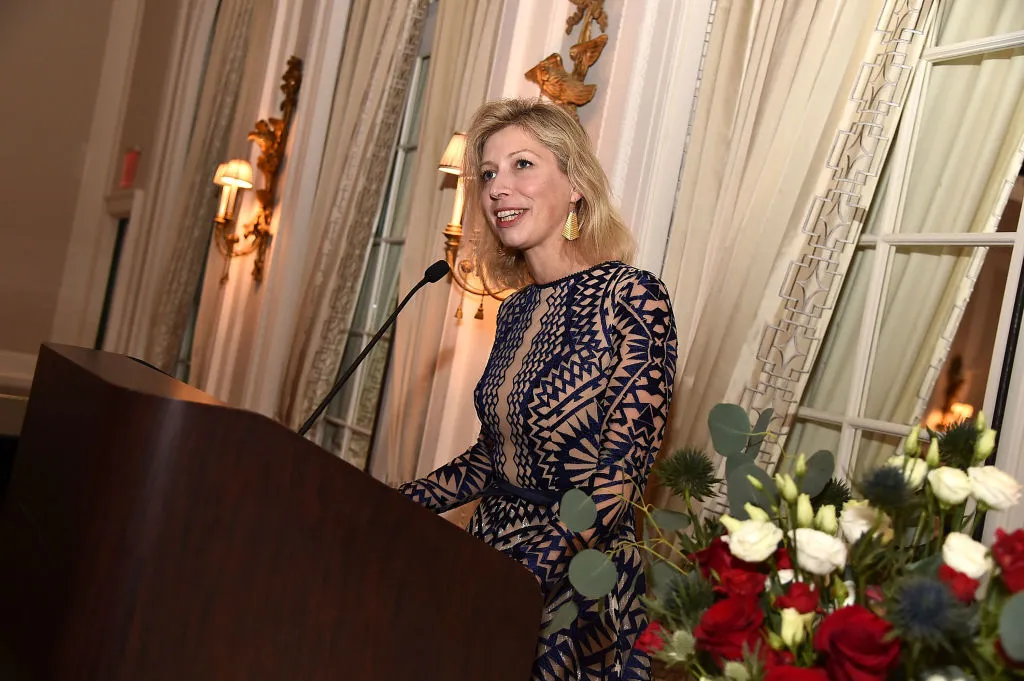
Anne-Claire Legendre, a senior diplomat and one of French President Emmanuel Macron’s closest advisers on North Africa and the Middle East, has been chosen to lead the Institut du Monde Arabe in Paris, according to Le Monde, marking a turning point for the institution after weeks of turmoil.
Legendre, 46, was selected by the institute’s board on Tuesday morning. Her appointment is expected to be ratified by the high council made up of representatives from the 22 member states of the Arab League. If confirmed, she will become the first woman to head the institute in its 40-year history.
She steps into the role following the abrupt resignation of Jack Lang earlier this month after renewed scrutiny over his past ties to Jeffrey Epstein. Lang, who had led the institute since 2013, denied the accusations and addressed staff shortly before investigators searched his office.
Legendre brings a career built in diplomacy. She joined the Elysée’s diplomatic team in December 2023 after serving for just over two years as spokesperson for France’s foreign ministry. Before that, she was France’s consul general in New York from 2016 to 2020 and briefly headed the embassy in Kuwait. A graduate of INALCO, she has long focused on the Arab world.
At Macron’s side, she played a role in France’s recognition of the State of Palestine, coordinating closely with Arab governments as well as Western partners during discussions held on the sidelines of the United Nations General Assembly in September 2025.
Her appointment signals a desire for renewal at an institution that has struggled in recent years. The Institut du Monde Arabe faces a structural deficit tied in part to uneven financial support from its member states. A planned expansion in Tourcoing has stalled for lack of funding. The institute has also seen its influence shrink as other cultural institutions in Paris expanded their own focus on Islamic art and the region.
There is a broader identity question as well. The institute was founded to serve as both a cultural center and a diplomatic bridge. Over time, that balance has blurred. A 2024 report by France’s Court of Auditors called on French and Arab authorities to rethink the political project that underpins the institution and bring it in line with current priorities.
Legendre now inherits a place that has hosted high-level discussions on Syria, Sudan, Gaza, and French-Moroccan relations, yet has often been sidelined in major cultural agreements, including the creation of the Louvre Abu Dhabi and France’s partnership with Saudi Arabia in Al-Ula.
