


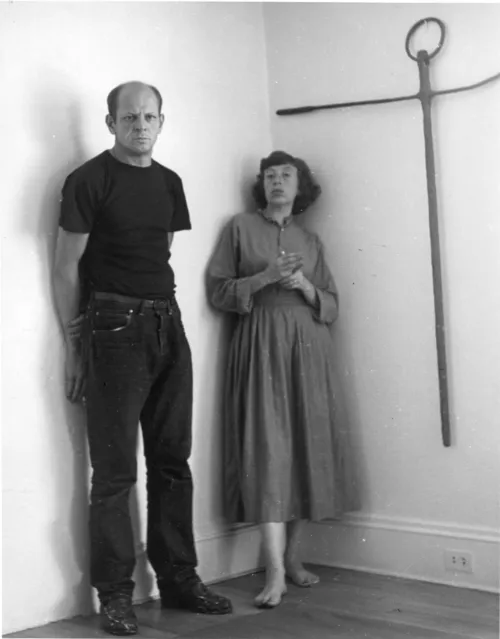
The Metropolitan Museum of Art in New York has announced a two-person show featuring major artists Lee Krasner and Jackson Pollock. The exhibition, titled “Krasner and Pollock: Past Continuous,” will be on view from October 4th, 2026 through January 31st, 2027. It brings together more than 120 paintings, works on paper, and ephemera from over 80 collections.
The comprehensive exhibition will cover the entire careers of the two Abstract Expressionist artists, who were peers and life partners, and trace the parallels between their practices. The show will mark the first time in over two decades that either artist has been the subject of a major show in New York.
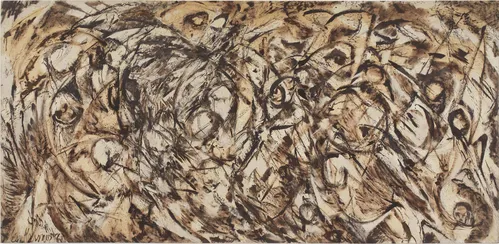
The Eye is the First Circle, 1960
Lee Krasner
Royal Academy of Arts
“By considering each artist on their own terms while also foregrounding their consequential relationship, the exhibition situates Krasner's and Pollock's work within a broader cultural and artistic context,” said The Met’s director, Max Hollein, in a statement. “This project affirms Krasner and Pollock not only as defining figures of their moment, but as artists whose work continues to shape and inspire future generations.”
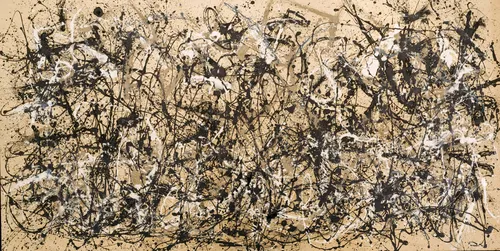
As distinct as their practices were, Krasner and Pollock also had an immense influence on each other’s work. They met as young artists when they were both included in an exhibition organized by the American painter John Graham in 1942, and married in 1945. Pollock soon shot to fame with his drip paintings which employed novel uses of paint on canvas, though his career was cut short by an untimely death in 1956. Krasner was known for her own approach to painting, in which the artist collaged paper and canvas from her previous works to form new compositions. Though she maintained her practice over the course of nearly six decades, she was largely overshadowed by Pollock—in 1949, LIFE Magazine asked if he was “the greatest living painter in the United States.” Recent dialogues have reconsidered the imbalance, and with the forthcoming exhibition, The Met seeks to course correct the narrative.
“‘Krasner and Pollock: Past Continuous’ begins with the fundamental premise that these artists are equals, partners in life, giants in the history of art, and revolutionaries who defined what abstraction could be,” said David Breslin, The Met’s curator in charge of the department of modern and contemporary art, in a statement. “Each found a partner who would insist on the primacy of art over life; and they both aspired to an art that was forged out of historical connections but that also promised freedom and radical possibility in a world forever changed by war. The exhibition concerns entwined lives but is also about how different artistic directions come from shared terrain.”
The show will be organized into twelve chapters, with some galleries dedicated to each artist individually, and others placing their work in dialogue. Highlights include Krasner’s Composition (1949), The Eye is the First Circle (1960), and Combat (1965), and Pollock’s Stenographic Figure (1942), Number 1, 1950 (Lavender Mist) (1950), and The Deep (1953). The show will feature rarely-seen works from private collections, as well as pieces on loan from institutions including the Museum of Modern Art (MoMA), the Whitney Museum of American Art, and the Centre Pompidou.
