


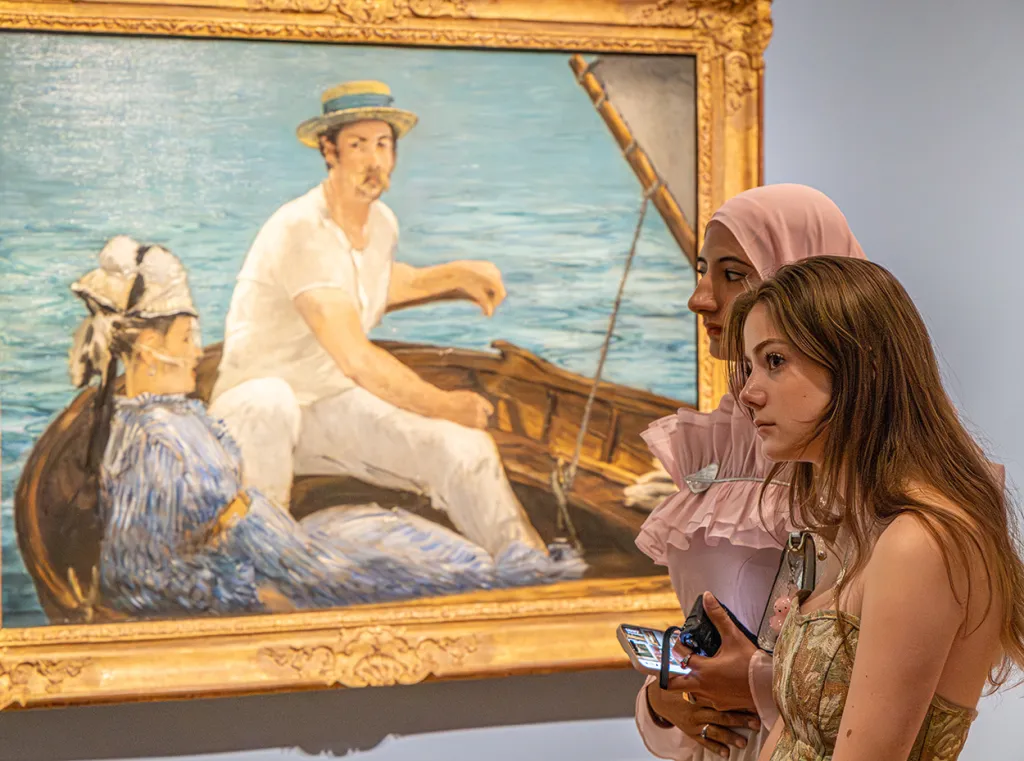
A sign of the times: Berthe Morisot, usually relegated to the realm of “women” Impressionists, gets equal billing with Edouard Manet, the arch modernist described as the “father” of Impressionism in “Manet & Morisot.” The exhibition, now on view at the Cleveland Museum of Art, originated at the Legion of Honor in San Francisco. Morisot, one of few women exhibiting with the Impressionists, has offered fertile ground for feminist art historians looking to diversify art’s histories, but “Manet & Morisot” goes further—claiming that Morisot did not just exist within a circle of famous men, but actually influenced the direction of modern painting.
This isn’t the first show to put Manet—who refused to exhibit with the Impressionists in his lifetime and thus secured himself a reputation as a singular figure of modernity—in dialogue with a fellow artist. Most recently, the Met’s “Manet/Degas” (2023) explored his often-contentious dialogue with Edgar Degas. The slash (/) of that show’s title foregrounds their rivalry, whereas the “&” here conjoins the two figures in a collaborative vision.
Famously, Manet and Morisot shared a long friendship. They met copying paintings at the Louvre in 1868 and their families, both from a similar social class, became close in the years that followed. Morisot would eventually marry Manet’s brother Eugène, but before she did so Edouard painted her portrait 11 times. The intimacy of these sessions has led to much speculation about the true nature of the relationship between Manet (36, married and already notorious for his scandalous entries to Paris Salon) and Morisot (27, an aspiring artist). The first room of the exhibition indulges these “did they or didn’t they” musings. The casual ease with which Morisot allows herself to be looked upon in Berthe Morisot Reclining (1873) certainly tempts such narratives.
Édouard Manet: Berthe Morisot with a Bouquet of Violets, 1872.
Photo © RMN – Grand Palais / Art Resource, New York
Happily, the exhibition quickly moves on from Morisot being seen to her seeing. View of Paris from the Trocadero (1871–1873) shows her attention both to Manet’s work—he had painted the same sprawling urban view during the Universal Exhibition in 1867—and to the changed nature of Paris following the Franco-Prussian War and the Commune. Manet’s fairground festivities have been replaced by Morisot’s subdued cityscape marked by violence. This is also a work in which she introduces a motif she will return to repeatedly throughout her oeuvre: a child with her back turned to the viewer. While they are usually read as invitations to see through the child’s eyes, to me these back-turned figures serve as a moment of withholding within the painting, one tied to the mysteries of childhood. Tempting without satisfying the viewer’s curiosity, they are a reminder of our inability to see as they do, or indeed, to see as anyone else does. When picturing adults, too, Morisot refuses to disclose the interiority of her subjects, who often look down or away, reserving something of themselves even as they enter into the public gaze via her painting.

Berthe Morisot: Woman at Her Toilette, 1875–80.
Curator Emily Beeny argues in the exhibition catalog that Manet borrowed Morisot’s motif of the child in his own attempts to reckon with a modernizing city, most visibly in The Railway (1873). The painting marks Manet’s transition from studio pictures updating Old Masters to an exploration of the world around him. It’s a work caught between two gazes, a woman looking out at the viewer and a child peering through an iron fence at the wonders of speed and steam. While Manet’s use of the direct gaze is one hallmark of his modernity, the child’s turning away might be read as another, a reminder of a burgeoning notion of privacy that was the counterpart to public life.
The other Morisot motif that stands out here is that of work. Manet is celebrated for his engagement with labor and class: The railway workers visible in the midground of The Railway, separated from the bourgeois protagonists by the iron fence, are an indicator of an increasingly stratified social world. But Morisot depicts labor perhaps even more often, if in a way that has gone largely unnoticed, through the figure of her family’s maid and nanny, Paisie. Paisie appears in several works in the show, sometimes with Morisot’s daughter Julie, serving double duty as both nanny and model. She is also shown sewing, her hands orchestrating an expressive burst of line in Paisie Sewing in the Garden at Bougival (1881).
Courtesy The Solomon R. Guggenheim Foundation / Art Resource, NY
Morisot’s depictions of sewing, embroidering, and other textile arts are another way of highlighting women’s work. But more than subjects to be illustrated, these activities resonate in the formal qualities of Morisot’s painting. Her brushwork often has a rhythmic quality that parallels the repetition of stitches used to make an embroidered form. She treats line as material in a manner that recalls the tactility of thread, forging a path to the physicality of painting that runs through craft.
It may seem reductive to focus on children and sewing in Morisot’s work, reinscribing precisely the gendered conventions the exhibition hopes to overturn. Yet Morisot lived and painted in a world defined by such conventions, and to ignore them may be to neglect her unique qualities. The exhibition ends with an 1885 self-portrait of Morisot at her most brash and vivid, staring out at the viewer amid a frenzy of brushstrokes. And while such boldness in a nineteenth-century woman is certainly worth celebrating, after seeing this show, I find the work too Manet-esque, obscuring some of Morisot’s subtler contributions to rendering interiority, childhood, and the weight of a line.
