


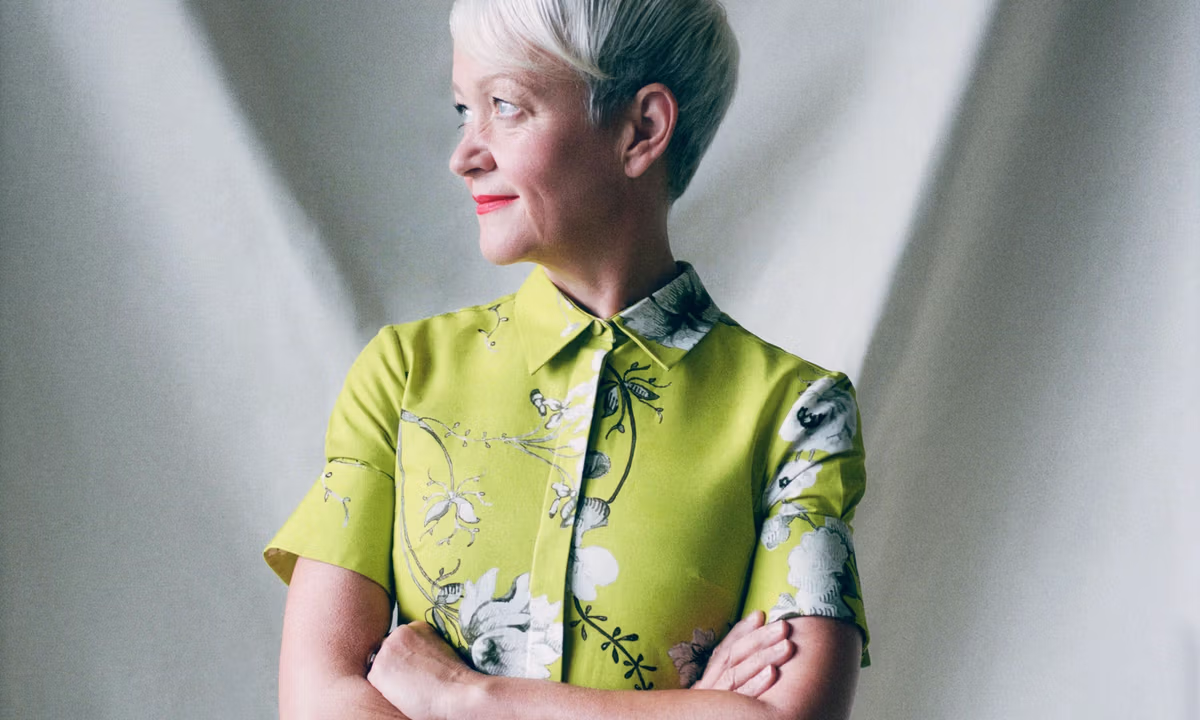
Maria Balshaw, the director of Tate, will step down from her post in spring 2026, the institution announced today.
Balshaw joined Tate in 2017 after a successful stint as the director of Manchester Art Gallery and the Whitworth Art Gallery. She replaced Nicholas Serota, who had held the Tate post for 29 years.
Balshaw said in a statement: “It has been an absolute privilege to serve as director of Tate over this last decade and to work with such talented colleagues and artists. With a growing and increasingly diverse audience, and with a brilliant forward plan in place, I feel now is the right time to pass on the baton to a next director who will take the organisation into its next decade of innovation and artistic leadership.”
During her tenure, Balshaw oversaw an eclectic programme, encompassing blockbuster shows such as The EY Exhibition: Van Gogh and Britain (Tate Modern, 2019), Yoko Ono (Tate Modern, 2024) and Sargent and Fashion (Tate Britain, 2024). Next year, for her final Tate project, Balshaw will co-curate the largest-ever survey of the artist Tracey Emin at Tate Modern (Tracey Emin: A Second Life, 27 February-31 August).
A statement from Tate celebrated Balshaw’s work to diversify Tate’s collection and bring greater gender balance and geographical breadth to new acquisitions. It also noted that under her leadership, Tate’s membership reached 150,000, which it describes as the largest arts membership in the world.
Roland Rudd, the chair of Tate, said in a statement: “Maria has been a trailblazer at Tate. She has never wavered from her core belief—that more people deserve to experience the full richness of art, and more artists deserve to be part of that story.
As the home of British art and of international modern and contemporary art, Tate today reflects the audiences we serve and the artists who make up our nation. We engage a wider public than ever before through our own galleries, our digital channels, and our projects in other venues across the UK and the world.”
Funding and redundancies
Balshaw’s departure comes against a complex backdrop at Tate. Earlier this year The Art Newspaper reported that the organisation was poised to cut 7% of its workforce as part of an institution-wide push to reduce costs. Approximately 40 roles were cut via recruitment freezes, targeted restructures and voluntary exits.
This followed the publication on 3 December 2024 of its 2023-2024 annual report and accounts, which stated that for 2024-2025 the museum group would be operating on a deficit budget.
Meanwhile, more than 150 Tate workers walked out earlier this month in a dispute over pay and terms and conditions. The Public and Commercial Services Union told The Art Newspaper that its members at Tate report in-work poverty and mental and physical health issues linked to their work.
A Tate spokesperson said at the time: “Tate has made careful savings this year in order to invest in staff pay and still achieve a balanced budget…It is only by creating and maintaining a sustainable financial model that we can continue to invest in our staff in the long term.”
This year has been turbulent for Tate in other ways too. In July the organisation addressed the decline in footfall it has seen in recent years, noting a marked drop in overseas visitors to Tate institutions, especially in people from Europe aged 16 to 24.
While Tate’s own research has shown that attendance by domestic audiences is close to 95% of pre-Covid levels, The Art Newspaper’s annual visitor figures report for 2024 showed that overall attendance was significantly lower than in 2019, a year of record highs. Tate Modern saw 25% fewer visitors than before the Covid-19 pandemic, Tate Britain was down 32% and Tate St Ives had a 37% drop in attendance.
Long-term future
After two decades of broadening the artistic canon, Tate Modern’s most overt collecting and programming priority today is in the field of Indigenous practices. This year, for its 25th anniversary, Tate Modern launched the first major exhibition of the Indigenous Australian artist Emily Kam Kngwarray. A Tate source told The Art Newspaper that Balshaw “supported directors to create the programmes implemented”.
In a radical move, in June Tate also launched an endowment fund to help secure its long-term future, inspired in part by a model pioneered by US museums. At least £50m has been raised for the endowment known as the Tate Future Fund. “It’s an inspired idea and should put Tate on a better financial footing,” a UK museum director who preferred to remain anonymous, told The Art Newspaper.
All eyes are now on possible successors to the role of director. Any candidates will have to navigate not just the challenges of funding and visitor figures, but competition likely to be posed by the National Gallery’s plans for a new wing, which were announced earlier this year.
